

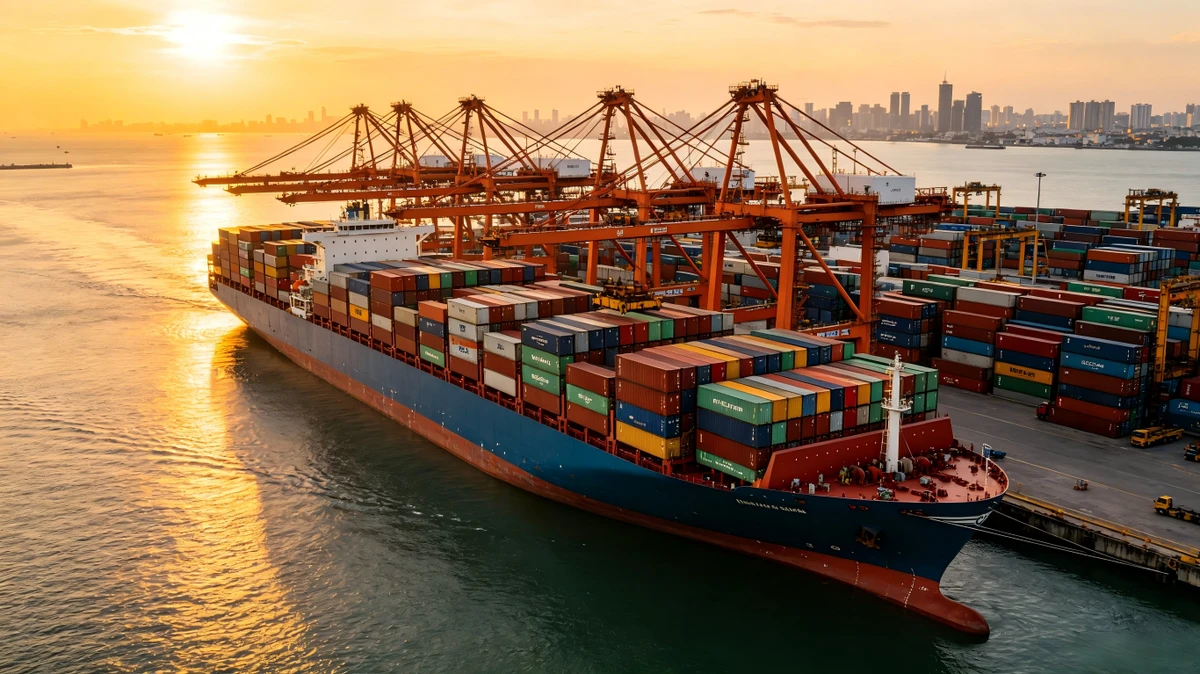
Sea freight from Vietnam to USA has become the backbone of one of the world’s fastest-growing trade corridors. With Vietnam now exporting over $100 billion annually to the United States, shippers across every industry — from textiles and furniture to electronics and Amazon FBA inventory — are racing to secure reliable ocean freight capacity. Yet most importers still struggle with the same three problems: ocean freight rates that change overnight, transit time estimates that seem to vary by the week, and hidden fees that inflate the landed cost long after the quote was signed.
At VNForwarder, Shipping from Vietnam to USA has been a core service since we began operating from our headquarters in Ho Chi Minh City in 2018, with a second hub in Hai Phong serving northern Vietnam’s manufacturing belt. This guide is not a generic re-write of publicly available shipping data. It is drawn from our actual operational experience moving FCL and LCL cargo from Cat Lai, Cai Mep, and Hai Phong to Los Angeles, New York, Savannah, and Houston every single week. Whether you are a B2B importer buying full containers, an Amazon FBA seller replenishing stock, or an SME looking for a true Door-to-Door solution — where your forwarder handles everything from factory pickup in Vietnam to final delivery at your US warehouse — you will leave this article knowing exactly which port to use, whether FCL or LCL fits your cargo, what the real costs are, how long it genuinely takes, and how to avoid the compliance mistakes that cost shippers thousands of dollars at US Customs and Border Protection (CBP).
What Is Sea Freight from Vietnam to USA?
Sea freight is the movement of cargo by ocean vessel from a Vietnamese port of loading to a US port of discharge. It is the dominant shipping mode on this lane, handling more than 90% of total trade volume by weight. For most businesses, the choice is not whether to ship by sea, but how to structure that shipment to balance cost, security, and transit time.
The two primary service types are FCL (Full Container Load) and LCL (Less than Container Load).
FCL means you book an entire shipping container — typically a 20-foot, 40-foot, or 40-foot High Cube unit — exclusively for your cargo. You pay a flat rate for the container regardless of whether you fill it completely. FCL is generally the best option once your shipment exceeds 13–15 cubic meters (CBM), because the per-unit cost drops dramatically and your goods remain sealed from origin to destination.
LCL means your cargo shares container space with other shippers. You pay only for the volume or weight you occupy, measured in CBM or metric tons. LCL is ideal for smaller shipments, sample orders, or businesses that source from multiple Vietnamese suppliers and want to consolidate cargo into a single US delivery. The trade-off is additional handling: your goods are consolidated at a Container Freight Station (CFS) in Vietnam and deconsolidated at a CFS in the United States, which adds time and slightly increases damage risk.
Sea freight wins over air freight on cost by a factor of five or more for most cargo types. It also offers versatility that air cannot match: refrigerated containers (reefers) for perishables, open-top containers for oversized machinery, and flat-rack units for project cargo. On a ton-per-kilometer basis, ocean freight carries a significantly lower carbon footprint than air cargo, an increasingly important consideration for US buyers with sustainability mandates.
Of course, sea freight is not always the right choice. If you are shipping urgent prototypes, high-value semiconductors, or time-sensitive e-commerce restocks, air freight from Vietnam to USA typically delivers in 3–7 days. For the vast majority of bulk inventory, however, sea freight remains the logical default.
If you are also sourcing from Vietnam for other major markets, VNForwarder offers dedicated route pages for Shipping from Vietnam to Australia, Shipping from Vietnam to UK, and Shipping from Vietnam to Germany.
Vietnam Export Ports: Cat Lai vs Cai Mep vs Hai Phong
Choosing the wrong origin port in Vietnam can add days to your transit time, hundreds of dollars to your trucking bill, and unnecessary complexity to your customs clearance. Vietnam’s geography is long and narrow, and its three major maritime gateways serve distinctly different manufacturing ecosystems.
Cat Lai (Ho Chi Minh City)
Cat Lai Port is Vietnam’s largest container terminal, handling roughly 40% of the country’s total export volume. If your supplier is located in southern Vietnam — Binh Duong, Dong Nai, Tay Ninh, or the Ho Chi Minh City metro area — Cat Lai is the default choice simply because of proximity. Inland trucking from Binh Duong industrial parks to Cat Lai typically takes 2–4 hours.
The downside is congestion. Cat Lai’s infrastructure is aging, and during peak season (August through October, plus the Tet Holiday rush in December and January) vessel berthing delays of 1–3 days are common. Additionally, the port’s draft and crane capacity limit direct calls by the largest mega-vessels (18,000+ TEU), which means some cargo must still be transshipped through Singapore or Busan before crossing the Pacific. For cargo with a final destination in Northeast Asia, VNForwarder also operates direct Shipping from Vietnam to South Korea.
Cai Mep–Thi Vai (Near Vung Tau)
Cai Mep–Thi Vai is Vietnam’s deep-water port complex, located roughly 80 kilometers southeast of Ho Chi Minh City. It is the only Vietnamese port capable of accommodating the largest container vessels on direct transpacific services. Carriers such as ZIM, Maersk, MSC, and CMA CGM regularly deploy express services from Cai Mep to Los Angeles and Long Beach with transit times as fast as 16–18 days port-to-port.
For shippers of oversized cargo, project freight, or high-volume FCL, Cai Mep offers a critical advantage: less congestion, newer infrastructure, and direct vessel access without transshipment. The inland trucking cost is higher than Cat Lai (typically 4–6 hours from Binh Duong), but the time savings and reliability often justify the difference. At VNForwarder, we actively recommend Cai Mep for clients shipping electronics, furniture, and Amazon FBA inventory to the US West Coast under tight deadlines.
Hai Phong (Northern Vietnam)
Hai Phong Port is the gateway for northern Vietnam’s manufacturing heartland: Hanoi, Bac Ninh, Hai Duong, and Hung Yen. If you are sourcing electronics, footwear, textiles, or automotive parts from this region, Hai Phong is the logical origin. Trucking from Bac Ninh industrial zones to Hai Phong takes 1.5–3 hours.
Hai Phong has seen significant terminal upgrades over the past five years and now offers competitive direct services to the US West Coast, with some carriers also routing through the Panama Canal for East Coast destinations. For northern suppliers, shipping from Hai Phong eliminates the 1,700-kilometer domestic haul to a southern port, saving both time and money.
Da Nang (Central Vietnam)
Da Nang Port plays a niche role. It is useful for specialized machinery, tech components, and project cargo originating in central Vietnam, but direct US sailings are limited. Most central Vietnam cargo destined for the United States is either trucked to Hai Phong or Cat Lai/Cai Mep, or shipped via regional feeder vessels to a larger hub.
| Port | Best For | Avg Inland Trucking (from major industrial zone) | Direct US Services | Congestion Level |
|---|---|---|---|---|
| Cat Lai | General southern cargo, convenience | 2–4 hrs (Binh Duong) | Moderate (some transshipment) | High in peak season |
| Cai Mep | Express transpacific, oversized cargo, FBA | 4–6 hrs (Binh Duong) | Excellent (mega-vessel direct) | Low |
| Hai Phong | Northern electronics, textiles, footwear | 1.5–3 hrs (Bac Ninh) | Good (West Coast direct) | Moderate |
| Da Nang | Central Vietnam specialized/project cargo | N/A (local only) | Limited | Low |
US Destination Ports & Shipping Routes
Where your cargo enters the United States determines your inland distribution cost, customs clearance speed, and susceptibility to port congestion. The Vietnam-US lane feeds into three primary US coastlines.
US West Coast
Los Angeles / Long Beach (LA/LB) is the top US gateway for transpacific cargo from Vietnam. It offers the highest sailing frequency, the most direct routes, and the largest intermodal rail connections to Chicago, Dallas, and Memphis. The downside is persistent congestion: chassis shortages, dwell time issues, and occasional labor action can add 3–7 days to cargo availability after vessel arrival.
Oakland and Seattle serve as alternative West Coast entries. Oakland is particularly popular for agricultural and food-grade imports because of its proximity to California’s distribution network. Seattle offers a direct pipeline to the Pacific Northwest and Midwest via BNSF and UP rail connections. If LA/LB is experiencing severe congestion, diverting to Oakland can save both time and drayage costs.
US East Coast
New York / New Jersey (NY/NJ) is the largest East Coast port complex and the natural entry point for cargo destined for the Northeast and Midwest. From NY/NJ, rail connections reach Chicago in 3–5 days and Ohio/Indiana distribution hubs in 2–4 days.
Savannah and Charleston are the fastest-growing Southeast gateways. Savannah, in particular, has invested heavily in crane capacity and berth deepening, making it an excellent choice for furniture, retail goods, and Amazon FBA inventory bound for southeastern fulfillment centers. Transit time from Vietnam to Savannah via the Panama Canal is typically 30–35 days port-to-port.
Norfolk offers a less congested alternative for Mid-Atlantic distribution, particularly for Department of Defense and government-related cargo.
US Gulf Coast
Houston is the dominant Gulf Coast entry. It serves the energy sector, petrochemical supply chains, and Midwest rail connections via Union Pacific and BNSF. For project cargo — such as oilfield equipment or renewable energy components — Houston’s heavy-lift infrastructure is unmatched on the Gulf. For importers with a North American distribution footprint beyond the United States, our Shipping from Vietnam to Canada service provides direct port coverage from Vancouver to Montreal.
Route Options Explained
- Direct Trans-Pacific (Fastest): Vietnam → Los Angeles/Long Beach. No transshipment. Best for time-sensitive West Coast cargo.
- Panama Canal Route: Vietnam → US East Coast (Savannah, Charleston, NY/NJ). Typically 30–35 days. The most common East Coast path.
- Suez Canal / Cape of Good Hope: Normally used for Europe, but during Red Sea disruptions (such as the ongoing instability in 2025–2026), carriers may reroute Asia-US East Coast cargo around Africa’s Cape of Good Hope. This adds 7–14 days but may occasionally offer lower spot rates when carriers are repositioning capacity.
FCL vs LCL Shipping from Vietnam to USA: Which One Should You Choose?
The FCL versus LCL decision is not simply about volume. It is about risk tolerance, cost structure, cargo fragility, and supply chain predictability.
Full Container Load (FCL)
When you book FCL shipping from Vietnam to USA, you are reserving an entire container. The standard sizes are:
- 20GP (General Purpose): ~33 CBM capacity
- 40GP (General Purpose): ~67 CBM capacity
- 40HQ (High Cube): ~76 CBM capacity (the most popular choice for light, bulky cargo such as furniture and textiles)
FCL pricing is a flat rate per container. Whether you fill it to 50% or 95%, the ocean freight charge remains the same. This creates a clear economies-of-scale advantage once your cargo exceeds the 13–15 CBM threshold, where the per-CBM cost of FCL drops below LCL. If you are comparing container specifications across North America, our Container from Vietnam to Canada guide provides parallel sizing benchmarks for the Canadian lane.
Beyond cost, FCL offers security. Your container is sealed at the factory or at the Vietnam port and remains sealed until it reaches your warehouse or the US deconsolidation facility. There is no intermediate handling by third-party warehouses, which dramatically reduces the risk of damage, pilferage, or misplacement. For high-value electronics, fragile furniture, or branded consumer goods, FCL is almost always the safer choice.
FCL is also faster. Because there is no consolidation or deconsolidation, you avoid the 2–5 day delays at each end that LCL shipments face.
Less Than Container Load (LCL)
LCL shipping from Vietnam to USA is the right choice when your shipment is smaller than 13 CBM, when you are shipping samples or trial orders, or when you source from multiple Vietnamese suppliers and want to merge their cargo into a single US delivery.
The process works as follows: your cargo is delivered to a CFS in Vietnam (near Cat Lai or Hai Phong), where it is palletized and loaded into a shared container with other shippers’ goods. The container sails to the United States, and at the destination CFS (typically near Los Angeles, New York, or Savannah), your cargo is unloaded, customs-cleared, and made available for pickup or final delivery.
The primary cost advantage of LCL is that you pay only for the space you use. Rates are quoted per CBM or per 1,000 kg, whichever is greater. However, LCL carries handling risk. Every time cargo is moved onto and off a pallet, loaded into a container, or sorted at a warehouse, there is a small chance of damage. Proper palletization, shrink-wrapping, and clear labeling are essential.
At VNForwarder, we run weekly LCL consolidation services at both Cat Lai and Hai Phong. This means your cargo does not wait for a consolidation window; it moves on a fixed schedule, giving you predictable departure dates even with smaller volumes. For Southeast Asian distribution, VNForwarder also offers weekly Shipping from Vietnam to Singapore and Shipping from Vietnam to Thailand consolidation services.
| Feature | FCL (Full Container Load) | LCL (Less than Container Load) |
|---|---|---|
| Best For | Shipments >13–15 CBM; high-value or fragile cargo | Shipments <13 CBM; samples; multi-supplier consolidation |
| Pricing | Flat per-container rate | Per CBM or per 1,000 kg (whichever is higher) |
| Transit Time | Faster (no consolidation delays) | Slower (+2–5 days each end for CFS handling) |
| Security | High (sealed container, minimal handling) | Moderate (multiple handling points; palletization critical) |
| Price per CBM | Lower at scale | Higher per unit, but no minimum container commitment |
| Booking Flexibility | Requires full container commitment | Highly flexible; ideal for irregular shipment sizes |
Sea Freight Transit Times from Vietnam to USA: The Real Numbers
If you have spent any time comparing shipping quotes, you have probably noticed that transit time estimates for Vietnam to USA shipping time by sea freight vary wildly. One forwarder promises 17 days to Los Angeles; another says 29. The truth lies in the details: port of origin, port of destination, direct sailing versus transshipment, and whether the estimate is port-to-port or door-to-door.
Below are VNForwarder’s actual operational averages for Q2 2026, based on shipments we have managed from Vietnam to the United States.
Port-to-Port Transit Times (FCL)
| Route | Standard Direct Service | Fast Express Service | Notes |
|---|---|---|---|
| Cat Lai / Cai Mep → Los Angeles / Long Beach | 20–25 days | 16–18 days (ZIM ZEX, Maersk TPX) | Fastest transpacific lane |
| Cat Lai / Cai Mep → Oakland / Seattle | 22–27 days | 18–21 days | Good alternative during LA/LB congestion |
| Hai Phong → Los Angeles / Long Beach | 18–25 days | 16–20 days | Competitive direct services from northern Vietnam |
| Vietnam → New York / New Jersey | 30–40 days | — | Via Panama Canal |
| Vietnam → Savannah / Charleston | 30–35 days | — | Via Panama Canal; popular for furniture |
| Vietnam → Houston | 32–38 days | — | Via Panama Canal or Suez/Cape reroute |
LCL Transit Time Add-On
LCL shipments typically take 3–7 days longer than FCL for the same route. This accounts for cargo consolidation at the origin CFS, vessel waiting for the consolidated cut-off, and deconsolidation at the destination CFS.
Door-to-Door Reality Check
When importers ask, “How long does sea freight take from Vietnam to USA?” they usually mean door-to-door — from their supplier’s factory to their US warehouse. To convert port-to-port times to door-to-door estimates, add:
- Origin inland trucking: 1–3 days (Vietnam factory to port)
- Export customs clearance: 1–2 days (assuming documentation is accurate)
- US import customs clearance: 2–5 days (CBP inspection can extend this)
- US inland drayage / trucking: 3–10 days (depending on final destination distance from port)
Total door-to-door estimates:
- US West Coast: 28–38 days
- US East Coast: 40–55 days
Why Transit Times Vary
Even with direct sailings, several factors can shift your delivery window:
- Transshipment vs Direct: A direct sailing from Cai Mep to Los Angeles is 16–18 days. If your cargo transships through Singapore or Busan, add 3–5 days.
- Port Congestion: LA/Long Beach chassis shortages and Cat Lai peak-season berthing delays are the most common culprits.
- Customs Inspections: US CBP randomly selects containers for examination. An Intensive Examination can add 3–7 days and several hundred dollars in exam fees.
- Blank Sailings: When carriers cancel scheduled sailings to manage overcapacity, your cargo may wait an extra 7 days for the next vessel.
- Weather: Vietnam’s typhoon season (June through November) can close ports for 1–3 days. The US West Coast occasionally faces winter storm delays.
Sea Freight Costs from Vietnam to USA (2026 Breakdown)
Understanding sea freight from Vietnam to USA cost requires looking beyond the base ocean freight rate. For a detailed month-by-month rate breakdown, see our dedicated guide to Shipping Cost from Vietnam to USA. A quote that looks cheap upfront can become expensive once fuel surcharges, terminal handling, customs fees, and inland trucking are layered on.
The tables below reflect VNForwarder’s Q2 2026 market data. These are reference ranges; actual rates depend on the carrier, sailing date, cargo type, and whether you are moving under a long-term contract or spot market pricing.
FCL Container Shipping Rates
| Container Type | US West Coast | US East Coast |
|---|---|---|
| 20FT Container | $1,800 – $3,000 | $2,800 – $4,500 |
| 40FT Container | $2,200 – $4,200 | $4,000 – $6,500 |
| 40FT High Cube | $2,400 – $4,500 | $4,200 – $7,000 |
Note: Fast express services (e.g., ZIM ZEX) to the West Coast may command a $300–$600 premium per container for the speed advantage.
LCL Shipping Rates
| Destination | Rate per CBM | Minimum Charge |
|---|---|---|
| US West Coast | $50 – $150 | 1 CBM or 1,000 kg |
| US East Coast | $80 – $200 | 1 CBM or 1,000 kg |
LCL rates fluctuate more frequently than FCL because they are tied to weekly consolidation volumes and CFS handling fees. North American shippers can reference our Shipping Cost from Vietnam to Canada analysis for parallel pricing trends on the transpacific lane.
The Complete Cost Breakdown: No Hidden Fees
A truly transparent quote should itemize every component. Here is what you are actually paying for:
- Base Ocean Freight: The carrier’s core charge for moving the container from Vietnam to the US port.
- BAF (Bunker Adjustment Factor): A fuel surcharge that fluctuates with global oil prices. Typically $100–$400 per container depending on vessel size and route.
- THC (Terminal Handling Charges): Fees levied by the port terminal for loading, unloading, and storage. Applied at both origin and destination.
- AMS Filing (Automated Manifest System): The pre-arrival cargo manifest filed with US Customs. Usually $25–$50 per Bill of Lading.
- ISF Filing (Importer Security Filing): Commonly known as ISF 10+2, this is mandatory data that must be submitted to CBP at least 24 hours before cargo is loaded onto the vessel in Vietnam. Late or inaccurate filings carry penalties of $5,000–$10,000 per violation.
- Customs Clearance: Brokerage fees for export clearance in Vietnam and import clearance in the USA. Complex cargo (FDA-regulated, textiles under quota, etc.) may incur additional review fees.
- Inland Trucking: Transportation from the Vietnamese factory to the origin port, plus delivery from the US port to your warehouse or Amazon fulfillment center.
- Duties & Taxes: Assessed by US CBP based on your cargo’s HS Code and declared value. US import duties on Vietnam-origin goods typically range from 0% to 25%, though certain categories face additional anti-dumping or countervailing duties.
- Demurrage & Detention: Penalties for exceeding the free time allowed to pick up your container from the port (demurrage) or return the empty container to the depot (detention). These can accumulate at $75–$150 per day.
- Cargo Insurance: Typically 0.3–0.5% of the cargo’s commercial invoice value. Highly recommended for electronics, furniture, and high-value goods.
At VNForwarder, we itemize every one of these charges in our quotes. There are no surprise “documentation fees,” “handling fees,” or “administrative charges” added after booking. What you see is what you pay.
Incoterms 2020 for Vietnam-USA Trade: FOB, CIF, DDP & DDU Explained
Your choice of Incoterms 2020 determines who pays for freight, who arranges customs, and where risk transfers from seller to buyer. For the Vietnam-USA corridor, this decision directly impacts your total landed cost and administrative burden.
EXW (Ex Works)
Under EXW, the seller makes goods available at their factory in Vietnam. The buyer is responsible for everything: pickup, export customs, ocean freight, import customs, duties, and US delivery. EXW gives the buyer maximum control but requires significant logistics expertise on both sides of the Pacific. VNForwarder frequently supports EXW buyers by managing the entire Vietnam export and US import process on their behalf.
FOB (Free On Board)
FOB is one of the most common terms for Vietnam exports. The seller delivers the goods onto the vessel at the named Vietnam port (e.g., FOB Cat Lai). From that point, the buyer assumes risk and pays for ocean freight, insurance, and US import clearance.
FOB works well for US importers who have their own customs broker and want to control the ocean freight carrier selection. However, if you do not have an established import agent in the United States, FOB can leave you scrambling to arrange customs clearance and inland delivery on arrival.
CIF (Cost, Insurance & Freight)
Under CIF, the seller pays for ocean freight and marine insurance to the destination US port. However — and this is a critical distinction — risk transfers to the buyer once the cargo passes the ship’s rail in Vietnam. If the container is damaged at sea, the buyer files the insurance claim, not the seller.
CIF can appear convenient, but it often masks the true cost of US import clearance, duties, and inland trucking, which remain the buyer’s responsibility.
DDU (Delivered Duty Unpaid)
DDU means the seller handles freight, export/import customs formalities, and delivery to the buyer’s door — but the buyer pays US import duties and taxes upon arrival. DDU is less common than DDP because most US buyers prefer to know their total cost upfront.
DDP (Delivered Duty Paid)
DDP shipping from Vietnam to USA is the most comprehensive option. The seller (or their freight forwarder) manages everything: pickup, export clearance, ocean freight, US import clearance, duty and tax payment, and final delivery to the buyer’s warehouse or Amazon FBA center.
For SMEs, e-commerce sellers, and first-time importers without a US customs broker, DDP is often the smartest choice. While the upfront quote looks higher than FOB, DDP typically reduces total landed cost by 8–12% because there are no surprise duties, no demurrage from customs delays, and no broker fees billed separately after arrival. Businesses expanding into the Middle East can explore our Shipping from Vietnam to Saudi Arabia service, which offers comparable DDP coverage.
| Incoterm | Who Pays Ocean Freight | Who Handles US Customs | Who Pays US Duties | Best For |
|---|---|---|---|---|
| EXW | Buyer | Buyer | Buyer | Experienced importers with full supply chain control |
| FOB | Buyer | Buyer | Buyer | Buyers with established US customs brokers |
| CIF | Seller (to US port) | Buyer | Buyer | Buyers who want freight arranged but handle US clearance |
| DDU | Seller | Seller | Buyer | Buyers willing to pay duties on delivery |
| DDP | Seller | Seller | Seller | SMEs, Amazon FBA sellers, first-time importers |
Documentation & Customs Compliance: The Complete Checklist
Customs compliance is where well-planned shipments either sail through or get stuck for weeks. US CBP and Vietnam Customs are both rigorous, and missing or inaccurate paperwork is the single most common cause of delays.
Vietnam Export Documents
- Commercial Invoice: Must accurately describe the goods, state the correct HS Code, and declare the true transaction value. Undervaluation is a red flag for both Vietnam export and US import authorities.
- Packing List: Detailed weights, dimensions, and carton counts for every package in the shipment.
- Bill of Lading (B/L) or Sea Waybill: The contract of carriage between shipper and carrier. A ** negotiable B/L** is used when payment is via Letter of Credit; a Sea Waybill is faster and suitable for trusted trading partners.
- Vietnam Customs Declaration: Filed electronically through Vietnam’s customs system (VNACCS). VNForwarder handles this as part of our standard export clearance service.
- Certificate of Origin (CO): While the United States and Vietnam do not have a bilateral free trade agreement, a CO may still be required for certain textile quotas, preference programs, or buyer compliance audits.
- Export License: Required for specific commodities such as timber, minerals, dual-use goods, or certain wildlife products.
US Import Requirements
- ISF 10+2 (Importer Security Filing): This is non-negotiable for ocean freight. The “10” data elements (shipper, consignee, manufacturer, etc.) and “2” data elements (container status messages) must be filed with CBP at least 24 hours before the cargo is loaded in Vietnam. Late filing penalties start at $5,000 and can reach $10,000 per violation. CBP may also place a hold on your cargo, adding days or weeks to clearance.
- AMS Manifest: Filed by the ocean carrier or their agent. Typically handled by the shipping line, but your forwarder should confirm it is submitted correctly.
- Entry Summary (CBP Form 7501): Filed by your US customs broker upon arrival. This document determines the final duty assessment.
- FDA / USDA / CPSC Permits: Additional agency clearances are required for food, beverages, agricultural products, cosmetics, medical devices, and certain consumer goods.
HS Code Accuracy
Your Harmonized System (HS) Code determines the duty rate, regulatory requirements, and whether your cargo is subject to anti-dumping duties. A single digit error can change your duty from 3% to 25% or trigger an intensive CBP examination. VNForwarder provides pre-shipment HS code verification for all clients to eliminate this risk. For European and African-bound cargo, similar classification support is available through our Shipping from Vietnam to Sweden and Shipping from Vietnam to South Africa services.
Anti-Dumping & Countervailing Duty Warning
Certain Vietnam-origin goods — notably steel, aluminum, solar panels, and some categories of wooden bedroom furniture — are subject to US anti-dumping (AD) or countervailing duty (CVD) orders. Additionally, CBP has intensified scrutiny of goods transshipped through Vietnam to disguise Chinese origin and evade Section 301 tariffs. Accurate origin documentation and transparent supply chain records are essential.
The VNForwarder Pre-Shipment Compliance Checklist
This checklist is compiled from our actual export clearance workflows at Cat Lai and Hai Phong. Use it before every shipment to avoid the documentation errors that cause 80% of preventable delays on the Vietnam-US lane.
2 Weeks Before Cargo Ready Date
- [ ] Confirm the correct HS Code with your supplier and cross-check against the latest US CBP tariff schedule.
- [ ] Verify whether your product category is on the current US anti-dumping or countervailing duty list.
- [ ] Request a draft Commercial Invoice and Packing List from your supplier to spot inconsistencies early.
- [ ] Book ocean freight space, especially if sailing within 4 weeks of Tet or the US Q4 peak season.
1 Week Before Cargo Ready Date
- [ ] Submit the Vietnam Customs Declaration (VNACCS) through your forwarder.
- [ ] Confirm that wood packaging materials carry ISPM-15 heat-treatment marks (if applicable).
- [ ] Arrange factory pickup or confirm the supplier will deliver to the nominated CFS or port.
- [ ] For LCL shipments: confirm pallet dimensions and weight with the consolidation warehouse to avoid CFS re-palletization fees.
48 Hours Before Vessel Loading
- [ ] File ISF 10+2 with US CBP. This is non-negotiable — late filings carry $5,000–$10,000 penalties.
- [ ] Double-check the consignee name and IRS number on the ISF match the US import records exactly.
- [ ] Confirm the AMS Manifest has been submitted by the carrier or their agent.
- [ ] Review the Bill of Lading draft for port names, container numbers, and seal numbers.
Upon Arrival at the US Port
- [ ] Ensure your US customs broker files the Entry Summary (CBP Form 7501) immediately.
- [ ] Monitor CBP status for “Exam” or “Holds” via the broker and alert your forwarder if cargo is selected for inspection.
- [ ] Arrange drayage pickup within the free-time window to avoid demurrage and detention charges.
Pro Tip from Our Operations Team: We recommend creating a shared digital folder (Google Drive, Dropbox, or your TMS) containing scanned copies of the Commercial Invoice, Packing List, B/L, CO, and ISF confirmation for every shipment. When CBP requests documentation, having everything in one place can reduce clearance time from 5 days to 24 hours.
Industry-Specific Sea Freight Guidance from Vietnam
Not all cargo moves the same way. Vietnam’s export strengths — textiles, electronics, furniture, and agricultural products — each carry unique shipping considerations.
Textiles & Garments
Vietnam is the world’s second-largest textile exporter, and the United States is its largest market. For apparel shipments, LCL consolidation is extremely popular because fashion orders often involve multiple SKUs in smaller batches. However, US buyers should ensure their supplier provides accurate fabric composition details and country-of-origin labeling to avoid CBP holds. VNForwarder’s weekly LCL service from both Cat Lai and Hai Phong is specifically optimized for textile exporters with multi-SKU requirements.
Electronics & Semiconductors
High-value electronics require enhanced security and packaging. We strongly recommend FCL for semiconductor components, consumer electronics, and PCBs to minimize handling exposure. Anti-static packaging, moisture barrier bags, and shock-resistant crating are standard requirements. Cargo insurance is essential — at 0.3–0.5% of invoice value, it is inexpensive protection against total loss.
Furniture & Wood Products
Wooden furniture is one of Vietnam’s fastest-growing export categories to the USA, but it is also one of the most scrutinized. Certain wooden bedroom furniture categories face US anti-dumping duties. Additionally, all wood packaging materials must meet ISPM-15 standards (heat treatment or fumigation) to prevent pest contamination. CBP agriculture specialists may physically inspect containers for wood-boring insects, and failure to comply can result in re-export at the shipper’s expense. For wood-product exporters targeting the Southern Hemisphere, our Sea Freight from Vietnam to Australia guide covers BMSB quarantine requirements and ISPM-15 compliance for the Australian market.
Amazon FBA Head-Haul by Sea
For Amazon sellers, sea freight + DDP is the most cost-effective replenishment strategy for non-urgent inventory. At VNForwarder, our Amazon FBA service includes:
- Factory pickup anywhere in Vietnam
- In-house quality inspection at our Ho Chi Minh City warehouse
- FNSKU labeling and Amazon-compliant packaging (poly bags, suffocation warnings, carton labels)
- Palletization to Amazon’s inbound receiving standards
- DDP delivery direct to FBA warehouses including LAX9, ONT8, ABE8, IND9, and FTW1
Sea freight to Amazon typically takes 35–45 days door-to-door, making it ideal for planned replenishment cycles rather than emergency restocks.
Project Cargo & Oversized Shipments
Vietnam’s manufacturing base increasingly produces machinery, renewable energy components, and industrial equipment that cannot fit inside a standard container. For these shipments, VNForwarder coordinates flat-rack containers, open-top containers, and breakbulk solutions. Recent projects have included wind turbine components from Da Nang to Houston and oversized manufacturing presses from Hai Phong to Savannah. These moves require route surveys, heavy-lift crane bookings at Cai Mep, and special permitting — expertise that only a Vietnam-based forwarder with local port relationships can deliver reliably.
Vietnam Operations Calendar: When to Book & Seasonal Risks
Timing your shipment correctly can save thousands of dollars and prevent missed delivery windows. Vietnam’s logistics calendar has three critical seasons that every US importer should plan around.
Tet Holiday Peak (December–February)
Tet Nguyen Dan (Vietnamese Lunar New Year) is the single most disruptive event in Vietnam’s logistics calendar. Factories in Hanoi, Ho Chi Minh City, and the surrounding industrial zones typically shut down for 1–2 weeks, and many workers return to their home provinces for up to a month. The impact on shipping is severe:
- Container and chassis shortages begin 4–6 weeks before Tet
- Trucking rates spike as driver availability drops
- Port congestion at Cat Lai and Hai Phong peaks in the final 10 days before the holiday
- Vessel space becomes scarce; carriers often implement blank sailings to reposition equipment
Action plan: Book ocean freight space 6–8 weeks before Tet. Confirm your supplier’s final production and cargo-ready dates no later than early December. If you miss the pre-Tet window, expect a 2–3 week delay before normal operations resume.
US Holiday Peak (August–October)
The back-to-school and Christmas inventory rush creates a secondary peak on the Vietnam-US lane. During this period:
- Peak Season Surcharge (PSS) typically adds $200–$800 per FCL container
- LCL consolidation warehouses operate at capacity, adding 2–3 days to handling times
- LA/Long Beach congestion often spills over into October and November
Action plan: If your inventory allows, ship in May–July to avoid the premium. If you must ship during peak season, secure annual volume contracts with carriers rather than relying on spot rates.
Typhoon & Rainy Season (June–November)
Vietnam’s monsoon season brings heavy rainfall and tropical storms to both the north and south. While modern ports are built to withstand severe weather, temporary closures of 1–3 days are not uncommon at Cat Lai and Hai Phong when typhoons make landfall. Cai Mep, located on a more sheltered coastline, is generally more resilient.
Action plan: Build a 3–5 day buffer into your production and shipping schedules during typhoon season. If your cargo is time-sensitive, consider Cai Mep as the origin port for greater schedule reliability. For shippers moving cargo to South Asia during the same monsoon window, our Shipping from Vietnam to India service includes contingency planning for Mumbai and Chennai port closures.
Off-Peak Windows (March–April, November)
These are the “sweet spots” for Vietnam-US shipping. Rates are typically 10–15% lower than peak season, vessel space is readily available, and customs clearance moves faster because both Vietnam and US ports are operating below maximum capacity.
Insider Tips: How to Reduce Sea Freight Costs from Vietnam to USA
Beyond timing your shipment for off-peak windows, here are five cost-saving strategies our operations team uses every day — most of which generalist forwarders will not tell you about.
1. Combine LCL Cargo into FCL at the Right Threshold
Many importers assume LCL is always cheaper for shipments under 13 CBM. In reality, the breakeven point shifts depending on the commodity. For lightweight, volumetric cargo (furniture, textiles), a 40HQ container becomes cost-competitive at as little as 45–50 CBM because the per-CBM ocean rate drops significantly. We run this analysis for every client: if your monthly volume is predictable, consolidating two LCL bookings into one FCL can cut your per-unit freight cost by 15–25%.
2. Negotiate Annual Volume Contracts Before Peak Season
Spot rates during August–October can be 40–60% higher than contracted rates. If you ship at least 5–10 containers per year, locking in an annual contract with carriers between February and April typically secures rates 20–30% below peak spot pricing. At VNForwarder, we aggregate client volumes across multiple shippers to negotiate preferential contract rates even for SMEs that do not individually meet carrier minimums.
3. Avoid Demurrage by Pre-Booking Drayage Before Vessel Arrival
The single most avoidable cost we see is demurrage at LA/Long Beach and NY/NJ. Importers often wait until the vessel arrives to book a trucker, but during congestion periods, drayage appointments can be 3–5 days out. Pre-booking your trucker 7 days before estimated arrival — and confirming the chassis provider has equipment available — eliminates demurrage in 90% of cases. This one step alone can save $300–$1,000 per container.
4. Use Cai Mep Instead of Cat Lai for Time-Sensitive Cargo
Cai Mep’s direct express services to Los Angeles (16–18 days) not only save transit time — they also reduce the risk of blank sailings and transshipment delays that plague Cat Lai during peak season. The slightly higher inland trucking cost (typically $80–$150 more per container from Binh Duong) is almost always offset by avoiding 3–5 days of demurrage or storage fees at the destination port.
5. Self-File ISF Only If You Have a Dedicated US Customs Broker
Some importers try to save $50–$100 by filing their own ISF 10+2. In our experience, 30% of self-filed ISFs contain minor errors (typos in consignee names, incorrect manufacturer addresses, mismatched container numbers) that trigger CBP holds costing far more than the filing fee. Unless you have a full-time customs compliance team, let your forwarder handle ISF — it is inexpensive insurance against a $5,000 penalty.
6. Split Shipments Across Multiple US Ports
If you distribute inventory to both the West Coast and the Midwest, consider splitting your cargo: send 60% to LA/Long Beach and 40% to Oakland or Seattle. Oakland often has lower chassis availability costs and faster rail connections to Chicago and Memphis than LA/LB during congestion. For East Coast distribution, splitting between Savannah (for the Southeast) and NY/NJ (for the Northeast) can reduce inland trucking costs by $200–$400 per container compared to routing everything through a single gateway.
How to Choose the Best Freight Forwarder from Vietnam to USA
Not all freight forwarders are equal — especially on a lane as complex as Vietnam to the United States. Whether your destination is the United States, Europe, or emerging markets such as Shipping from Vietnam to Nigeria, the criteria for choosing a forwarder remain the same: local presence, transparent pricing, and proven customs expertise. A forwarder based in London or Hong Kong may have a slick website, but if they do not have their own staff on the ground in Vietnam, they are relying on third-party agents for customs clearance, pickup, and problem resolution. That adds cost, delays, and ambiguity.
The Vietnam Advantage
Choosing a forwarder that is physically based in Vietnam delivers three concrete benefits:
- Direct port and customs relationships: A Vietnam-based forwarder knows the Cat Lai customs officers, the Cai Mep terminal operators, and the Hai Phong port authority by name. When a documentation issue arises, they resolve it in hours, not days.
- Real-time problem solving: Time zone alignment matters. When your cargo is sitting at a Vietnam warehouse at 9:00 AM local time, a forwarder in Los Angeles is asleep. A forwarder in Ho Chi Minh City is already on the phone.
- No intermediary markup: When you book through a US or European forwarder, they typically subcontract to a Vietnam agent and mark up the price. Dealing directly with the origin operator removes that layer. A truly regional forwarder can also support your Southeast Asian supply chain through Shipping from Vietnam to Cambodia and Shipping from Vietnam to Malaysia.
Red Flags to Avoid
- Quotes that omit THC, BAF, or ISF fees — these are not optional; they are being hidden.
- Forwarders with no Vietnam office or staff — if their “Vietnam network” is just a business card they hand out, you are paying for a middleman.
- No clarity on who handles US import clearance — if the forwarder cannot explain how your cargo clears CBP, they are not equipped to manage DDP.
Why Shippers Choose VNForwarder
Since 2018, VNForwarder has built its reputation as a Vietnam-based specialist for the US market. In 2025 alone, our operations team managed over 4,200 TEU of Vietnam-US cargo across textiles, furniture, electronics, and automotive parts — giving us real-time visibility into carrier capacity, port congestion patterns, and customs clearance timelines that generalist forwarders simply do not have. Our clients receive:
- 2–4 hour transparent quoting with itemized cost breakdowns and zero hidden fees
- 24⁄7 customer support plus a Dedicated Account Manager assigned to every client
- Deep carrier relationships across ZIM, Maersk, MSC, COSCO, ONE, Evergreen, and CMA CGM, ensuring stable space even during peak season
- End-to-end service covering factory pickup, Vietnam export customs, ocean freight, US import clearance, duty payment, and final delivery under DDP or DDU terms
- Amazon FBA expertise including quality inspection, FNSKU labeling, compliant packaging, and direct delivery to Amazon fulfillment centers
- Proven experience with textiles, furniture, electronics, automotive parts, and oversized project cargo
FAQ: Sea Freight from Vietnam to USA
How long does sea freight take from Vietnam to USA? For FCL shipments, budget 18–25 days port-to-port to the US West Coast and 30–40 days to the US East Coast. Door-to-door delivery adds approximately 10–15 days for trucking and customs clearance at both ends.
How much does it cost to ship a 40ft container from Vietnam to USA? As of Q2 2026, a 40-foot High Cube container from Vietnam to Los Angeles ranges from $2,400 to $4,500. To the US East Coast (New York or Savannah), expect $4,200 to $7,000 depending on the carrier and sailing date.
What is the cheapest way to ship from Vietnam to USA? For shipments under 13 CBM, LCL sea freight is the most economical option. For larger volumes, FCL offers the lowest per-unit cost. Avoiding peak season (August–October and pre-Tet) and booking 4–6 weeks in advance will also reduce your rate.
What documents are required for shipping from Vietnam to USA? At minimum: Commercial Invoice, Packing List, Bill of Lading, Vietnam Export Declaration, and ISF 10+2 filing for US import. Depending on your product, you may also need a Certificate of Origin, export license, or FDA/USDA permits.
Is DDP shipping available from Vietnam to USA? Yes. VNForwarder offers full DDP service, meaning we manage factory pickup, export clearance, ocean freight, US import clearance, duty and tax payment, and final delivery to your door or Amazon FBA warehouse.
Can I ship Amazon FBA inventory from Vietnam by sea? Absolutely. Sea freight plus DDP is the most cost-effective method for replenishing Amazon FBA inventory from Vietnam. Typical door-to-door time to major US fulfillment centers is 35–45 days.
What is ISF 10+2 and who files it? ISF 10+2 is the Importer Security Filing required by US CBP. It must be submitted at least 24 hours before your cargo is loaded onto the vessel in Vietnam. Late or inaccurate filings trigger penalties of $5,000–$10,000. VNForwarder files ISF on behalf of all DDP and DDU clients.
Cat Lai or Cai Mep — which port should I use? Use Cat Lai for general southern Vietnam cargo where convenience and lower trucking cost are priorities. Use Cai Mep for direct transpacific express services, oversized cargo, or when schedule reliability is critical.
Do Vietnam-origin goods face anti-dumping duties in the USA? Certain categories — including steel, aluminum, solar panels, and some wooden furniture — are subject to US anti-dumping or countervailing duties. Accurate HS code classification and transparent origin documentation are essential to avoid penalties.
Conclusion: Ship Smarter from Vietnam to USA
Sea freight from Vietnam to the United States is not simply about finding the lowest rate on a freight marketplace. It is about choosing the right port, the right container type, the right Incoterm, and the right forwarder — then timing your shipment to avoid the seasonal landmines that catch inexperienced importers off guard.
Here is what to remember:
- Choose Cai Mep for direct express services to the West Coast; Hai Phong for northern Vietnam manufacturing.
- Ship FCL when your cargo exceeds 13–15 CBM or when security is paramount. Use LCL for smaller, flexible shipments.
- Budget 18–25 days to the West Coast and 30–40 days to the East Coast, port-to-port.
- DDP simplifies everything for SMEs and Amazon sellers who do not have a US customs broker on staff.
- Watch the calendar. Book 6–8 weeks ahead of Tet, avoid the US Q4 rush if possible, and build a weather buffer during typhoon season. Beyond the United States, explore our growing network of transpacific and trans-oceanic routes, including Shipping from Vietnam to Paraguay and Shipping from Vietnam to Israel.
If you are ready to move cargo from Vietnam to the United States, VNForwarder is here to help. Request your free, itemized sea freight quote and receive a detailed breakdown within 2–4 hours. Our Vietnam-based operations team is available 24 hours a day, and every client is assigned a Dedicated Account Manager to ensure your shipment moves smoothly from factory floor to final delivery — with zero hidden fees.