

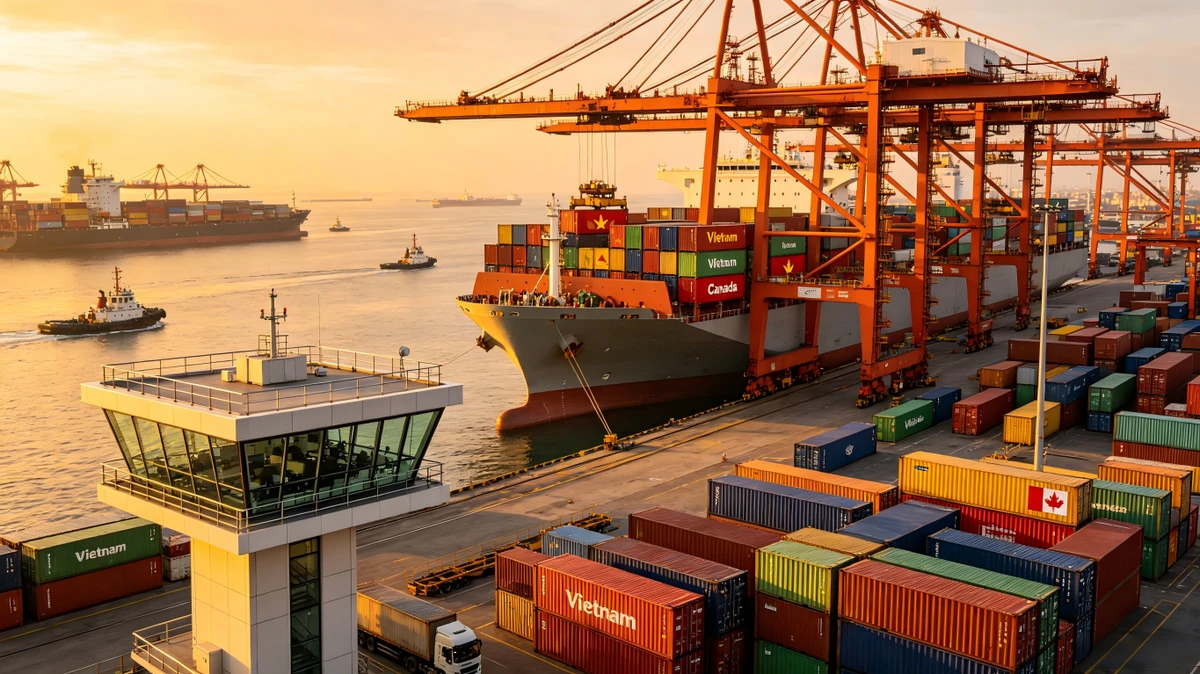
Shipping cost from Vietnam to Canada is the single biggest question we hear from importers, e-commerce sellers, and procurement teams sourcing out of Ho Chi Minh City, Hai Phong, or Da Nang. With bilateral merchandise trade between Vietnam and Canada reaching CAD $14 billion in 2023 according to Statistics Canada and Vietnam’s Ministry of Industry and Trade (MOIT)—and rising fast—understanding exactly what you will pay, what is hidden in the fine print, and how to avoid sticker shock at delivery is no longer optional. In this guide, we break down 2026 market rates for FCL, LCL, air freight, and DDP door-to-door shipments, complete with real product scenarios, a sample landed-cost invoice, and seasonal timing strategies you will not find in generic freight calculators.
Whether you are moving a 20-foot container of furniture, a 500 kg air freight pallet of electronics, or your first Amazon FBA shipment to a Canadian fulfillment center, the sections below give you the numbers, timelines, and decision frameworks to budget accurately and ship with confidence.
Shipping Modes at a Glance: FCL vs LCL vs Air vs DDP
Before diving into rate tables, here is how the four main shipping modes stack up for the Vietnam–Canada trade lane.
| Mode | Best For | Door-to-Door Transit | Pricing Structure | Ideal Shipper |
|---|---|---|---|---|
| Sea FCL | 15+ CBM, full containers | 43–47 days | Flat per-container rate | Manufacturers, wholesalers |
| Sea LCL | 1–15 CBM, smaller shipments | 44–49 days | Per-CBM rate + CFS fees | SMEs, multi-SKU importers |
| Air Freight | 100 kg+, urgent restocks | 8–18 days | Per-kg by weight break | Electronics, seasonal goods |
| Express Courier | Samples, docs, <100 kg | 3–5 days | Per-kg premium | E-commerce testers |
| DDP Door-to-Door | Hands-off importers | Varies by mode | All-in landed cost | SMEs without Canada brokers |
Quick decision tree:
- Under 1 CBM and under 100 kg? → Express or small air freight.
- 1–15 CBM and not rush? → LCL is usually cheapest.
- 15+ CBM or heavy pallets? → FCL wins on per-unit cost.
- Need delivery to your warehouse with all taxes paid? → DDP door-to-door.
Key terms to know:
- FCL (Full Container Load): You book an entire 20’ or 40’ container. The seal stays intact from origin to destination.
- LCL (Less than Container Load): Your cargo shares container space with other shippers. It is consolidated at the origin port and deconsolidated in Canada.
- Chargeable Weight: Airlines bill whichever is higher—actual weight or volumetric weight (Length × Width × Height in cm ÷ 6000).
- Incoterms 2020: Standard trade terms that define who pays for what. FOB and CIF are common for sea freight; DDP and DDU define door-to-door responsibility.
Sea Freight Costs from Vietnam to Canada: FCL & LCL Breakdown
Ocean freight remains the workhorse for Vietnam–Canada trade. It is cost-effective for high-volume goods, but the final bill depends heavily on container type, route, and a long list of surcharges most first-time importers overlook. Importers running multi-destination supply chains often compare this lane with Shipping from Vietnam to USA; the U.S. West Coast is faster, but Canada’s CPTPP duty savings can offset the longer voyage.
Insider routing note: Most Canada-bound FCL cargo exits through Cat Lai (Ho Chi Minh City) or Cai Mep deep-water port. While Cat Lai handles the highest volume, Cai Mep offers direct all-water service to Vancouver on select carriers, shaving 2–3 days off transshipment delays via Singapore or Hong Kong. If your factory is in Dong Nai or Binh Duong, trucking to Cai Mep can actually be faster and cheaper than crossing the city to Cat Lai.
FCL (Full Container Load) Rates
For shipments above roughly 13–18 CBM, FCL becomes more economical than LCL because you avoid origin and destination CFS handling fees.
| Container Type | Capacity | Ho Chi Minh → Vancouver | Ho Chi Minh → Montreal/Toronto |
|---|---|---|---|
| 20’GP | ~28 CBM | $1,800–$2,200 | $2,700–$3,300 |
| 40’GP | ~58 CBM | $2,500–$3,000 | $3,500–$4,200 |
| 40’HQ | ~68 CBM | $2,700–$3,200 | $3,700–$4,500 |
Rates are 2026 Q2 market references for port-to-port ocean freight only. All-in DDP quotes will be higher.
Hidden fees to budget for:
- THC (Terminal Handling Charge): ~\(135 (20') / ~\)200 (40’)
- Documentation & seal fee: ~\(45–\)55
- BAF (Bunker Adjustment Factor / fuel surcharge): fluctuates monthly
- AMS/ACI manifest filing: ~\(30–\)75
- Port congestion surcharge (if applicable): ~\(100–\)300
- Customs clearance at origin: ~\(80–\)150
- Inland trucking to port (Vietnam): varies by distance
LCL (Less than Container Load) Rates
LCL is billed per cubic meter (CBM). You pay only for the space you use, but destination CFS deconsolidation fees can add up.
| Route | Base Ocean Rate / CBM | Est. Destination CFS | Effective All-In Range |
|---|---|---|---|
| Ho Chi Minh → Vancouver | $90–$130 | $45–$90 | $140–$230 |
| Ho Chi Minh → Toronto/Montreal | $110–$170 | $60–$120 | $180–$300 |
LCL vs FCL break-even point (2026):
- Under 10 CBM → LCL is almost always cheaper.
- 10–18 CBM → Request both LCL and FCL quotes. Destination fees often erode LCL savings in this range.
- Over 18 CBM → FCL is typically the better deal.
At VNForwarder, we run weekly LCL consolidations from both Cat Lai (Ho Chi Minh City) and Hai Phong. That means smaller importers can combine cargo from multiple suppliers into a single consolidated shipment with unified export customs clearance—cutting both paperwork and per-unit cost. For a full-service overview of this trade lane, visit our Shipping from Vietnam to Canada route page.
Sea Freight Product Scenarios
Scenario A: Furniture 20’GP FCL, Ho Chi Minh → Vancouver, CPTPP A Canadian retailer imports a 20’GP container of solid wood furniture from a factory in Binh Duong Province. Because the goods are wholly produced in Vietnam, they qualify for CPTPP duty-free entry. The all-in DDP landed cost includes ocean freight (~\(2,000), THC (\)135), origin customs (\(120), ACI filing (\)45), Canadian customs clearance ($180), GST at 5% on the CIF value, and final-mile delivery to their Vancouver warehouse.
Scenario B: Textiles 5 CBM LCL, Hai Phong → Toronto, DDP A mid-sized wholesaler sources 5 CBM of apparel from a Hanoi supplier. LCL ocean rate at \(140/CBM = \)700. Adding origin CFS (\(35), destination CFS (\)85), customs on both ends, and DDP last-mile delivery brings the all-in door-to-door cost to approximately \(1,400–\)1,650.
Scenario C: Agriculture Reefer, Da Nang → Montreal Fresh dragon fruit ships in a reefer container (temperature-controlled) from Da Nang. Reefer rates run 20–40% above dry containers, plus pre-cooling and plug-in charges at both ports. Transit via Montreal typically takes 37–42 days, so harvest timing and cold-chain integrity are critical.
Air Freight Costs from Vietnam to Canada: Per-Kg Pricing by Weight Break
When a 45-day ocean transit will not cut it, air freight bridges the gap. The key to accurate budgeting is understanding chargeable weight and the weight-break discount curve.
Airport-to-Airport Base Rates
| Chargeable Weight | SGN/HAN → Vancouver | SGN/HAN → Toronto | SGN/HAN → Montreal |
|---|---|---|---|
| +45 kg | $8.50–$11.00/kg | $9.00–$11.75/kg | $9.60–$12.00/kg |
| +100 kg | $6.50–$8.50/kg | $7.00–$9.00/kg | $7.50–$9.50/kg |
| +300 kg | $5.50–$7.00/kg | $6.00–$7.80/kg | $6.50–$8.50/kg |
| +500 kg | $4.80–$6.20/kg | $5.20–$6.80/kg | $5.80–$7.50/kg |
| +1,000 kg | $4.00–$5.50/kg | $4.50–$6.00/kg | $5.00–$6.50/kg |
Rates are 2026 market references for general cargo. Dangerous goods, pharma, and perishables carry 20–50% surcharges.
Chargeable weight explained: Airlines bill whichever is higher—actual weight or volumetric weight.
- Volumetric weight (air cargo) = Length × Width × Height (cm) ÷ 6000
- Example: A carton measuring 50 × 40 × 30 cm has a volumetric weight of 10 kg. If the actual weight is 8 kg, you pay for 10 kg.
Origin Surcharges (Vietnam Side)
On top of the base rate, expect:
- AWB / AMS fee: ~$15 per shipment
- X-ray / security screening: ~$0.015–$0.02/kg
- Terminal handling: ~$0.05–$0.08/kg
- Fuel surcharge (varies monthly)
This is where a Vietnam-based forwarder often beats international courier list rates. Local forwarders negotiate block-space agreements with Vietnam Airlines, Air Canada, and regional carriers, passing volume discounts to clients.
Air Cargo vs Express Courier
| Factor | Air Cargo (Forwarder) | Express (DHL/FedEx/UPS) |
|---|---|---|
| Weight sweet spot | 150 kg+ | Under 100–150 kg |
| Transit (door-to-door) | 5–8 days | 3–5 days |
| Cost per kg | Lower at volume | Higher, but flat rate simplicity |
| Customs complexity | Forwarder handles brokerage | Included, but rigid process |
| Tracking | Detailed B/L or AWB tracking | Proprietary portal |
Scenario D: 500 kg Electronics, SGN → Toronto, DDP, 5–7 Days A Canadian electronics brand needs urgent restock before Q4. Chargeable weight is 500 kg at \(6.50/kg = \)3,250 base freight. Adding origin pickup (\(120), export customs (\)80), fuel/security surcharges (~\(280), Canadian customs clearance + GST advance (\)320), and final-mile delivery (\(180) yields an all-in DDP cost of approximately \)4,230. Total door-to-door time: 5–7 days.
Door-to-Door & DDP Shipping: The True Landed Cost
DDP (Delivered Duty Paid) is increasingly popular among Canadian buyers who lack an in-house customs broker or simply want one invoice and zero surprises. But “door-to-door” means different things to different providers. Here is what a transparent DDP quote actually covers.
What DDP Really Includes (Sample Invoice Breakdown)
| Line Item | Cost (Sample: 20’GP FCL, Furniture, HCM → Vancouver) |
|---|---|
| Ocean freight (port-to-port) | $2,000 |
| Origin THC | $135 |
| Origin documentation & seal | $50 |
| Vietnam export customs clearance | $120 |
| ACI / eManifest filing | $45 |
| International ocean transit | — |
| Canada import customs clearance | $180 |
| Import duty under CPTPP | $0 (duty-free) |
| GST 5% on CIF value ($15,000) | $750 |
| Destination port drayage | $350 |
| Final-mile delivery to warehouse | $280 |
| Total All-In DDP | ~$3,910 |
Note: If CPTPP does not apply, add MFN duty (e.g., 18% for cotton apparel) on top.
At VNForwarder, our DDP quotes are structured exactly like this—every line item disclosed upfront. No hidden THC, no surprise storage fees, no vague “handling charges” after arrival.
DDU vs DDP: Which Saves You Money?
| Factor | DDU (Delivered Duty Unpaid) | DDP (Delivered Duty Paid) |
|---|---|---|
| Who pays duty/GST | Canadian buyer | Shipper / forwarder |
| Upfront quote clarity | Lower, but final cost uncertain | Higher, but fully predictable |
| Best for | Buyers with Canada customs brokers | SMEs, e-commerce sellers, first-time importers |
| Cash flow impact | Buyer pays duty on arrival | Shipper pre-pays; often built into product pricing |
Rule of thumb: If you do not have a Canadian customs broker on speed dial, DDP is usually worth the premium for peace of mind.
First-Mile & Last-Mile Costs
Door-to-door is not magic—it is a chain of services stitched together.
Vietnam first-mile:
- Factory pickup in Binh Duong or Dong Nai to Cat Lai/Cai Mep: ~$80–$180 depending on distance
- Factory pickup around Hanoi to Hai Phong: ~$60–$120
- Warehouse consolidation (if combining multiple suppliers): ~$25–$50/CBM handling fee
Canada last-mile:
- Vancouver port → Calgary/Edmonton: ~$900–$1,400
- Vancouver port → Winnipeg: ~$1,200–$1,800
- Montreal port → Ottawa/Quebec City: ~$350–$600
- Montreal port → Toronto: ~$450–$750
Amazon FBA & E-Commerce Shipping from Vietnam to Canada
Canada is Amazon’s fifth-largest marketplace by revenue, and Vietnamese suppliers are increasingly feeding that demand with textiles, home goods, electronics accessories, and furniture. Yet not one of the top-ranking “shipping from Vietnam to Canada” guides addresses the unique cost structure and compliance requirements of Amazon FBA head-haul logistics. Here is what FBA sellers need to know.
The FBA Head-Haul Flow
- Quality inspection at the Vietnam factory or forwarder warehouse
- FNSKU labeling and poly-bagging per Amazon standards
- Carton labeling (Made in Vietnam, FNSKU, shipment ID, bilingual English/French where required)
- Palletization to Amazon Canada specs (usually 48” × 40” hardwood, 72” max height)
- Export customs clearance (Vietnam)
- Ocean or air freight to Vancouver, Toronto, or Montreal
- Canadian import clearance + GST payment
- Delivery appointment at YVR, YYZ, or YUL fulfillment centers
FBA Cost Structure vs Standard B2B
| Cost Component | Standard B2B Shipment | FBA Shipment |
|---|---|---|
| Ocean/air freight | Same base rate | Same base rate |
| Origin prep (labeling, bagging) | Not needed | $0.30–$0.80/unit |
| Carton/pallet rework | Not needed | $15–$35/pallet |
| Amazon delivery appointment | Not needed | Included in DDP or ~$150–$300 |
| Bilingual labeling compliance | Optional | Mandatory for some categories |
Cost example: A 2 CBM LCL shipment of 500 home décor SKUs from Ho Chi Minh City to Amazon YVR (Vancouver fulfillment center) might run:
- LCL freight + DDP clearance: ~$950
- FNSKU labeling + poly-bag + carton rework: ~$350
- Amazon delivery appointment: ~$180
- Total all-in: ~$1,480
At VNForwarder, we bundle FBA prep into our Vietnam export workflow—inspect, label, pack, and load directly at our consolidation warehouse before the container seals. That reduces handling damage and eliminates the need for a third-party prep center in Canada.
Transit Times by Route & Mode
Importers with multi-market distribution networks often review several lanes simultaneously. If you also ship to Oceania, our Shipping from Vietnam to Australia guide offers parallel transit-time benchmarks.
Sea Freight Transit Times (Port to Port)
| Vietnam Port | Canada Port | Avg. Days | Notes |
|---|---|---|---|
| Hai Phong | Vancouver | 28–33 | Direct FP2/Griffin service available |
| Hai Phong | Montreal | 35–40 | Via Panama Canal or transshipment |
| Ho Chi Minh City | Vancouver | 22–27 | Fastest sea lane; strong transpacific capacity |
| Ho Chi Minh City | Montreal | 37–42 | All-water via Suez or Panama |
| Da Nang | Vancouver | 25–30 | Limited direct sailings; often transshipped |
Note: LCL adds 3–7 days at origin and 2–5 days at destination for consolidation/deconsolidation.
Air Freight Transit Times
| Segment | Timeline |
|---|---|
| Airport-to-airport | 3–5 days |
| Door-to-door (DDU/DDP) | 5–7 days |
| Express courier | 3–5 days |
Total Door-to-Door Timeline
| Mode | Door-to-Door Range |
|---|---|
| Sea FCL | 43–47 days |
| Sea LCL | 44–49 days |
| Air freight | 8–18 days |
| Express | 3–5 days |
Pro tip for planning: Book FCL departures at least 2–3 weeks before your target delivery date, and add a 5-day buffer for Canadian customs exams or port congestion.
Canadian Customs, Duties & CPTPP: What Importers Must Know
Getting goods into Canada is straightforward when your paperwork is clean. Getting the cost calculation wrong—or missing a CPTPP origin claim—can turn a profitable shipment into a margin killer.
Step-by-Step Duty & Tax Calculation
Canadian import costs boil down to five inputs:
- Country of origin — Vietnam qualifies for CPTPP preferential treatment.
- HS Code — Your supplier should provide this. If not, use the CBSA Customs Tariff search.
- Customs value (CIF) — Product value + international shipping + insurance.
- Applicable tariff rate — MFN rate or preferential CPTPP rate (often 0%).
- GST/HST — 5% federal GST assessed on the customs value plus duty.
Worked example:
- Cotton T-shirts, HS 6109.10
- CIF value: $10,000
- MFN duty rate: 18% → $1,800
- CPTPP duty rate: 0% → $0
- GST 5% on $10,000: $500
- Total due with CPTPP: $500
- Total due without CPTPP: $2,300
That is a $1,800 difference—more than enough to justify spending 15 minutes confirming your origin documentation.
CPTPP Duty-Free Advantage for Vietnam Origin Goods
Vietnam is a full member of the Comprehensive and Progressive Agreement for Trans-Pacific Partnership (CPTPP). That means goods wholly obtained or sufficiently transformed in Vietnam can enter Canada duty-free.
Three-question origin self-test:
- Was the product wholly manufactured in Vietnam from Vietnamese materials? → Likely qualifies.
- If foreign materials were used, did the final transformation meet the CPTPP product-specific rule of origin? → Check the HS-specific rule.
- Is there any labeling or marking suggesting the goods are “Made in” a non-CPTPP country (e.g., “Made in PRC”)? → May disqualify the shipment.
Sample origin statement for your commercial invoice:
“I hereby certify that the goods covered by this invoice originate from Vietnam and meet the rules of origin under the CPTPP.”
Duty free ≠ tax free. Even CPTPP-qualifying goods are subject to Canadian GST/HST at 5% (plus provincial HST where applicable).
Required Documents Checklist
- Commercial Invoice — Detailed description, HS code, unit price, total value, currency
- Packing List — Gross/net weight, dimensions, carton count, packaging type
- Bill of Lading (B/L) for sea freight or Air Waybill (AWB) for air freight
- Certificate of Origin — Required for CPTPP claims on shipments valued over CA$3,300. Your supplier or forwarder obtains this from the Vietnam Chamber of Commerce and Industry (VCCI). The most common rejection reason we see is a mismatch between the HS code on the Certificate of Origin and the Commercial Invoice—always cross-check both documents before sailing.
- Vietnam Export Customs Declaration — Handled by your forwarder
For shipments under CA$3,300, a simplified origin statement on the commercial invoice is sufficient—no separate Certificate of Origin needed.
When to Ship: Seasonal Timing & Cost Optimization
Timing your shipment correctly can save 10–30% compared to booking during peak crunch periods. Here is the Vietnam–Canada shipping calendar from an insider perspective.
Vietnam’s Lunar New Year (Tet) Impact
Tet is the single biggest disruption on the Vietnam logistics calendar. Factories typically shut down for 7–14 days, and trucking capacity evaporates 2–3 weeks before the holiday.
Tet 2027 planning window:
- Last viable factory pickup: ~3 weeks before Tet
- Last reliable sailing: ~2 weeks before Tet
- Capacity normalization: ~2 weeks after Tet
If your Canada arrival target is March, book ocean freight by early January at the latest. Air freight capacity is even tighter—rates can spike 50–80% in the final 10 days before Tet.
Peak Season Surcharges (PSS)
The August–October window is peak season for Asia–North America lanes as retailers build holiday inventory. Carriers impose PSS (Peak Season Surcharge) that adds \(200–\)600 per container.
Mitigation tactics:
- Lock long-term rates in June–July before PSS announcements.
- Consider split shipments: move 60% of Q4 inventory early (July sailing) and 40% via air freight for mid-season restocks.
- Book LCL space 3–4 weeks ahead; LCL consolidators fill up faster than FCL during peak season.
General Rate Increases (GRI) & Booking Tactics
Carriers typically announce GRIs at the start of each month. Savvy importers exploit a counterintuitive pattern:
- End-of-month bookings often secure lower rates as carriers try to fill remaining vessel slots.
- Beginning-of-month bookings frequently hit freshly announced GRIs.
Our experience at VNForwarder: booking 2–3 weeks in advance consistently yields rates 10–20% below spot-market quotes for the same sailing.
Currency & Cost-Saving Tips
- Consolidate shipments. Combining multiple SKUs or suppliers into one LCL or FCL booking breaks through weight/volume discount tiers.
- Optimize packaging. Reducing “dead air” inside cartons lowers volumetric weight, which directly cuts air freight costs.
- Monitor VND/USD volatility. If you pay suppliers in Vietnamese Dong and book freight in USD, a weakening Dong can inflate your effective cost. Consider locking freight rates in USD when the Dong is stable.
How to Choose a Freight Forwarder for Vietnam-to-Canada Shipments
Not all forwarders are equal on this lane. A global brand name does not guarantee competitive Vietnam-origin rates or responsive local support. Use this rubric to evaluate your options objectively.
Evaluation Rubric
| Criterion | Why It Matters | What to Ask |
|---|---|---|
| Quote transparency | Hidden fees destroy budgets | “Is this all-in? What is excluded?” |
| Vietnam local network | Own warehouse/trucking saves days | “Do you operate your own warehouse in HCM or Hai Phong?” |
| Canada destination capability | DDP requires a reliable broker partner | “Who handles your Canadian customs clearance and last-mile delivery?” |
| Track & trace | Visibility reduces anxiety | “Do you provide milestone updates or just B/L tracking?” |
| FBA / e-commerce experience | Amazon has strict receiving rules | “Have you delivered to Amazon YVR, YYZ, or YUL before?” |
| Response speed | Delays in quoting often signal operational delays | “How fast is your standard quote turnaround?” |
Why VNForwarder?
If you are looking for a forwarder that checks every box above, here is why buyers consistently choose VNForwarder for the Vietnam–Canada lane:
- Founded in 2018, based in Vietnam. We are not a distant broker routing calls through three time zones. Our operations team sits in Ho Chi Minh City and Hai Phong, which means same-day factory pickups and real-time problem solving when customs questions arise.
- Transparent, all-in quotes. The price we send in 2–4 hours is the price you pay. No hidden THC, no surprise storage fees, no post-arrival “handling” invoices.
- Dedicated Account Manager + 24⁄7 support. You get one point of contact who knows your product, your schedule, and your Canadian delivery requirements.
- Deep local carrier relationships. Block-space agreements with major shipping lines and airlines let us hold capacity when the market is tight.
- FBA end-to-end service. From quality inspection and FNSKU labeling in our Vietnam warehouse to delivery appointments at Amazon fulfillment centers across Canada.
- CPTPP compliance support. We help you structure your origin documentation so you do not leave duty savings on the table.
- Oversized & project cargo capability. Flat-rack containers, heavy-lift coordination, and route surveys for machinery and industrial equipment.
Ready to get a real number? Request your Vietnam-to-Canada shipping quote and we will return an all-in DDP or port-to-port estimate within 2–4 hours.
FAQ: Shipping from Vietnam to Canada
How much does it cost to ship from Vietnam to Canada? It depends on mode and volume. LCL ocean freight starts around \(140–\)230 per CBM all-in. FCL ranges from \(1,800–\)4,500 per container depending on route and container size. Air freight runs \(4.00–\)12.00 per kg by weight break. DDP door-to-door adds customs clearance, duties, taxes, and last-mile delivery on top.
What is the cheapest way to ship from Vietnam to Canada? For commercial cargo under 15 CBM, LCL sea freight is usually cheapest. For parcels under 2 kg, Vietnam Post is economical but slow. For anything time-sensitive, air freight beats express couriers above 150 kg.
How long does sea freight take from Vietnam to Canada? Port-to-port: 22–33 days to Vancouver/Prince Rupert; 35–42 days to Montreal/Toronto. Door-to-door: add 7–10 days for customs, deconsolidation, and trucking.
Can goods from Vietnam enter Canada duty-free? Yes—if they qualify under CPTPP rules of origin. You need proper origin documentation (a Certificate of Origin for shipments over CA$3,300, or a statement on the commercial invoice for lower values). Duty-free does not mean tax-free; GST/HST still applies.
What documents do I need to ship from Vietnam to Canada? Commercial Invoice, Packing List, Bill of Lading or Air Waybill, and a Certificate of Origin (if claiming CPTPP benefits). Your forwarder handles the Vietnam export customs declaration.
Is DDP or DDU better for shipping to Canada? Choose DDP if you want one all-in price and do not have a Canadian customs broker. Choose DDU if you have import experience, a local broker, and prefer to pay duty/GST directly to CBSA upon arrival.
Can I ship Amazon FBA inventory from Vietnam to Canada? Absolutely. The process is identical to standard B2B shipping plus FNSKU labeling, Amazon-compliant packaging, and a delivery appointment at a Canadian fulfillment center (YVR, YYZ, or YUL).
What is the LCL vs FCL break-even point? In 2026, the crossover typically falls between 13 and 18 CBM. Below 10 CBM, LCL is almost always cheaper. Between 10–18 CBM, request both quotes because destination CFS fees can make LCL unexpectedly expensive.
How is chargeable weight calculated for air freight? Airlines charge the higher of actual weight or volumetric weight. Volumetric weight = Length × Width × Height (cm) ÷ 6000 for standard air cargo, or ÷ 5000 for express couriers.
Do I need a Certificate of Origin for CPTPP benefits? For shipments valued over CA$3,300, yes. For shipments under that threshold, a signed origin statement on the commercial invoice is sufficient.
Conclusion: Ship Smarter from Vietnam to Canada
Getting an accurate shipping cost from Vietnam to Canada is about more than plugging numbers into a generic calculator. It is about matching the right mode to your cargo volume, understanding where hidden fees lurk, leveraging CPTPP duty savings, and timing your bookings to avoid peak-season surcharges. Our companion analysis of Shipping Cost from Vietnam to USA provides a useful cross-border benchmark for importers serving both markets.
To recap the essentials:
- Sea FCL/LCL is your cost champion for bulk goods; aim to book 2–3 weeks ahead.
- Air freight wins when speed matters—know your chargeable weight to avoid billing surprises.
- DDP door-to-door removes customs complexity but demands a forwarder who itemizes every cost upfront.
- CPTPP can eliminate import duties entirely for Vietnam-origin goods, provided your paperwork is correct.
- Amazon FBA from Vietnam to Canada is a fast-growing lane with unique prep and labeling requirements.
If you are ready to stop guessing and start shipping with confidence, VNForwarder is here to help. We are a Vietnam-based freight forwarder with deep local roots, transparent all-in pricing, and end-to-end service—from factory floor to Canadian warehouse.
Disclaimer: All rates and transit times quoted in this guide are 2026 market references based on VNForwarder’s operational data and publicly available carrier tariffs. Actual costs vary by commodity, volume, seasonality, and regulatory changes. CPTPP duty eligibility depends on accurate origin documentation and HS code classification; always verify current tariff schedules with the Canada Border Services Agency (CBSA) before shipping. This article does not constitute legal or financial advice.