

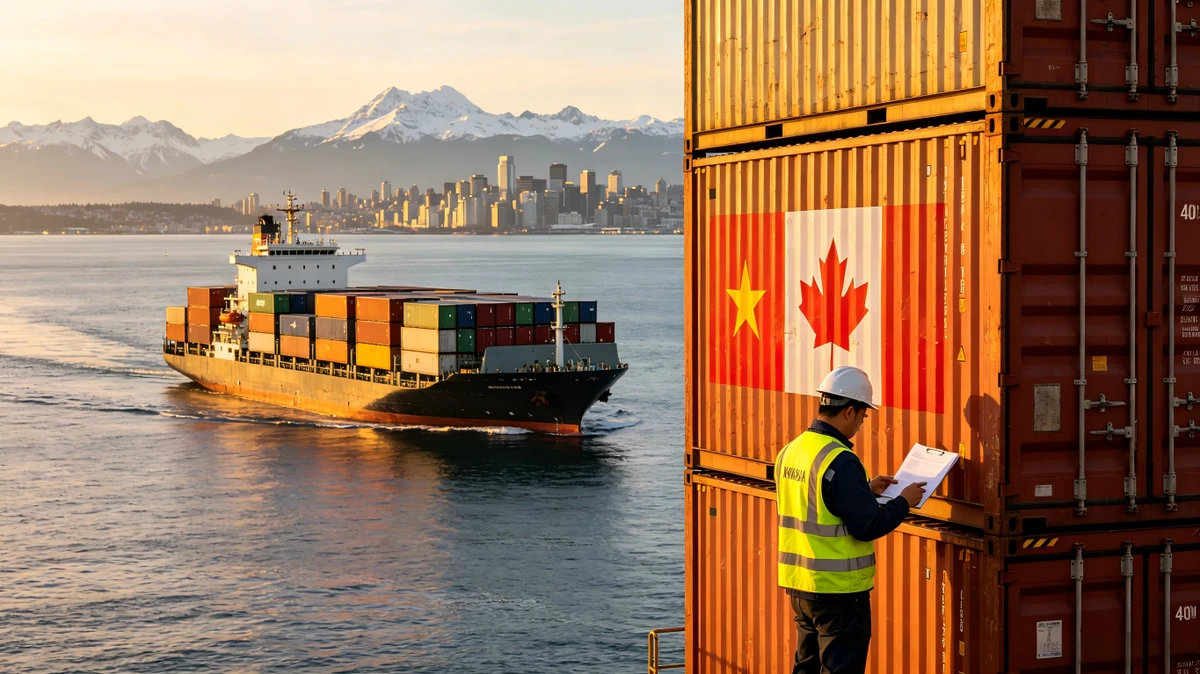
With over a decade of experience moving cargo from Vietnam to North America, our team at VNForwarder recently coordinated a Container from Vietnam to Canada — a 40’HC of furniture from a factory in Binh Duong to a warehouse in Toronto under DDP terms. By structuring the Certificate of Origin to claim CPTPP preferential rates, the client saved 11% on landed costs. Here’s exactly how we did it, and how you can replicate it for your own shipments.
Shipping a container from Vietnam to Canada involves multiple ports, Incoterms decisions, CBSA customs rules, and hidden surcharges. One wrong HS code or missing CO can delay cargo by weeks. In this guide, you’ll learn everything you need to move FCL or LCL cargo from Vietnam to Canada in 2026 — including cost ranges, transit times, CPTPP tariff advantages, Amazon FBA options, and a complete documentation checklist.
FCL vs. LCL vs. Air Freight: Which Shipping Mode Fits Your Cargo?
Choosing the right shipping mode is the first decision that affects your budget, timeline, and risk exposure. For shipping from Vietnam to Canada, most importers choose between FCL, LCL, and air freight.
What Is FCL (Full Container Load)?
FCL means you book an entire container exclusively for your cargo. Standard sizes are the 20-foot container (20’GP, ~33 CBM capacity) and the 40-foot container (40’GP or 40’HC, ~67–76 CBM capacity).
FCL becomes cost-effective when your cargo measures more than approximately 13–15 CBM. Pricing is flat-rate: you pay for the whole container regardless of whether it is completely full. This makes FCL ideal for large-volume shipments like furniture, bulk textiles, or full manufacturing runs.
FCL is also faster than LCL because there is no consolidation at origin or deconsolidation at destination. Your container is sealed at the factory in Vietnam and opened only at your warehouse in Canada, reducing handling damage and theft risk.
What Is LCL (Less Than Container Load)?
LCL means your goods share container space with cargo from other shippers. Your freight forwarder consolidates multiple shipments at a warehouse near Cat Lai Port or Hai Phong Port, loads them into a shared container, and deconsolidates them at a warehouse in Vancouver or Montreal upon arrival.
LCL is the right choice when your shipment is smaller than ~13 CBM. You pay only for the space you use, but the cost per CBM is higher than FCL. LCL typically adds 3–7 days to total transit time due to the consolidation and deconsolidation process.
Air Freight from Vietnam to Canada
Air freight is the fastest option, with transit times of 3–7 days door-to-door. It is best for urgent restocks, high-value electronics, or perishable goods. However, air freight is significantly more expensive than ocean freight.
Chargeable weight pricing decreases as shipment size increases:
| Chargeable Weight | Price per kg |
|---|---|
| 10 kg | ~$96.59 |
| 100 kg | ~$12.81 |
| 300 kg | ~$7.47 |
Airlines calculate chargeable weight using the greater of gross weight or volumetric weight. For standard air cargo, volumetric weight = (L × W × H in cm) / 6000.
Express Courier
For samples, documents, or parcels under 100 kg, express couriers like DHL, FedEx, and UPS offer door-to-door delivery in 1–4 days. This is rarely used for containerized freight but is useful for sending product samples to Canadian buyers before placing a full order.
FCL vs. LCL Decision Framework
| Factor | FCL | LCL |
|---|---|---|
| Best Volume | >13–15 CBM | <13–15 CBM |
| Cost Structure | Flat rate per container | Per-CBM rate |
| Transit Time | Faster (no consolidation) | Slower (+3–7 days) |
| Cargo Security | Sealed at origin | More handling points |
| Flexibility | Requires volume commitment | Flexible for small orders |
In our experience, the biggest risk for LCL shippers is peak-season space shortages — we have seen smaller forwarders lose bookings entirely when carriers prioritize FCL volumes. At VNForwarder, we run weekly LCL consolidation services at both Hai Phong and Cat Lai, with dedicated container allotments on Canada-bound vessels. This means our LCL clients get reliable space even during peak season.
Vietnam Export Ports and Canadian Gateway Ports
The ports you choose at origin and destination directly impact cost, transit time, and inland logistics.
Vietnam Export Ports (Ports of Origin)
| Port | Location | Best For |
|---|---|---|
| Cat Lai / Port of Ho Chi Minh City | Southern Vietnam | Factories in Binh Duong, Dong Nai, Mekong Delta |
| Hai Phong Port | Northern Vietnam | Electronics and textiles near Hanoi, Bac Ninh, Hai Duong |
| Da Nang Port | Central Vietnam | Suppliers in Quang Nam, Thua Thien Hue |
Cat Lai handles the highest container volume in Vietnam and is the default choice for southern manufacturers. Hai Phong is the deepest-water port in the north and offers direct sailings to Vancouver that can be faster than transshipment routes from Ho Chi Minh City.
Canadian Import Ports (Ports of Arrival)
| Port | Region | Best For |
|---|---|---|
| Port of Vancouver | British Columbia | Fastest Pacific gateway; rail connections to Toronto/Calgary |
| Port of Prince Rupert | British Columbia | Shorter rail distance to Midwest; less congestion |
| Port of Montreal | Quebec | Eastern Canada distribution; all-water Panama Canal route |
| Port of Halifax | Nova Scotia | Atlantic alternative for Europe-originated transshipment |
Vancouver is Canada’s busiest port and the primary entry point for Asia-Pacific cargo. Prince Rupert is growing rapidly because its rail connection to the Canadian National network bypasses some of the congestion seen at Vancouver. For Ontario and Quebec destinations, containers typically arrive at Vancouver or Prince Rupert and move by rail to Toronto or Montreal.
Route Selection Strategy
- Speed priority: Choose Hai Phong → Vancouver direct sailing (~22–28 days port-to-port).
- Eastern Canada distribution: Vancouver rail to Toronto, or direct Montreal sailing via Panama.
- Cost sensitivity: Compare Prince Rupert vs. Vancouver — sometimes Prince Rupert offers lower inland rail rates.
VNForwarder maintains direct carrier contracts on the Vietnam–Canada lane, including Yang Ming and ONE direct sailings from Hai Phong to Vancouver. This eliminates transshipment delays at intermediate hubs like Singapore or Busan.
Transit Times: How Long Does Shipping from Vietnam to Canada Take?
Transit time is one of the most searched variables for this trade lane. The answer depends on origin port, destination port, and whether you choose FCL or LCL.
FCL Transit Times (Port-to-Port)
| Route | Transit Time |
|---|---|
| Ho Chi Minh City → Vancouver | 22–27 days |
| Hai Phong → Vancouver | 28–33 days |
| Ho Chi Minh City → Montreal | 37–42 days |
| Hai Phong → Montreal | 35–40 days |
| Ho Chi Minh City → Toronto (via rail) | 37–45 days |
| Hai Phong → Toronto (via rail) | 35–43 days |
Direct sailings save 3–7 days compared to routes that transship through Singapore, Busan, or Kaohsiung. Always ask your forwarder whether the sailing is direct or transshipment.
LCL Transit Times
LCL adds approximately 3–7 days to the port-to-port timeline due to consolidation in Vietnam and deconsolidation in Canada. Typical LCL door-to-door timelines range from 33–47 days.
Door-to-Door Timeline Breakdown
| Leg | Duration |
|---|---|
| Factory pickup → Vietnam port | 1–2 days |
| Vietnam export customs clearance | 1–2 days |
| Ocean transit (port-to-port) | 22–42 days |
| Canada port discharge and handling | 1–2 days |
| CBSA customs clearance | 1–3 days |
| Inland rail/truck to final destination | 3–7 days |
| Total Door-to-Door (FCL) | 29–55 days |
| Total Door-to-Door (LCL) | 33–55 days |
Factors That Delay Transit
- Peak season congestion (August–October): Space tightens and ports backlog.
- Tet Holiday (January–February): Vietnamese factories close for 1–2 weeks; book 4–6 weeks ahead.
- Port congestion at Vancouver or Montreal: Can add 2–5 days.
- CBSA inspection holds: Random or targeted inspections add 2–7 days.
- Panama Canal draft restrictions: Reduce vessel capacity during drought seasons.
At VNForwarder, we provide 24⁄7 milestone tracking with proactive delay alerts. If your container is selected for CBSA inspection, your dedicated account manager notifies you immediately and provides an updated ETA.
Container Shipping Costs from Vietnam to Canada (2026 Outlook)
Ocean freight rates are volatile. The figures below reflect market conditions as of early 2026 and are intended as budgeting references only — always request a live quote before booking. If you are also evaluating North American logistics budgets, our guide to shipping cost from Vietnam to USA offers a useful rate benchmark.
FCL Rate Ranges (2026 Estimates)
Rates fluctuate based on fuel surcharges, peak-season demand, and global capacity. The following ranges reflect recent market conditions for standard dry containers:
| Route | 20’ Container | 40’HC Container |
|---|---|---|
| Ho Chi Minh City → Vancouver | $2,200–$2,800 | $2,600–$3,500 |
| Hai Phong → Vancouver | $2,000–$2,600 | $2,400–$3,200 |
| Ho Chi Minh City → Montreal | $6,400–$8,500 | $7,600–$10,200 |
| Hai Phong → Montreal | $6,000–$8,000 | $7,200–$9,500 |
| Ho Chi Minh City → Toronto | $6,400–$8,500 | $7,600–$10,200 |
| Hai Phong → Toronto | $6,000–$8,000 | $7,200–$9,500 |
These figures represent base ocean freight ranges. Actual quotes vary by carrier, booking date, and fuel surcharges. In volatile periods, 40’HC rates can swing from \(1,800 to over \)12,000 depending on Suez Canal disruptions, demand surges, and General Rate Increases (GRI).
LCL Cost Structure
LCL pricing is calculated per CBM or per metric ton, whichever is greater:
| Destination | LCL Rate per CBM |
|---|---|
| Vancouver | $80–$110 |
| Montreal / Toronto | $100–$130 |
LCL is cheaper than FCL only when your total volume stays below approximately 13 CBM. At higher volumes, the per-unit savings of FCL outweigh the flexibility of LCL.
Hidden Fees and Surcharges
Beyond the base ocean freight rate, expect these additional charges:
| Surcharge | Typical Cost | Description |
|---|---|---|
| THC (Terminal Handling Charge) | $150–$350 | Port handling at origin and destination |
| B/L Fee | $50–$100 | Bill of Lading issuance |
| Documentation Fee | $50–$150 | Export/import paperwork processing |
| CIC (Container Imbalance Charge) | $100–$300 | Applied when container supply is tight |
| EBS (Emergency Bunker Surcharge) | $200–$500 | Fuel price adjustment |
| AMS (Advance Manifest System) | $25–$50 | Canada advance cargo declaration |
| Demurrage | $50–$150/day | Container storage at port beyond free time |
| Detention | $30–$100/day | Container held by consignee beyond free time |
Always confirm whether your quote is port-to-port or door-to-door. A low port-to-port rate can double in cost once inland trucking, customs brokerage, and duties are added.
Complete Landed Cost Breakdown
To calculate your true landed cost, add every leg of the journey:
- Ocean freight charges
- Origin handling (Vietnam port fees, trucking to port)
- Export customs clearance
- International transit
- Destination port fees and storage
- CBSA customs duties and GST/HST
- Inland trucking or rail to final destination
- Cargo insurance (typically 0.3–0.5% of commercial invoice value)
- Fuel surcharges and congestion fees
Money-Saving Tips
- Book 3–4 weeks ahead, especially for Q4 shipments.
- Ship off-peak (November–July) when carriers have more space.
- Compare FCL vs. LCL at ~75% container capacity — upgrading to FCL often makes sense.
- Consider Prince Rupert for faster transit and potentially lower inland rail costs.
- Clarify quote scope before signing to avoid demurrage and detention surprises.
- If your distribution network also covers the United States, explore our shipping from Vietnam to USA service for competitive cross-border rates.
Insider Tip: Carrier Contract Flexibility
Most importers do not realize that freight forwarders with direct carrier contracts can often roll your cargo to the next sailing at no extra charge if you miss a cutoff — something impossible when booking directly with a carrier as a small-volume shipper. Because VNForwarder maintains annual volume commitments with Yang Ming and ONE, we can typically absorb a 24–48 hour factory delay without passing roll-over fees to the client. This is one reason experienced importers prefer working with a Vietnam-based forwarder rather than managing carrier relationships themselves.
VNForwarder provides transparent, all-inclusive DDP quotes with no hidden fees. We itemize every charge upfront so you know your exact landed cost before the container leaves Vietnam. Typical quote turnaround is 2–4 hours.
Incoterms 2020: Choosing the Right Term for Canada-Bound Shipments
Incoterms 2020 define who pays for transportation, insurance, and customs clearance at each stage. Choosing the wrong term can cost thousands in unexpected fees.
Quick Definitions for the Vietnam–Canada Lane
| Incoterm | Seller Pays For | Buyer Pays For | Best For |
|---|---|---|---|
| EXW (Ex Works) | Goods at factory | Everything: pickup, export, freight, import, delivery | Buyers with own Vietnam logistics network |
| FOB (Free on Board) | Goods to origin port + export clearance | Ocean freight, insurance, import clearance, delivery | Experienced importers who want freight control |
| CIF (Cost, Insurance, Freight) | Goods to destination port + insurance | Import clearance, duties, inland delivery | Buyers who want seller to arrange ocean leg |
| DDU (Delivered Duty Unpaid) | Everything except import duties/taxes | Import duties, GST/HST, customs clearance | Rarely used; being phased out in Incoterms 2020 |
| DDP (Delivered Duty Paid) | Everything: pickup to final delivery, including duties | Nothing — single all-in price | SMEs, e-commerce sellers, first-time importers |
Which Incoterm Should You Choose?
- EXW only makes sense if you have your own trucks in Vietnam and a trusted Canadian customs broker. Most importers underestimate the complexity of arranging both ends themselves.
- FOB and CIF work well for experienced importers who want to control carrier selection and negotiate ocean rates directly. However, you still need to manage Canadian customs clearance yourself.
- DDP is the safest choice for most SMEs and e-commerce sellers. You receive a single quote covering everything from factory pickup in Vietnam to warehouse delivery in Canada. No surprise GST/HST bills, no demurrage disputes, no broker coordination.
Case Study: FOB vs. DDP on a $50,000 Furniture Shipment
Consider a 40’HC of furniture from Hai Phong to Toronto:
| Cost Component | FOB Hai Phong | DDP Toronto |
|---|---|---|
| Product value | $50,000 | $50,000 |
| Ocean freight | Buyer arranges (~$7,500) | Included |
| Origin handling | Seller pays to port | Included |
| Export customs | Seller pays | Included |
| Import customs / broker | Buyer pays (~$400) | Included |
| Duties (CPTPP rate) | Buyer pays (~$0) | Included |
| GST (5%) | Buyer pays (~$2,875) | Included |
| Inland trucking to Toronto | Buyer arranges (~$800) | Included |
| Insurance | Buyer arranges (~$250) | Included |
| Total Landed Cost | ~$61,825 | ~$60,500 |
| Hidden Risk | Demurrage, storage, broker delays | None — fixed price |
In this scenario, DDP is not only simpler but also cheaper because the forwarder bundles services at volume rates and absorbs unexpected costs.
Common Incoterm Mistakes
- Confusing DDP with DDU: Under DDP, the seller pays duties. Under DDU (now largely obsolete), the buyer pays. Some suppliers still quote DDU and leave buyers surprised by GST/HST bills.
- Using FOB without verifying supplier logistics: If your Vietnamese supplier cannot reliably deliver to the port on time, you risk missing your vessel and paying roll-over fees.
- Accepting minimal CIF insurance: The seller’s CIF insurance may only cover total loss, not partial damage or theft. Verify coverage limits.
CPTPP and CUSMA: How to Claim Preferential Tariffs on Vietnam-Origin Goods
This is where most competitors stop short. According to Global Affairs Canada, Vietnam and Canada are both members of the Comprehensive and Progressive Agreement for Trans-Pacific Partnership (CPTPP), which entered into force for Vietnam in January 2019. For qualifying goods, this means reduced or 0% tariff rates entering Canada — but only if your documentation is correct.
Why CPTPP Matters for Canadian Importers
Without CPTPP, most goods from Vietnam enter Canada at standard Most Favored Nation (MFN) tariff rates, which can range from 5% to 18% depending on the product category. With a valid Certificate of Origin, many categories drop to 0%.
Product categories that benefit most:
- Textiles and apparel
- Footwear
- Certain electronics and machinery parts
- Agricultural and seafood products
CPTPP Rules of Origin (Simplified)
Not every product made in Vietnam qualifies. The CPTPP uses three main origin tests:
- Wholly Obtained: The product is entirely grown, produced, or manufactured in Vietnam (e.g., raw seafood, agricultural crops).
- Substantial Transformation: Non-originating materials undergo sufficient processing in Vietnam to change their tariff classification.
- Regional Value Content (RVC): A minimum percentage of the product’s value must originate from CPTPP member countries.
Each HS code chapter has specific product rules. For example, apparel often qualifies if it is both knitted and finished in Vietnam, even if the yarn was imported.
Step-by-Step: Completing a Vietnam-Issued CPTPP Certificate of Origin
- Verify your HS code and look up the corresponding CPTPP product-specific rule in the Canada Customs Tariff.
- Obtain a supplier’s declaration of origin from your Vietnamese manufacturer, confirming that the goods meet CPTPP origin criteria.
- Complete the CPTPP Certificate of Origin through the Vietnam Chamber of Commerce and Industry (VCCI) or an authorized issuer.
- Ensure the CO travels with the shipment or is presented to CBSA at the time of entry. Electronic submission is acceptable if CBSA’s requirements are met.
- Retain records for 5 years — CBSA can audit origin claims long after the shipment has cleared.
CBSA Proof-of-Origin Requirements
To claim the preferential rate at the border, the importer must possess:
- A valid CPTPP Certificate of Origin, or
- An importer’s knowledge statement (allowed for trusted suppliers after the first qualifying shipment, provided you have documentation supporting origin).
The CO must reference the correct HS code, match the Commercial Invoice, and be signed by the exporter or authorized agent.
Common Mistakes That Void Preferential Status
- Using a generic (non-CPTPP) Certificate of Origin.
- Mismatched HS codes between the CO, Commercial Invoice, and Packing List.
- Missing supplier declaration or insufficient RVC documentation.
- Claiming preferential status on transshipped goods that did not undergo substantial transformation in Vietnam.
At VNForwarder, our in-house documentation team reviews every Certificate of Origin and HS code before export. We catch mismatches before they become CBSA delays, saving clients an average of 2–3 days in customs processing.
Navigating Canada Customs Clearance and CBSA Requirements
All containerized imports into Canada must clear the Canada Border Services Agency (CBSA) before release. Understanding the process prevents costly storage fees and demurrage.
Calculating Duties and Taxes: 5 Steps
- Determine Country of Origin: Vietnam is CPTPP-eligible, so confirm whether your goods qualify for preferential rates.
- Classify Goods Using the Correct HS Code: Use the Canada Customs Tariff. Incorrect classification is the leading cause of customs delays and unexpected duty bills.
- Establish Customs Value: Typically the CIF value (Cost + Insurance + Freight). CBSA scrutinizes undervaluation.
- Apply the Import Tariff: Use the preferential CPTPP rate if eligible; otherwise, apply the MFN rate.
- Add GST and Provincial Taxes: Federal GST is 5%. Some provinces charge HST (harmonized sales tax) instead of separate GST + PST.
Required Documents for CBSA Clearance
| Document | Purpose |
|---|---|
| Bill of Lading (B/L) | Proof of shipment and title transfer |
| Commercial Invoice | Itemized goods with values for duty calculation |
| Packing List | Detailed contents per carton/pallet |
| Certificate of Origin | Required for CPTPP preferential duty claims |
| Canada Customs Invoice | Mandatory for shipments valued over CAD $2,500 |
| Import Permit | Required for regulated goods (firearms, pharmaceuticals, etc.) |
Restricted and Prohibited Items
Restricted (require permits or licenses):
- Dairy products (Canadian Dairy Commission)
- Firearms (RCMP)
- Pharmaceuticals (Health Canada)
- Tobacco and alcohol (provincial commissions)
- Plants and animals (Canadian Food Inspection Agency)
Prohibited (cannot enter Canada):
- Narcotics without permits
- Counterfeit goods
- Endangered species products
- Hate propaganda and obscene materials
Anti-Dumping and Countervailing Duties (AD/CVD)
Some Vietnam-origin products face additional AD/CVD measures. As of 2026, categories under review include certain steel products, solar panels, and select furniture types. Always check CBSA’s Measures in Force list before shipping.
Customs Inspection Types
- Random inspection: A percentage of shipments are selected randomly. Typical delay: 1–3 days.
- Targeted inspection: Triggered by first-time importer status, high-risk HS codes, valuation discrepancies, or origin doubts. Typical delay: 2–7 days.
Working with a Canadian Customs Broker
If you are importing under FOB or CIF, you will need a licensed Canadian customs broker to file your B3 entry and coordinate with CBSA. Broker fees typically range from CAD \(150–\)400 per entry depending on complexity.
Under VNForwarder’s DDP service, our Canadian partner broker network handles clearance as part of the all-inclusive quote. You do not need to hire a separate broker or manage B3 filing yourself.
Door-to-Door Shipping from Vietnam to Canada: A Step-by-Step Breakdown
Door-to-door shipping means one quote covers everything from factory pickup in Vietnam through to warehouse delivery in Canada. Here is exactly what happens at each milestone.
The Complete Journey
| Day | Milestone | Who Handles It |
|---|---|---|
| 0 | Factory pickup (Binh Duong / Hanoi / Da Nang) | VNForwarder or supplier under EXW/FOB |
| 1–2 | Cargo consolidation (LCL) or container stuffing (FCL) | VNForwarder warehouse team |
| 2–3 | Vietnam export customs clearance at Cat Lai / Hai Phong | VNForwarder customs brokerage team |
| 3–25 | Ocean transit to Vancouver / Prince Rupert / Montreal | Ocean carrier |
| 25–27 | Vessel discharge and port handling at Canadian port | Port authority + carrier |
| 27–29 | CBSA customs clearance + inspection (if flagged) | CBSA + customs broker |
| 29–32 | Inland rail or trucking to Toronto / Edmonton / Calgary | Rail/truck carrier |
| 32–33 | Final-mile delivery and unloading at warehouse | Local trucking partner |
Responsibility Matrix: DDP vs. FOB
| Leg | DDP | FOB |
|---|---|---|
| Factory pickup | Forwarder | Supplier |
| Export customs | Forwarder | Supplier |
| Ocean freight | Forwarder | Buyer arranges |
| Import customs | Forwarder | Buyer |
| Duties and taxes | Forwarder | Buyer |
| Inland delivery | Forwarder | Buyer arranges |
Under DDP, VNForwarder acts as your single point of contact for every leg. Under FOB, you coordinate four or more separate vendors.
Typical Delay Nodes and How to Avoid Them
- Vietnam export documentation errors: Solution — pre-clearance review 48 hours before vessel cutoff.
- Transshipment port congestion: Solution — book direct sailings rather than transshipment routes.
- CBSA inspection holds: Solution — ensure HS codes, valuation, and origin documents are 100% consistent.
- Canadian rail ramp congestion: Solution — schedule off-peak delivery appointments when possible.
VNForwarder provides real-time milestone updates via WhatsApp and email. If your shipment hits a delay node, your dedicated account manager explains exactly what happened and the revised ETA.
Amazon FBA Shipping from Vietnam to Canada
Amazon.ca is one of North America’s fastest-growing marketplaces. Sellers sourcing from Vietnam need a reliable pipeline into Amazon fulfillment centers.
Amazon.ca Fulfillment Centers Accepting Container Delivery
| FC Code | Location | Container Acceptance |
|---|---|---|
| YVR | Vancouver area | Yes — appointment required |
| YYZ | Toronto area | Yes — appointment required |
| YYC | Calgary area | Yes — limited slots |
Not all Amazon FCs accept full container deliveries. YVR and YYZ are the most common destinations for Vietnam-origin FBA inventory.
FBA Prep Requirements from Vietnam
Before your cargo leaves Vietnam, it must meet Amazon’s inbound requirements:
- Quality Inspection: Check for defects at the factory or at a prep warehouse in Ho Chi Minh City.
- FNSKU Labeling: Every unit must carry an Amazon barcode (FNSKU), not the manufacturer’s UPC.
- Poly-bagging: Items in loose fabric or with exposed materials must be sealed in poly bags with suffocation warning labels.
- Pallet Specifications: 40” × 48” GMA standard, 4-way entry, maximum height 72”, weight limit 1,500 lbs per pallet.
- Carton Labeling: Each carton must display “Amazon FBA”, the ship-from address, shipment ID, and pallet label.
Shipping Strategy: Direct to FC vs. Via 3PL
| Strategy | Pros | Cons |
|---|---|---|
| Direct to Amazon FC | Faster, lower handling cost, no middleman | Strict appointment scheduling; non-compliant pallets rejected |
| Via Canadian 3PL | Allows re-palletization, QC rework, inventory splitting | Adds cost and 3–5 days to timeline |
Most experienced sellers use a Canadian 3PL for their first few shipments to ensure pallet compliance, then transition to direct FC delivery once the process is proven.
Timeline Example: Vietnam to Amazon YVR
| Day | Event |
|---|---|
| 0 | Factory QC and FNSKU labeling in Ho Chi Minh City |
| 2 | Container loading at Cat Lai Port |
| 22 | Ocean arrival at Vancouver |
| 24 | CBSA clearance complete |
| 26 | Delivery appointment at YVR fulfillment center |
Common FBA Mistakes from Vietnam
- Sending goods without FNSKU labels causes immediate refusal at the Amazon dock.
- Using non-compliant pallets triggers forced floor-loading fees (CAD $150+ per pallet).
- Undervaluing goods on the Commercial Invoice raises CBSA red flags and can lead to seizure.
VNForwarder operates a dedicated Amazon FBA prep warehouse in Ho Chi Minh City. We handle FNSKU labeling, quality control, palletization, and DDP delivery to Amazon.ca FCs — all included in a single quote.
Industry-Specific Shipping Guidance
Different product categories face unique compliance requirements when entering Canada from Vietnam.
Shipping Furniture from Vietnam to Canada
Vietnam is a top global furniture exporter. Canadian importers must be aware of:
- CFIA Wood Regulations: Wooden furniture may require treatment certificates depending on the wood species and origin of the timber.
- BMSB Seasonal Considerations: While Brown Marmorated Stink Bug (BMSB) regulations are most famous for shipping from Vietnam to Australia, Canadian inspectors also scrutinize wooden goods more closely during peak risk seasons (September–April).
- Moisture Protection: Ocean transit from Vietnam to Canada crosses tropical and temperate climates. Proper moisture-barrier packaging prevents mold and warping.
- DDP Advantage: Furniture importers without Canadian customs brokers benefit enormously from DDP service, since bulky cargo is expensive to store if customs delays occur.
Shipping Textiles and Apparel from Vietnam to Canada
- CPTPP Tariff Advantages: Vietnam-origin garments enter Canada at 0% under CPTPP for most HS chapters. This is one of the highest-value categories for preferential trade.
- Labeling Requirements: Canada requires fiber content labels in English and French, along with country of origin marking.
- Quota Status: Under CPTPP, most textile quotas have been eliminated or significantly expanded compared to the pre-agreement era.
Shipping Electronics from Vietnam to Canada
- CSA Certification: Many electrical products require CSA (Canadian Standards Association) marking or equivalent certification before sale in Canada.
- IC Certification: Radio and telecommunications devices require Innovation, Science and Economic Development Canada (ISED) certification.
- Lithium Battery Restrictions: Devices containing lithium batteries must comply with UN 38.3 testing and IMDG Code Section II or IB rules for ocean freight.
- High-Value Insurance: Electronics shipments often exceed $100,000 in container value. Cargo insurance at 0.3–0.5% of invoice value is strongly recommended.
Oversized and Project Cargo
For Oversized & Project Cargo — machinery, renewable energy components, or construction equipment that exceeds standard container dimensions:
- Flat-rack containers: Open-sided platforms for wide cargo.
- Open-top containers: For cargo that is tall but not necessarily wide.
- Breakbulk shipping: Individual pieces loaded directly onto the vessel without a container.
- Heavy-Lift Ports: Vancouver and Halifax have heavy-lift capabilities for project cargo.
- Provincial Permitting: Oversized loads crossing Canadian provinces may require route surveys and transport permits.
Required Documentation Checklist
Accurate documentation is the difference between smooth clearance and a two-week port storage bill. Here is the complete checklist for Vietnam-to-Canada container shipping.
Vietnam Export Documents
- [ ] Commercial Invoice — Itemized goods with correct HS codes and Incoterms.
- [ ] Packing List — Detailed carton-level contents, weights, and dimensions.
- [ ] Bill of Lading (B/L) or Sea Waybill — Ocean carrier contract of carriage.
- [ ] Vietnam Export Customs Declaration — Filed by forwarder or supplier.
- [ ] Certificate of Origin (CPTPP form) — Required if claiming preferential rates.
- [ ] Export License — Only for regulated commodities (timber, minerals, etc.).
Canada Import Documents
- [ ] Canada Customs Invoice — Mandatory for shipments over CAD $2,500.
- [ ] CBSA B3 Customs Coding Form — Completed by your customs broker.
- [ ] Import Permit — Required for restricted goods (firearms, pharmaceuticals, etc.).
- [ ] Proof of Origin — CPTPP CO or importer’s knowledge statement.
Optional but Recommended
- [ ] Cargo Insurance Certificate — Essential for high-value shipments.
- [ ] Letter of Credit — If your payment terms require it.
- [ ] FBA Routing Slip — For Amazon FBA shipments.
- [ ] Dangerous Goods Declaration — If shipping hazardous materials.
Print this checklist and review it with your supplier and forwarder before every shipment. Missing even one document can trigger CBSA holds, storage fees, and missed delivery appointments.
FAQ: Container Shipping from Vietnam to Canada
How much does it cost to ship a 40’ container from Vietnam to Canada? In 2026, a 40’HC from Ho Chi Minh City to Vancouver ranges from approximately \(2,600 to \)3,500 for base ocean freight. Door-to-door DDP to Toronto can range from \(7,200 to \)10,500 depending on cargo value, duties, and inland delivery. Rates are volatile, so request a live quote for accurate pricing.
How long does sea freight take from Ho Chi Minh City to Vancouver? Port-to-port FCL typically takes 22–27 days. Door-to-door adds 7–10 days for customs and inland trucking, bringing the total to approximately 29–37 days.
What is the cheapest way to ship from Vietnam to Canada? For shipments over 13–15 CBM, FCL ocean freight is the cheapest per-unit method. For smaller shipments, LCL is more economical than booking a partially empty container. Booking 3–4 weeks ahead and shipping during off-peak months (November–July) also reduces costs.
Do I need a customs broker to import into Canada? If you are shipping under FOB or CIF terms, yes — you need a licensed Canadian customs broker to file your B3 entry with CBSA. If you use DDP terms, your forwarder should include broker services in the all-inclusive price.
What is the difference between FCL and LCL? FCL means you rent an entire 20’ or 40’ container. LCL means your cargo shares container space with other shippers. FCL is faster and more secure; LCL is more flexible for small volumes.
Can I ship directly from my Vietnam supplier’s factory? Yes. Under EXW or DDP terms, the forwarder can arrange factory pickup. Under FOB, the supplier is responsible for delivering cargo to the port. Always confirm your supplier’s capabilities before finalizing Incoterms.
What documents are needed for Canada customs clearance? At minimum: Bill of Lading, Commercial Invoice, Packing List, and Canada Customs Invoice (for shipments over CAD $2,500). If claiming CPTPP preferential rates, you also need a Certificate of Origin.
Does Vietnam have a free trade agreement with Canada? Yes. Both countries are members of the CPTPP (Comprehensive and Progressive Agreement for Trans-Pacific Partnership). Many Vietnam-origin goods qualify for reduced or 0% tariffs when entering Canada with proper origin documentation.
How do I claim CPTPP preferential tariffs? You need a valid CPTPP Certificate of Origin issued by an authorized body in Vietnam (such as VCCI). The certificate must reference the correct HS code and travel with the shipment or be presented to CBSA at entry.
What is DDP shipping, and is it worth it? DDP (Delivered Duty Paid) means the seller or forwarder handles everything from factory pickup to final delivery, including all duties and taxes. It is worth it for SMEs and first-time importers who want predictable costs and no customs surprises.
Can I ship Amazon FBA from Vietnam to Canada? Yes. You can ship containerized FBA inventory directly to Amazon.ca fulfillment centers in Vancouver (YVR) and Toronto (YYZ). Your cargo must meet Amazon’s labeling, pallet, and packaging requirements before leaving Vietnam.
Are there any restricted items when importing from Vietnam to Canada? Restricted items include dairy, firearms, pharmaceuticals, tobacco, alcohol, and plants/animals — all requiring permits. Prohibited items include narcotics, counterfeit goods, and endangered species products.
What is the best port in Canada for Vietnam cargo? Vancouver is the most popular entry point for Asia-Pacific cargo. Prince Rupert offers faster rail connections to Toronto for some lanes. Montreal is the primary Eastern Canada gateway.
How do I track my container from Vietnam to Canada? Your forwarder should provide a container tracking link using the B/L number. VNForwarder offers 24⁄7 milestone tracking with proactive alerts at key stages: export clearance, vessel departure, arrival, customs clearance, and final delivery.
What are demurrage and detention charges? Demurrage is the fee for storing a container at the port beyond the free time allowed by the terminal. Detention is the fee for keeping the container outside the port beyond the free time allowed by the carrier. Both can add \(30–\)150 per day.
Is cargo insurance necessary for Vietnam–Canada shipments? While not legally required, cargo insurance is strongly recommended. Ocean transit involves multiple handling points, and carrier liability is limited. Insurance typically costs 0.3–0.5% of the commercial invoice value.
How does Tet Holiday affect shipping from Vietnam? Tet (Vietnamese Lunar New Year, usually January or February) closes factories and government offices for 1–2 weeks. Container space becomes scarce 4–6 weeks before Tet. Book early and plan inventory accordingly.
Why should I use a Vietnam-based freight forwarder instead of a Canadian one? A Vietnam-based forwarder like VNForwarder has direct relationships with local carriers, customs officials, and warehouse operators. We can coordinate factory pickups, handle Vietnamese export documentation in the local language, and resolve issues on the ground in real time — something a Canadian broker cannot do from 12 time zones away.
Conclusion: Your Next Step to Stress-Free Shipping from Vietnam to Canada
Container shipping from Vietnam to Canada does not have to be complicated. With the right forwarder, accurate documentation, and a clear understanding of CPTPP benefits, you can move cargo reliably and cost-effectively across the Pacific.
If you are an SME or e-commerce seller, DDP door-to-door service eliminates the complexity of managing multiple vendors, brokers, and carriers. You get one quote, one point of contact, and one delivery appointment.
If you are an experienced importer, knowing how to structure your Certificate of Origin and HS code classification can save thousands of dollars in duties per shipment.
At VNForwarder, we have been specializing in container shipping from Vietnam to Canada since 2018. Whether you are moving FCL furniture from Binh Duong, LCL textiles from Hanoi, or Amazon FBA inventory to Vancouver, we provide transparent, all-inclusive quotes with no hidden fees. Our team typically responds to quote requests within 2–4 hours, and every Canada-bound shipment gets a dedicated account manager and 24⁄7 tracking support.
Get started today. Request your free quote and let us handle the logistics while you focus on growing your business.