
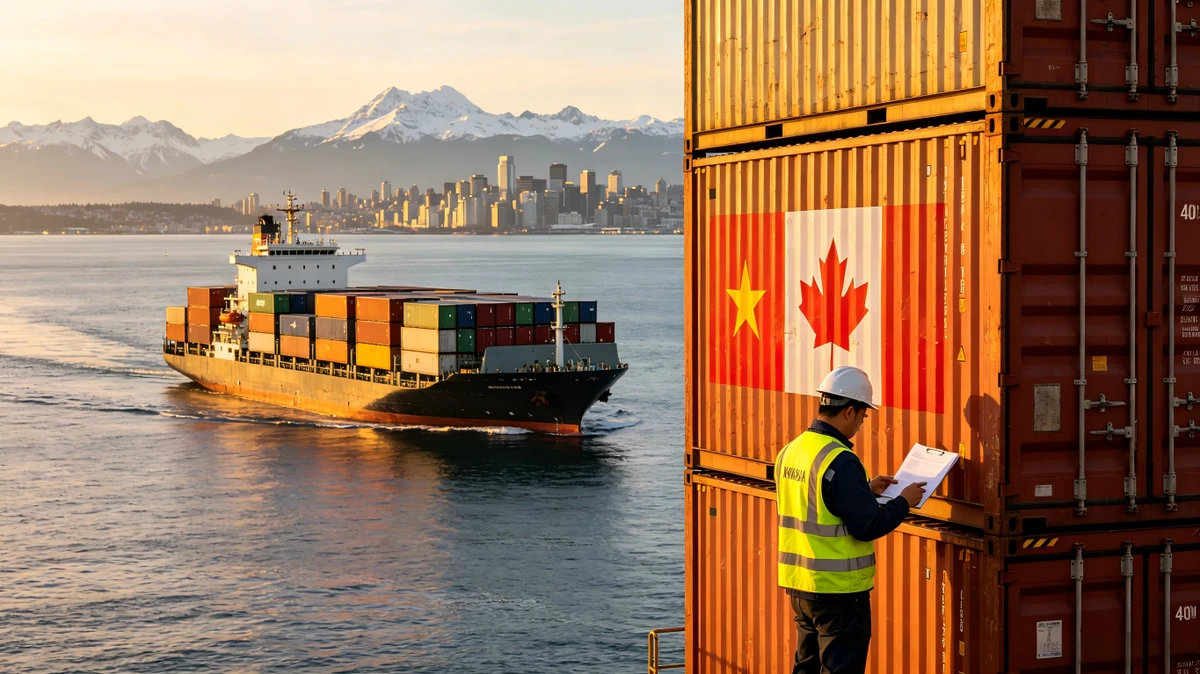
Sea freight from Vietnam to Canada is now one of the busiest Asia–North America trade lanes for B2B importers, e-commerce sellers, and SMEs. In 2025, two-way merchandise trade between Vietnam and Canada reached CAD 11.6 billion, with Canadian imports from Vietnam climbing steadily year over year. Yet moving goods by ocean is rarely as simple as booking a container. Importers constantly ask us: Which port should I use? FCL or LCL? How long will it really take? What will my total landed cost be? And how do I handle Canadian customs?
This guide answers those questions. Whether you are shipping furniture from Binh Duong, textiles from Hai Phong, or Amazon FBA inventory to Toronto, you will learn how to choose the right Shipping from Vietnam to Canada service, avoid common customs mistakes, and control your total landed cost.
1. Why Choose Sea Freight from Vietnam to Canada?
For most shipments above a few pallets, sea freight is the most economical way to move goods from Vietnam to Canada. It is slower than air but costs a fraction per kilogram, especially when you ship Full Container Load (FCL) or consolidate regular volumes through Less than Container Load (LCL). If you are also moving goods to the United States, our Shipping from Vietnam to USA service offers the same transparent quoting and end-to-end management across the Pacific.
Typical cargo on this lane includes:
- Furniture and wood products
- Textiles, apparel, and footwear
- Electronics and consumer goods
- Machinery and industrial parts
- Coffee, seafood, and agricultural products
Our Industry Insight: In our experience, Canadian buyers sourcing furniture and textiles from Vietnam can often cut freight spend by 30–50% compared with air freight by planning around sea freight schedules. The key is building a 4–6 week buffer into your inventory plan and locking space before peak season.
Sea freight also offers a lower carbon footprint per kilogram than air cargo, which matters for brands tracking supply-chain emissions. When speed is not the deciding factor, ocean is usually the right call for container shipping from Vietnam to Canada — and a cost structure that compares favorably with lanes like Sea Freight from Vietnam to Australia.
2. Key Ports and Routes for Sea Freight from Vietnam to Canada
Vietnam Export Ports
| Port | Region | Best For | Key Advantage |
|---|---|---|---|
| Cat Lai / Cai Mep-Thi Vai | Ho Chi Minh City area | Southern factories, electronics, furniture, textiles | Direct mother-vessel services to North America |
| Hai Phong | Northern Vietnam | Hanoi, Bac Ninh, Hai Duong electronics and textiles | Main gateway to Northern Vietnam manufacturing |
| Da Nang | Central Vietnam | Central region suppliers | Niche option with fewer sailings |
Most large-volume sea freight from Vietnam to Canada departs from Cai Mep-Thi Vai or Cat Lai, where carriers operate direct trans-Pacific strings. Hai Phong is the better choice if your supplier is in the north, because it avoids a long domestic truck haul to the south. For other Asia-Pacific destinations, we also manage Shipping from Vietnam to Australia using the same port-first planning approach.
Canadian Import Ports
| Port | Region | Best For | Inland Connection |
|---|---|---|---|
| Vancouver | British Columbia | Western Canada and Pacific Rim trade | CN/CP rail to Toronto, Montreal, Calgary |
| Prince Rupert | British Columbia | Faster Asia-Pacific access | Dedicated CN rail corridor to central Canada |
| Montreal | Quebec | Quebec and Ontario markets | Direct St. Lawrence access; avoids Vancouver rail backlog |
| Halifax | Nova Scotia | Atlantic Canada and Europe-linked services | Rail/truck to Toronto and Montreal |
For most importers, Vancouver is the default entry point. If you are delivering to Toronto or Montreal, you have two main options: a direct all-water service through Vancouver followed by rail, or a direct string to Montreal that avoids the Vancouver port-rail transfer. The right choice depends on vessel schedule, rail capacity, and your final destination.
Our Industry Insight: During peak season, Vancouver terminal and rail congestion can add 5–10 days to inland transit. We often route time-sensitive FCL shipments through Prince Rupert to bypass that bottleneck. The ocean leg is slightly shorter, and the dedicated CN rail connection to Edmonton and Chicago is more predictable.
3. FCL vs. LCL: Which Container Option Fits Your Shipment?
FCL (Full Container Load) means you book an entire container. LCL (Less than Container Load) means your cargo shares container space with other shippers.
| Factor | FCL | LCL |
|---|---|---|
| Typical volume | Above 13–15 CBM | 1–13 CBM |
| Cost structure | Flat per-container rate | Per CBM or per-ton |
| Security | Seal stays intact from origin to destination | Cargo is consolidated and deconsolidated |
| Transit time | Faster (no consolidation) | Adds 3–7 days for handling |
| Best for | High volume, fragile goods, tight schedules | Small shipments, samples, flexible timelines |
Common container sizes include 20GP (about 28 CBM), 40GP (about 58 CBM), 40HQ (about 68 CBM), and 45HQ for larger volumes. If your cargo is temperature-sensitive, you will need a reefer container. For oversized cargo, options like flat-rack or open-top containers are available.
For furniture and textiles, Container from Vietnam to Canada via FCL shipping from Vietnam to Canada is usually the better choice once you fill more than half a 20-foot container. For smaller e-commerce restocks or samples, LCL shipping from Vietnam to Canada keeps total cost low, even though the per-CBM rate is higher.
4. Sea Freight Transit Times from Vietnam to Canada
Port-to-port transit times vary by origin port, destination port, and whether the service is direct or transshipped.
| Vietnam Port | Canada Port | Typical Port-to-Port Time |
|---|---|---|
| Ho Chi Minh City / Cai Mep | Vancouver | 22–30 days |
| Ho Chi Minh City / Cai Mep | Montreal | 35–45 days |
| Hai Phong | Vancouver | 28–35 days |
| Hai Phong | Montreal | 38–48 days |
| Ho Chi Minh City / Cai Mep | Prince Rupert | 20–28 days |
Door-to-door transit is usually 7–14 days longer because of pickup, export clearance, consolidation (for LCL), customs exams, inland rail, and final delivery.
How long does sea freight take from Vietnam to Canada? For a direct FCL shipment from Cai Mep to Vancouver, expect 22 to 30 days port-to-port. For a shipment to Toronto or Montreal, plan for 35 to 45 days door-to-door depending on the inland leg.
Factors that can delay your shipment include:
- Transshipment at hubs like Singapore, Hong Kong, or Busan
- Peak season before Tet (Vietnamese Lunar New Year) and Q3 holiday rush
- Port congestion or weather in Vancouver or Prince Rupert
- Canadian customs exams and CARM clearance delays
5. Sea Freight Costs from Vietnam to Canada (Landed Cost Breakdown)
No two shipments cost the same, but every Shipping Cost from Vietnam to Canada quote is built from the same components.
| Cost Component | What It Covers | Typical Range |
|---|---|---|
| Ocean freight (O/F) | Base sea freight rate | Market-dependent |
| BAF / CAF | Bunker and currency adjustments | Fluctuates with fuel and exchange rates |
| Terminal handling (THC) | Loading/unloading at origin and destination ports | Per container or per CBM |
| Documentation | B/L, export/import declarations, certificates | Flat fee |
| Customs brokerage | Canada B3-3 filing and CBSA coordination | CAD 50–200 per entry |
| Duties and taxes | MFN duty if CPTPP not claimed + GST/HST | GST 5%; HST 13–15% |
| Inland transport | Rail, drayage, and final delivery | Depends on distance |
| Cargo insurance | Marine insurance for transit | 0.15–0.5% of cargo value |
Indicative estimates only (actual rates vary by market conditions):
- 20GP FCL from Ho Chi Minh City to Vancouver: USD 1,500–3,500 depending on season
- LCL per CBM from Vietnam to Canada: USD 110–200 depending on volume and season
Real-Life Scenario: A Canadian home-goods retailer recently shipped a 20GP container of furniture from Binh Duong to Toronto. The base ocean freight was USD 2,800, but the landed cost also included origin trucking (USD 180), destination THC (USD 450), customs brokerage (CAD 120), GST (5% on value for duty), and inland rail to Toronto (USD 850). Without a forwarder who broke down every line item, the importer would have been surprised by the final bill.
6. Required Documents for Vietnam Export and Canadian Import
Accurate paperwork is the single biggest factor in avoiding customs delays. Here is a checklist for both sides.
Vietnam Export Documents
| Document | Purpose |
|---|---|
| Commercial Invoice | Transaction value, product description, Incoterms |
| Packing List | Carton-level weights, dimensions, and contents |
| Bill of Lading (B/L) | Contract of carriage and title document |
| Export Customs Declaration | Filed by Vietnam Customs |
| Certificate of Origin | Needed for CPTPP preferential tariff |
| Export License / Permits | For regulated products like wood, minerals, or wildlife |
Canada Import Documents
| Document | Purpose |
|---|---|
| Commercial Invoice | Must match packing list and B/L |
| Packing List | Itemizes shipment contents |
| Bill of Lading | Required for customs entry |
| Certification of Origin | Self-certified for CPTPP on shipments over CAD 3,300 |
| B3-3 Canada Customs Coding Form | Prepared by your customs broker |
| Product Certificates | CFIA, Health Canada, phytosanitary, etc. if applicable |
The most common errors we see are mismatched invoice and packing-list quantities, incorrect HS codes, and missing Certificate of Origin records. Fix these before the cargo sails.
7. Canadian Customs, Duties, and the CPTPP Advantage
The Canada Border Services Agency (CBSA) manages all commercial imports. Since January 2019, the Comprehensive and Progressive Agreement for Trans-Pacific Partnership (CPTPP) has given Vietnam-origin goods preferential access to Canada.
Under CPTPP, most manufactured goods from Vietnam enter Canada duty-free under the Comprehensive and Progressive Vietnam Tariff (CPVNT). That includes electronics, furniture, footwear, textiles, and consumer goods. To claim this rate, you need:
- A valid Certification of Origin (self-certified by exporter, producer, or importer)
- Proof that the goods meet CPTPP rules of origin
- Correct declaration on the B3-3 Canada Customs Coding Form
For shipments valued at CAD 3,300 or less, a certification is not required at the border, but you should still keep records in case of CBSA verification.
You will still pay GST (5%) and, in some provinces, HST (13–15%). Registered Canadian businesses can recover these as Input Tax Credits, but they still represent a cash-flow cost at the border.
Important: CUSMA does not apply to Vietnam-origin goods. CUSMA covers Canada, the United States, and Mexico only. If your supplier or a logistics partner marks a Vietnam shipment under CUSMA, the claim is wrong and CBSA can reassess the entry.
Since 2021, commercial importers must also register with CARM (CBSA Assessment and Revenue Management). CARM requires a Business Number with an import/export account, a surety bond or cash deposit, and a designated customs broker. If you are not registered, your goods can be held at the border.
8. Special Cargo and Service Options
Door-to-Door Shipping from Vietnam to Canada
Door-to-door shipping from Vietnam to Canada covers pickup at the supplier’s factory, Vietnam export clearance, ocean freight, Canadian import clearance, and final delivery to your warehouse. Under DDP (Delivered Duty Paid), the forwarder also pays duties and taxes on your behalf. Under DDU (Delivered Duty Unpaid), you pay duties and taxes at destination.
DDP is ideal for SMEs without a Canadian customs broker or importers who want one fixed invoice. FOB and CIF are better if you have your own broker and want more control over the ocean freight rate.
Amazon FBA Canada
E-commerce sellers can ship from Vietnam to Amazon FBA Canada by sea, then complete FNSKU labeling, poly-bagging, palletizing, and inspection before delivery to FCs near Vancouver, Calgary, Toronto, or Ottawa. The right prep process at origin prevents rejection at the Amazon receiving dock.
Other Specialized Cargo
- Reefer containers: Seafood, agriculture, pharmaceuticals, frozen food
- Oversized / project cargo: Flat-rack, heavy-lift, breakbulk for machinery and industrial equipment
- High-value electronics: Marine insurance, secure sealing, and optional GPS tracking
9. How to Choose a Reliable Freight Forwarder for Vietnam–Canada Sea Freight
A strong freight forwarder on this lane should offer:
- Local Vietnam presence and direct carrier/port relationships
- Transparent, all-inclusive quotes with no hidden fees
- A Canadian customs broker network or partnership
- Experience with your cargo type and service level (FCL, LCL, DDP, FBA)
- Real-time tracking and milestone updates
- Dedicated account manager and 24⁄7 support
VNForwarder is a professional freight forwarder based in Vietnam, founded in 2018. We specialize in sea freight from Vietnam to Canada, including FCL, LCL, door-to-door shipping, DDP, and Amazon FBA to Canada. Our clients receive a transparent quote within 2–4 hours, a dedicated account manager, and 24⁄7 support throughout the shipment lifecycle.
Our Industry Insight: We have seen importers lose CPTPP duty-free eligibility because they could not produce a valid Certificate of Origin when CBSA asked for it. Before you ship, we verify origin documentation with your supplier so you do not pay unnecessary MFN duties at the border.
10. FAQ
How long does sea freight take from Vietnam to Canada?
Direct FCL from Cai Mep to Vancouver takes about 22–30 days port-to-port. To Montreal or Toronto, plan 35–45 days door-to-door.
How much does sea freight cost from Vietnam to Canada?
Rates vary by season and volume. A 20GP FCL from Ho Chi Minh City to Vancouver typically ranges from USD 1,500 to 3,500. LCL is usually USD 110–200 per CBM.
What is the cheapest way to ship from Vietnam to Canada?
For non-urgent shipments above a few pallets, LCL or FCL sea freight is the cheapest option. Booking early and shipping off-peak also lowers rates.
What documents are needed to ship from Vietnam to Canada?
At minimum: Commercial Invoice, Packing List, Bill of Lading, and Certificate of Origin for CPTPP. Your customs broker files the B3-3 form in Canada.
Does Vietnam have a free trade agreement with Canada?
Yes. Vietnam and Canada are both members of the CPTPP, which gives most Vietnam-origin manufactured goods duty-free access to Canada.
Is CUSMA applicable to Vietnam-origin goods?
No. CUSMA applies only to Canada, the United States, and Mexico. Vietnam-origin goods use CPTPP.
What is the difference between FCL and LCL?
FCL is a full container for one shipper. LCL shares container space with other shippers and is billed per CBM.
Can I ship Amazon FBA from Vietnam to Canada?
Yes. You can ship by sea to Vancouver or Prince Rupert and then prep and deliver to Canadian Amazon fulfillment centers.
Do I need a customs broker in Canada?
For commercial shipments, yes. A broker classifies goods, files the B3-3, and coordinates CBSA release.
What is CARM and do I need to register?
CARM is CBSA’s online assessment and revenue system. All commercial importers must register and maintain a bond or cash deposit.
11. Conclusion
Sea freight from Vietnam to Canada is a reliable, cost-effective way to move high-volume goods across the Pacific. Success comes down to choosing the right port and container mode, preparing accurate documents, understanding Canadian customs under CPTPP, and working with a forwarder who knows the lane from origin to destination.
At VNForwarder, we help importers and Amazon sellers ship from Vietnam to Canada every day. Whether you need FCL, LCL, DDP, or FBA delivery, we deliver transparent quotes, a dedicated account manager, and 24⁄7 support to keep your cargo moving.
Get your transparent, all-inclusive sea freight quote from VNForwarder within 2–4 hours. Contact us today and let our Vietnam-based team handle the rest.