

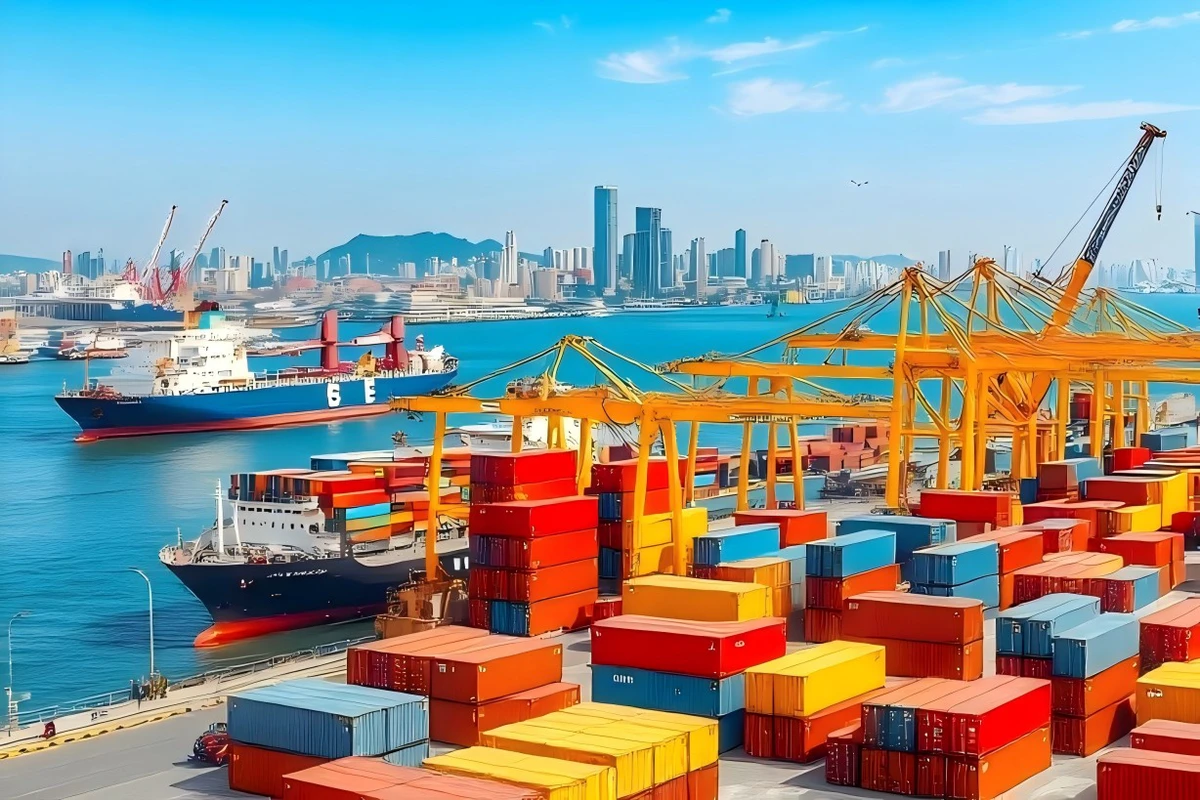
Australia has become one of Vietnam’s most dynamic export lanes. Two-way trade keeps climbing, Australian importers are actively diversifying away from single-country sourcing, and Vietnam’s manufacturers — furniture, footwear, electronics, coffee, seafood — are filling that gap. But for many buyers, the biggest question is not what to buy; it is how to get it from a factory floor in Binh Duong or Bac Ninh to a warehouse in Sydney or Melbourne without juggling five different service providers.
That is exactly what door-to-door shipping does. One forwarder, one quote, one chain of custody: pickup at the supplier’s dock in Vietnam, export customs clearance, ocean or air freight, Australian import clearance, duty and tax settlement, and final delivery to your address. This guide explains how door-to-door shipping from Vietnam to Australia actually works, what DDP and DDU pricing include, how Australian duty and GST are calculated, and — the part most guides skip — how Australia’s BMSB biosecurity rules can still affect cargo that leaves from Vietnam.
What “Door-to-Door” Covers on the Vietnam → Australia Lane
A true door-to-door service bundles every leg of the journey into a single shipment plan:
- Pickup and trucking from the factory or supplier’s warehouse anywhere in Vietnam — Ho Chi Minh City, Binh Duong, Dong Nai, Hanoi, Bac Ninh, Hai Phong, Da Nang, or beyond.
- Export customs clearance in Vietnam, including the customs declaration, commercial invoice, packing list, and any certificates the cargo needs.
- Main carriage by sea (FCL full container load or LCL less than container load) or by air.
- Australian import clearance — border filing with the Australian Border Force (ABF) and biosecurity assessment by the Department of Agriculture (DAFF).
- Duty and GST payment at the border.
- Onward delivery from the port or airport to your warehouse, distribution center, retail store, or Amazon FBA fulfillment center.
The critical variable is who pays steps 4 and 5’s taxes. That is the difference between DDP and DDU (now formally DAP under Incoterms 2020), covered in detail below.
Main Ports, Airports, and Transit Times
Vietnam’s cargo for Australia ships primarily out of Cat Lai port (Ho Chi Minh City), Haiphong port in the north, and Da Nang port in the center. On the Australian side, the four gateways are the Port of Sydney, Port of Melbourne, Port of Brisbane, and Port of Fremantle (Perth). Air cargo moves through Tan Son Nhat (SGN) and Noi Bai (HAN) airports into Sydney (SYD), Melbourne (MEL), Brisbane (BNE), and Perth (PER).
Typical transit times for a door-to-door shipment:
| Mode | Port-to-port | Door-to-door (typical) |
|---|---|---|
| Sea FCL | 15–25 days | 25–40 days |
| Sea LCL | 20–30 days | 30–45 days |
| Air freight | 1–3 days | 3–7 days |
Cat Lai to Sydney is one of the faster sailings at roughly 18–22 days port-to-port; Haiphong to Melbourne tends to run a few days longer, and LCL adds deconsolidation time at both ends. If you are comparing container options on this lane, our container shipping from Vietnam to Australia guide breaks down FCL versus LCL selection, and our Australia route page summarizes the full service portfolio for the lane.
Sea Freight vs Air Freight for Door-to-Door Cargo
Sea freight dominates this trade lane because Vietnam–Australia volumes reward scale and the transit time is short by ocean standards. Indicative market ranges (they move with capacity and fuel, so treat them as planning figures, not quotes):
- 20’GP FCL: roughly US$900–1,800 from Cat Lai to Sydney or Melbourne
- 40’GP/40’HQ FCL: roughly US$1,600–3,200 per container on the same corridor
- LCL: roughly US$25–50 per cubic meter, with minimum charges — sensible from about 2–3 CBM upward if you can fill a container sooner
- Air freight: roughly US$4–8 per kilogram, depending on weight break and airline
A 40’ high cube carrying 60+ CBM of furniture at ~US$2,000 works out to about US$33 per cubic meter — which is why Vietnamese furniture, the single biggest category on this lane, moves almost entirely by sea. Air freight makes sense for samples, apparel replenishment, electronics, and anything where a week of shelf time is worth more than the freight saving. Keep volumetric weight in mind when budgeting air cargo: chargeable weight is the greater of actual and volumetric weight, as explained in our air freight volumetric weight guide.
DDP vs DDU: Who Pays Australian Duty and GST?
This is where door-to-door quotations differ most, and where misunderstandings get expensive. Australia levies two border charges on most imports:
- Customs duty: most general goods attract 0% or 5%, set by HS code. Under the ASEAN–Australia–New Zealand Free Trade Agreement (AANZFTA), most Vietnamese-origin goods qualify for 0% duty — but only if you hold a valid Certificate of Origin proving the goods were made in Vietnam.
- GST: 10%, calculated on the Value of Taxable Importation — the customs value plus duty, international freight, and insurance. GST is recoverable as an input tax credit if you are GST-registered in Australia.
Consignments with a customs value of A$1,000 or less generally clear through a Self-Assessed Clearance (SAC) with no duty and no border GST (registered overseas vendors collect GST at the point of sale instead). Above A$1,000, a Full Import Declaration (FID) is required, duty and GST are assessed, and an import processing charge applies (about A$68 for sea entries).
Against that backdrop:
- Under DDP (Delivered Duty Paid), your Vietnamese supplier or their forwarder quotes one price that includes freight, Australian clearance, duty, GST, and delivery. You sign for the goods and pay nothing more. For buyers without an Australian import setup, DDP is often the smoothest entry.
- Under DDU — replaced by DAP (Delivered at Place) in Incoterms 2020 — the seller delivers to your door but the buyer pays Australian duty and GST at the border. You need an ABN or a customs broker arrangement, and you must budget the tax on top of the freight quote.
Our Incoterms 2020 explained guide maps every term to Vietnam-specific examples, and the DDP shipping from Vietnam guide goes deep on how DDP pricing is built and where the risks hide. One practical note: on Vietnam → Australia, the AANZFTA Certificate of Origin is so valuable for duty elimination that even on DDP shipments you should insist the paperwork chain is handled correctly — a missing or invalid CO can convert a 0% duty line into a 5% one.
BMSB: The Biosecurity Rule That Can Still Stop “Vietnam” Cargo
Australia runs the world’s strictest biosecurity regime, and the Brown Marmorated Stink Bug (BMSB) seasonal measures are the piece most relevant to importers on this lane. For the 2026–27 season (running 1 September 2026 to 30 April 2027), targeted goods manufactured in, or shipped from, BMSB target risk countries must be treated — by heat, methyl bromide, sulfuryl fluoride, or the newly approved ethyl formate — before arrival, unless an exemption applies.
Here is the nuance that trips people up: Vietnam is not a BMSB target risk country. Pure Vietnam-origin cargo shipped directly from a Vietnamese port is generally outside the mandatory BMSB treatment net — a genuine competitive advantage over routing the same goods out of China, where target-high-risk categories face mandatory treatment every BMSB season. But three situations pull Vietnam shipments back into scope:
- Goods manufactured in a target risk country. The measures key off manufacture or shipment origin. Furniture (HS chapter 94), toys and games (chapter 95), machinery, and vehicles made in China, the USA, Japan, Korea, the UK, or the EU are caught even if they are consolidated and shipped from Cat Lai or Haiphong.
- Transhipment through a target risk country. Cargo that unloads and reloads in a target risk port during the season can become subject to treatment and the 120-hour post-treatment loading window.
- Mixed containers. An LCL container mixing exempt Vietnam goods with target high risk goods is managed at the container level — meaning the whole box can be held for treatment.
Treatment must be performed by providers registered under the department’s AusTreat scheme, break bulk and open-top/flat-rack cargo generally must be treated offshore, and untreated target cargo on arrival can be directed for export at the importer’s cost. A competent forwarder will run the BMSB checklist — manufacture country, HS chapter, season dates, transhipment plan — before the booking, not after the vessel sails. Beyond BMSB, standard Australian biosecurity still applies to every shipment: clean, dry cargo free of soil and plant matter, ISPM 15 compliant wood packaging, and correct BICON classification for any food, plant, or animal products.
Step by Step: A Door-to-Door Shipment from Ho Chi Minh City to Sydney
A typical DDP door-to-door run looks like this:
- Booking and documentation — commercial invoice, packing list, HS codes confirmed, Certificate of Origin applied for under AANZFTA where the goods qualify.
- Factory pickup — container delivered to the supplier (FCL) or cargo trucked to the forwarder’s Cat Lai warehouse for consolidation (LCL).
- Vietnam export clearance — customs declaration lodged; the details matter more than most buyers expect, so our Vietnam customs clearance guide is worth a read if your supplier handles this step.
- Ocean transit — roughly 18–22 days to Sydney, with vessel tracking shared as standard.
- Australian arrival — FID lodged, biosecurity assessment, BMSB screening for the shipment’s origin profile.
- Duty and GST settlement — 0–5% duty depending on HS code and CO validity, plus 10% GST.
- Final delivery — wharf cartage and delivery to your door, typically 3–7 days after vessel arrival once the entry is clean.
What a Realistic Door-to-Door Budget Looks Like
A complete Vietnam → Australia door-to-door quote is built from:
- Origin charges: pickup, THC, documentation, export clearance
- Freight: the ocean or air leg
- Destination charges: Australian port/terminal fees, wharfage, biosecurity charges, clearance/broker fees, import processing charge
- Taxes: duty (0–5%, often 0% under AANZFTA) and 10% GST
- Delivery: cartage from port to your address
As a worked example, a 1 CBM LCL parcel of Vietnamese ceramics to a Sydney address might land around US$350–550 all-in on DDU terms, plus 5% duty if the HS line is dutiable and the 10% GST; a 20’ FCL of furniture on DDP terms commonly runs US$2,500–4,000 door-to-door depending on the pickup point and delivery address. The spread between quotes is usually destination charges and tax assumptions — not the ocean freight — so always ask for a line-item breakdown before comparing.
Choosing a Forwarder for the Vietnam → Australia Lane
The lane is short, but the compliance surface is not: AANZFTA certificates, GST treatment, biosecurity declarations, and seasonal BMSB screening all have to be right the first time. Vet forwarders on three things — whether they quote door-to-door in writing with duty and tax assumptions spelled out, whether they run an explicit BMSB origin check on every booking from September to April, and whether they have their own clearance capability in Australia rather than passing you to a subcontractor.
VNForwarder has managed door-to-door shipments from Vietnam to Sydney, Melbourne, Brisbane, and Perth since 2018, with in-house teams on both the Vietnamese export side and the Australian clearance side. Send us your cargo details and destination postcode, and we will return a line-itemized door-to-door quotation within 2–4 hours.