
Every shipment leaving Vietnam — whether a single pallet of garments by air or a full 40ft container of furniture by sea — must pass through customs clearance before it is allowed to board the vessel or aircraft. For importers buying from Vietnamese factories, this process happens largely out of sight, but it controls everything: how fast your goods actually ship, whether documents match your purchase order, and whether a surprise inspection adds a week and a few hundred dollars to your timeline.
This guide explains how Vietnam customs clearance actually works in 2026: the legal framework, the exact documents your supplier must prepare, how the electronic declaration system processes shipments, what duties apply, and the practical steps you can take to keep your cargo moving.
How Vietnam’s Customs System Is Organized
Vietnam’s customs authority is the General Department of Vietnam Customs (GDVC), which operates under the Ministry of Finance. The legal backbone is the Customs Law of 2014 (amended in 2020) together with Decree 08/2015/ND-CP and its amendments, plus Circular 38/2015/TT-BTC, which governs customs procedures in detail.
Two structural facts matter for importers:
- Export clearance is the seller’s responsibility. Under FOB, CIF, and most other common Incoterms, your Vietnamese supplier (or their agent) files the export declaration, pays any export duties, and obtains customs release at the port of loading. If you buy EXW (Ex Works), you or your forwarder inherit that burden — a common source of first-time importers getting stuck.
- Clearance is fully electronic. Since the national single window (VNSW) and the Vietnam Automated Cargo and Port Consolidated System (VASSCM) matured, virtually all declarations are filed online through the e-customs portal (ecus.vn customs software used by brokers). Paper documents still exist as backups, but the declaration, risk assessment, and release decision all happen in the digital system.
Vietnam also maintains a risk-management channel system. Declarations are routed into one of three lanes: Green (immediate release, roughly 60–70% of compliant shipments), Yellow (documentary check — the officer reviews scanned paperwork before release), or Red (physical inspection — cargo is moved to a designated area and opened). Your lane is assigned automatically based on the exporter’s compliance history, the commodity, and random selection.
The Export Customs Process Step by Step
A typical export clearance through Cat Lai (Ho Chi Minh City), Cai Mep–Thi Vai, or Hai Phong looks like this:
Step 1: Commercial Invoice and Packing List
The supplier issues a commercial invoice stating the buyer, seller, description of goods, HS codes, quantity, unit prices, total value, currency, and Incoterm. The packing list breaks the cargo down by carton or package: dimensions, gross and net weight, and package marks. These two documents drive almost everything else — the customs declaration value, the bill of lading details, and your import filing at destination. Errors here cascade.
Step 2: HS Code Classification
Every product is classified under the Harmonized System (HS). Vietnam uses 8-digit national codes built on the international 6-digit HS structure. The HS code determines whether the goods need an export license, whether export duty applies (most manufactured goods are 0%), and — critically for you — the import duty rate your country will charge, since destination customs applies its own tariff to the same classification. A wrong HS code on the Vietnamese side can trigger a mismatch at destination and a customs hold on arrival.
Step 3: Export Customs Declaration Filing
A licensed customs broker (or the exporter’s logistics staff) files the electronic customs declaration through GDVC’s system, typically 24–48 hours before cargo cutoff at the port. The declaration references the invoice, packing list, HS codes, value, and the booking with the shipping line or airline. After submission, the system assigns the green/yellow/red lane within minutes.
Step 4: Physical Delivery and Gate-In
Trucks deliver the cargo to the port container yard (for FCL) or to a container freight station (for LCL consolidation). The terminal confirms receipt and the shipment data feeds into the port system. For export declarations routed to the green lane, release is often granted electronically without anyone physically touching the boxes.
Step 5: Inspection (If Selected)
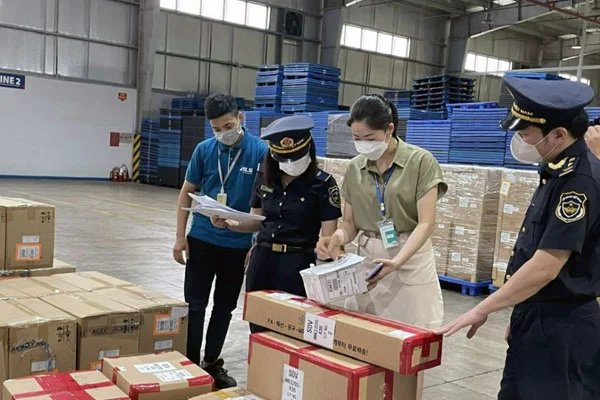
Yellow-lane declarations require the officer to review scanned documents — invoice, packing list, and sometimes a certificate of origin — before release. Red-lane shipments are physically opened and counted against the declaration. Exporters with clean track records are inspected in low single-digit percentages of shipments; new exporters, sensitive commodities (food, chemicals, used goods), or value anomalies raise the odds considerably.
Step 6: Customs Release and On-Board Confirmation
Once released, the customs system transmits the release to the terminal, and the container is cleared for loading. After the vessel or flight departs, customs issues confirmation, and the shipping line or airline transmits the manifest. Only then can the supplier receive the original bill of lading (or telex release / sea waybill), which is the document you need to take possession at destination.
In normal conditions, the whole clearance cycle — from declaration filing to release — takes 1–3 working days for green-lane cargo. Yellow lane adds 1–2 days; red lane can add 3–7 days depending on inspection queue.
Export Documents Checklist: What Your Supplier Must Prepare
The table below lists the core documents for a standard export shipment from Vietnam. Requirements vary slightly by commodity and destination, but this covers 95% of manufactured-goods exports:
| Document | Purpose | Prepared By |
|---|---|---|
| Commercial Invoice | Declared value, terms of sale, customs valuation basis | Exporter |
| Packing List | Package-level weight, dimensions, marks & numbers | Exporter |
| Customs Declaration (HQ/2015 form) | The official e-declaration filed with GDVC | Exporter / Broker |
| Bill of Lading (B/L) or Air Waybill (AWB) | Contract of carriage & title document | Shipping line / Airline |
| Certificate of Origin (C/O) | Proves origin for tariff preferences | Exporter (VCCI or local DOIT) |
| Export License | Required for controlled/sensitive goods | Exporter (from MOIT etc.) |
| Phytosanitary Certificate | Wood packaging, plants, food products | Exporter (plant quarantine agency) |
| Fumigation Certificate | Wooden pallets/packaging (ISPM 15) | Approved fumigation provider |
| VGM (Verified Gross Mass) | Container weight verification (SOLAS) | Exporter / Terminal |
The Certificate of Origin deserves special attention. Vietnam holds free trade agreements with the EU (EVFTA), UK (UKVFTA), Japan, South Korea, Australia, and the CPTPP bloc, among others. With a valid preferential C/O — Form EUR.1 for the EU, for example — your goods can enter those markets at reduced or zero import duty. The C/O must be applied for before or at shipment and declared on the export side; it cannot be created retroactively. If you are importing under an FTA, tell your supplier before production is even finished, because origin rules sometimes require specific sourcing of materials to qualify.
Export Duties: What Leaves Vietnam Costs What
Here is the good news for buyers of Vietnamese manufactured goods: most exports from Vietnam are duty-free. The export duty rate is 0% for the overwhelming majority of finished industrial products — furniture, garments, footwear, electronics, machinery, plastics.
Export duty still applies to a narrow list of natural-resource-based goods, set by the government from time to time: certain minerals, scrap metal, rare earths, and raw agricultural products in some cases. Rates on those items range from roughly 5% to 45%, depending on the commodity and policy period. If you are sourcing anything raw or mineral-based from Vietnam, confirm the export duty treatment in the quotation phase, because suppliers sometimes quote prices that exclude it.
Even at 0% duty, exporters still pay clearance-related costs: the broker’s filing fee (typically $20–$60 per declaration), port documentation fees, and any inspection charges if selected. These are small numbers, but they explain why a supplier’s “FOB price” and the final invoice total can differ slightly.
The Importer’s Side: Why Vietnam Clearance Affects Your Destination Clearance
Customs is not a one-country story. Data filed at export reappears at import. Three mismatches between the Vietnamese export declaration and your import filing cause a disproportionate share of destination customs holds:
- Description and HS code drift. The Vietnamese side uses one description; your broker at destination files another, finer or coarser. Customs algorithms flag the inconsistency.
- Value discrepancies. Under-declaration at origin to reduce duty is a known (and risky) practice. With the spread of the WTO’s Customs Valuation Agreement enforcement and data-sharing between authorities, importers increasingly face post-entry audits when the declared value looks off-market.
- Quantity and weight mismatches. Carton counts or weights that disagree between the packing list, the B/L, and the manifest trigger holds even when everything is legitimate — a frequent paperwork error, not fraud.
The fix is boring but effective: ask your supplier for the final commercial invoice, packing list, and a copy of the export declaration before the vessel arrives, and give them to your destination broker so both sides tell the same story.
Common Clearance Delays and How to Avoid Them
Even with a compliant shipment, delays happen. The most frequent causes we see from the Vietnam side, and their practical remedies:
- New exporter, no compliance history. First-time exporters face higher inspection odds and slower officer reviews. If your supplier has never exported, build 3–5 extra days into the schedule and consider having an experienced broker handle the filing rather than the factory’s in-house staff.
- Sensitive or regulated commodities. Food, cosmetics, chemicals, batteries, wooden goods, and anything with radio transmission (Bluetooth/Wi-Fi devices) may need extra certificates or export licenses. Confirm the regulatory category of your product early — a missing license found at declaration time means the cargo simply cannot ship until it is issued.
- Wooden packaging without ISPM 15 treatment. Pallets or crates that are not heat-treated and stamped can be refused at destination, or even at export for certain markets. Specify ISPM 15-compliant pallets in your purchase order.
- Peak-season congestion. Pre-Lunar New Year (January–February) and the September–October pre-holiday rush slow both terminals and customs. Book space earlier and file declarations as soon as cargo is ready.
- Dual-invoice games. If a supplier offers to show a lower value on export documents “to save you duty,” decline. Destination customs increasingly cross-references against export data and marketplace prices; penalties and seizure cost far more than the duty saved.
How a Local Freight Forwarder Changes the Equation
Customs clearance in Vietnam is procedurally straightforward for experienced exporters and genuinely painful for everyone else. A forwarder with a licensed in-house brokerage team — rather than one that subcontracts every declaration — controls the variables that matter: correct HS classification, clean documentation, fast response when a yellow or red lane appears, and pre-alert to your destination broker so both ends of the shipment are aligned.
That is the operating model behind VNForwarder: local teams in Ho Chi Minh City and the northern industrial belt who file declarations daily, 24⁄7 support when a shipment is sitting in a red-lane queue at 11 PM, and a dedicated account manager who knows your product’s regulatory category from the first shipment onward. If you are setting up or scaling a supply chain out of Vietnam, get a quote from VNForwarder and you will have a clear answer on routing, documents, and landed timing within hours — not days of email tag with a factory’s part-time logistics clerk.
Frequently Asked Questions
How long does customs clearance take in Vietnam?
For compliant, green-lane exports, release typically comes within 1–3 working days of declaration filing. Documentary (yellow lane) checks add 1–2 days; physical (red lane) inspections add 3–7 days depending on queue and commodity.
Who is responsible for export customs clearance from Vietnam?
Under FOB, CIF, CFR, and most other Incoterms besides EXW, the Vietnamese seller is responsible. Under EXW, the buyer (you) must arrange or hire export clearance — one reason EXW quotes from small factories often produce headaches. Our Incoterms 2020 explained guide walks through each term’s division of responsibility.
Do I pay duties when goods leave Vietnam?
Almost certainly not on the export side — most manufactured goods carry 0% export duty. Your import duties are paid in your own country, based on your HS classification and the applicable tariff or FTA rate. If your forwarder arranges DDP, those destination duties are prepaid on your behalf and included in one landed quote; see our DDP shipping from Vietnam guide for how that works end to end.
What is a Certificate of Origin and do I need one?
A C/O proves where the goods were manufactured. You need a preferential one (EUR.1, Form AJ for Japan, etc.) if you want reduced import duty under an FTA between Vietnam and your market. Request it from your supplier before shipment, as it is validated against the export declaration.
Can customs inspect my cargo even if everything is correct?
Yes. Vietnam’s system applies a statistical risk model, and a percentage of fully compliant shipments are selected for physical inspection at random. With accurate documents and proper packaging, a red-lane inspection adds days, not problems.
What happens if documents have errors?
Minor errors (typos in marks, weight rounding) can often be corrected by an amended declaration before release. Material misdeclaration — wrong HS code affecting licensing, or under-declared value — can trigger fines, seizure, and a permanently damaged compliance record for the exporter. Accuracy beats cleverness, every time.
The Bottom Line
Vietnam’s customs clearance system is modern, electronic, and — for documented, well-classified cargo — fast. The delays that plague importers rarely come from the customs authority itself; they come from missing certificates, inconsistent paperwork between origin and destination, and suppliers who have never exported. Treat documentation as part of your product specification, request the export declaration copies proactively, and work with a forwarder whose brokerage team files in Vietnam every day. Get those three things right, and customs becomes the quiet, boring part of your supply chain that it should be.