

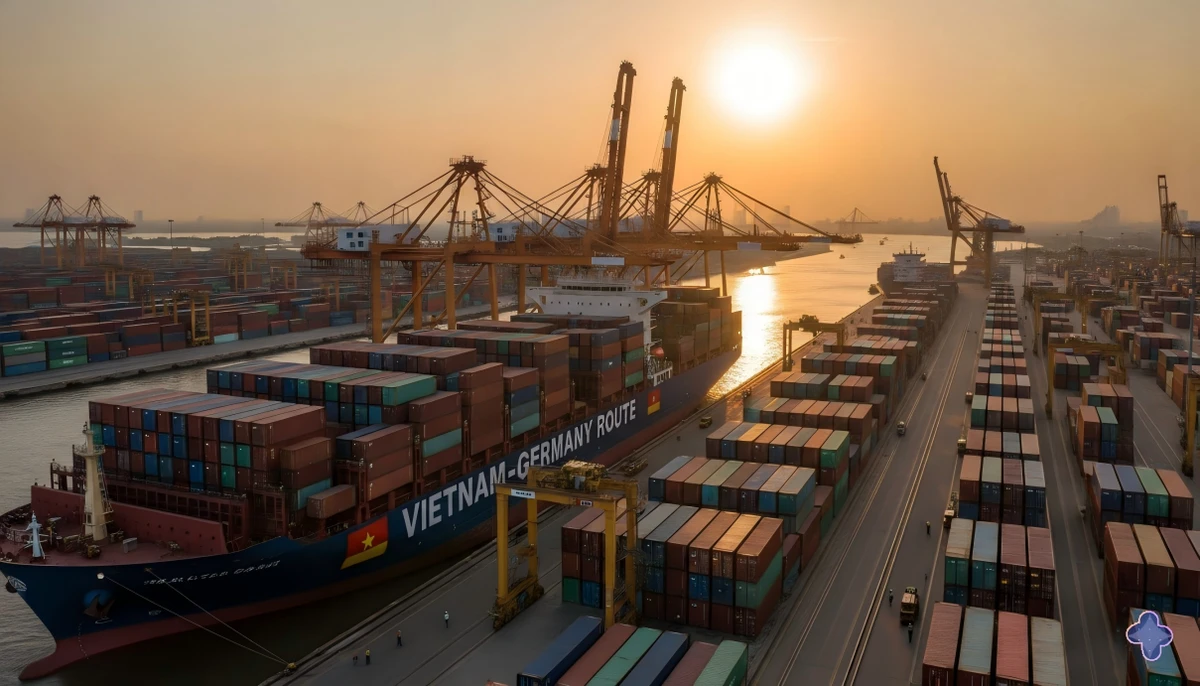
Vietnam exported over $7.5 billion worth of goods to Germany in 2025 — and with the EVFTA slashing tariffs to 0% on most industrial products, that number is climbing fast. Understanding container shipping from Vietnam to Germany is the difference between a cost-efficient supply chain and a logistics operation that quietly erodes your margins. Getting a container from a Vietnamese factory to a German warehouse is not just about booking a vessel — it is about navigating two customs regimes, choosing the right shipping mode, and avoiding hidden destination charges that can eat 15–25% of your landed cost.
By the end of this guide, you will know which shipping option fits your cargo — FCL, LCL, or DDP — the step-by-step process from factory to delivery, realistic cost breakdowns, and how to leverage Vietnam’s EVFTA tariff advantage. This guide from VNForwarder — a Vietnam-headquartered freight forwarder operating since 2018 — delivers real-world knowledge from active Vietnam–Germany trade lane management.
Why Ship Container Freight from Vietnam to Germany?
The EU-Vietnam Free Trade Agreement (EVFTA) , in force since August 2020, is the single most powerful reason. The EU has eliminated 99% of customs duties on Vietnamese goods — as of 2026, virtually all industrial products enter Germany at 0% tariff. A furniture importer paying 0% under EVFTA versus 2.7% from China saves approximately $1,350 in duties on a $50,000 shipment. To claim this, you need a valid EUR.1 Movement Certificate certified by the Vietnam Chamber of Commerce and Industry (VCCI) — we cover the full process in Section 5.
Vietnam’s manufacturing strengths span industries where it holds genuine global advantage — textiles and garments (2nd largest exporter worldwide), footwear (2nd largest exporter), electronics (Samsung & Apple supply chain hub), furniture (top 5 global exporter), and coffee (2nd largest exporter). Manufacturing clusters in two corridors: the Southern hub (Ho Chi Minh City, Binh Duong, Dong Nai) for furniture, footwear, and agriculture, and the Northern hub (Hanoi, Bac Ninh, Hai Phong) for electronics, textiles, and machinery.
Germany is Europe’s logistics gateway. The three major ports — Hamburg (largest, best for Northern/Eastern Germany), Bremerhaven (automotive hub, strong rail links south), and Wilhelmshaven (deep-water, ideal for the Ruhr region) — offer strategic entry-point flexibility.
For importers distributing across multiple European markets, VNForwarder also provides dedicated shipping from Vietnam to UK services — ideal for businesses serving both German and British markets from a single Vietnam supply base.
Container Shipping Options: FCL, LCL & Door-to-Door DDP
FCL (Full Container Load)
FCL means you book an entire container exclusively for your cargo, sealed at origin and remaining sealed until destination.
| Container Type | Capacity | Best For |
|---|---|---|
| 20ft GP | ~33 CBM / 28 tons | Heavy/dense cargo; smaller volumes above LCL threshold |
| 40ft GP | ~67 CBM | Standard choice for furniture, textiles, electronics |
| 40ft High Cube | ~76 CBM | Voluminous but lighter cargo — garments, assembled furniture |
| Reefer (20RF/40RF) | ~28 / ~58 CBM | Temperature-controlled: coffee, seafood, tropical fruits |
Choose FCL when: cargo exceeds ~15 CBM (per-unit cost drops below LCL), goods are fragile or high-value, you ship regularly, or timelines are tight. FCL offers faster transit (~30–38 days Cai Mep to Hamburg), minimal handling, and predictable timing.
LCL (Less than Container Load)
LCL means your cargo shares a container with other shipments — consolidated at a Vietnam CFS, shipped in a shared container, and deconsolidated at a German CFS. Pricing follows the W/M rule — charged per CBM or per ton (1,000 kg) , whichever is greater, with a 1 CBM minimum.
Choose LCL when: cargo is below ~15 CBM, testing a new supplier, or running trial orders. LCL offers lower entry cost but slower transit — HCMC LCL to Hamburg can take 60–68 days versus 38–46 days FCL. However, Hai Phong LCL to Hamburg is only 28–35 days (routing via Singapore with a direct Rotterdam connection), sometimes faster than HCMC FCL.
Door-to-Door DDP (Delivered Duty Paid)
Under Incoterms 2020 DDP, your forwarder handles everything: factory pickup → Vietnam export clearance → ocean freight → German import clearance → duty/VAT payment → last-mile delivery.
| Incoterm | Who Handles German Customs? | Best For |
|---|---|---|
| FOB | Importer | Experienced importers with own customs broker |
| CIF | Importer | Importers who bundle freight but handle own clearance |
| DDP | Freight forwarder | First-time importers, SMEs, Amazon FBA sellers |
| DDU | Importer | Similar to DDP but importer pays duties/VAT |
Beyond standard containers, VNForwarder handles oversized/project cargo (flat-rack, breakbulk), Amazon FBA forwarding to German centers (DTM2, FRA3 — including FNSKU labeling and quality inspection), and reefer containers.
The Six-Step Shipping Process
Step 1: Factory Pickup & Cargo Preparation
Cargo is collected from the factory — Binh Duong for furniture, Bac Ninh for electronics — and trucked to the departure port or CFS. Essential prep: humidity-resistant packaging for the 4–5 week ocean journey, double-wall cartons with corner posts for fragile goods, standardized palletization, and SOLAS VGM (Verified Gross Mass) certification.
Step 2: Vietnam Export Customs Clearance
| Required Document | Purpose |
|---|---|
| Commercial Invoice | Cargo description, value, buyer/seller, Incoterm |
| Packing List | Itemized contents — quantity, weight, dimensions |
| Bill of Lading (B/L) | Contract of carriage between shipper and carrier |
| Certificate of Origin (EUR.1) | Required for EVFTA 0% tariff in Germany |
| Vietnam Customs Declaration | Electronic filing via VNACCS/VCIS system |
| Fumigation Certificate | Required for wooden packaging (ISPM 15) |
Most shipments clear within 1–2 days through the electronic VNACCS/VCIS system. Physical inspections can add 2–5 days. Common pitfalls: incorrect HS code classification, missing fumigation certificates, and not planning 4–6 weeks ahead for Tet Holiday (January/February).
Step 3: Port Departure
Vietnam’s ports: Cat Lai (HCMC, busiest for all cargo), Cai Mep International (Ba Ria-Vung Tau, deep-water with direct Europe mother vessels — fastest to Germany), Hai Phong (serves Northern electronics/textiles), and Da Nang (Central Vietnam, feeder connections). Cut-off times are typically 24–48 hours before sailing — missing them delays your shipment by a week.
Step 4: Ocean Transit
Standard routing: South China Sea → Malacca Strait → Indian Ocean → Suez Canal → Mediterranean → Hamburg/Bremerhaven. Most services transship at Singapore, Port Kelang, or Rotterdam. Direct-call services from Cai Mep (CMA CGM YANGTSE, ONE FE5) are faster but less frequent. Key risks: Suez disruptions adding 10–14 days and $1,000–$2,000/container via Cape of Good Hope, peak season port congestion, and South China Sea typhoons (June–November).
Step 5: German Import Customs Clearance
German customs operates through the ATLAS electronic system:
- EORI Number: Every EU importer needs this unique identifier (1–2 weeks via German Customs Portal). Under DDP, VNForwarder clears under our registration.
- Import VAT (Einfuhrumsatzsteuer): 19% standard (7% reduced for books, food) on CIF value + duty. Recoverable for VAT-registered businesses.
- Duty Calculation: Customs Value (CIF) × Duty Rate = Customs Duty; (CIF + Duty) × VAT Rate = Import VAT. A $10,000 CIF furniture shipment under EVFTA pays $0 duty + $1,900 VAT.
- ICS2: EU advance cargo information system — forwarder’s responsibility, but missing filings block clearance.
- Customs Broker: Under FOB/CIF without a German entity, a licensed broker costs €150–€350 per declaration. Included under DDP.
Step 6: Port Arrival & Last-Mile Delivery
Avoid costly demurrage (container at terminal beyond 3–7 free days: $50–$150/day) and detention (container beyond return window: $50–$150/day). Have clearance documents ready before vessel arrival.
For FCL, rail is 30–50% cheaper for long German distances (Hamburg to Munich: ~€500–800/container by rail vs. ~€1,200–1,800 by truck). LCL adds 2–5 days for deconsolidation at the destination CFS.
Insider Tips: 7 Years on the Vietnam–Germany Lane
1. The Hai Phong LCL advantage. Hai Phong LCL to Hamburg at 28–35 days is routing discipline — the best consolidators book direct mother vessel slots to Rotterdam, then use bonded trucking to Hamburg. If your suppliers are in Hanoi or Bac Ninh, insist on Northern consolidation even if your forwarder defaults to Saigon.
2. The Tet buffer is not optional. The 2–3 weeks before Tet see container availability drop 40–60% and trucking rates spike 25–35%. Book containers 6 weeks ahead for Tet-adjacent sailings.
3. German rail booking timing matters. Hamburg to Munich by rail is ~€500–800 per container — but only if booked 7–10 days before vessel arrival. Wait until the container sits on the terminal, and trucks become your only option at €1,200–1,800.
4. EUR.1 rejections: the #1 preventable delay. German customs rejects ~15–20% of EUR.1 certificates on first submission. Causes: HS code mismatch between EUR.1 and ATLAS declaration, blurred VCCI stamps, and exporter address inconsistencies. Triple-check these three fields before departure — it takes 10 minutes and prevents 5–10 day clearance delays.
Vietnam–Germany Routes, Ports & Transit Times
| Route | FCL Transit | LCL Transit | Frequency |
|---|---|---|---|
| Ho Chi Minh (Cat Lai) → Hamburg | 38–46 days | 60–68 days | Weekly |
| Ho Chi Minh (Cai Mep) → Hamburg | 30–38 days | n/a (mostly FCL) | Weekly |
| Cat Lai → Bremerhaven | 35–42 days | 55–65 days | Every 1–2 weeks |
| Hai Phong → Hamburg | 30–38 days | 28–35 days | Weekly |
| Hai Phong → Bremerhaven | 32–40 days | 32–40 days | Every 1–2 weeks |
| Da Nang → Hamburg | 40–50 days | 65–75 days | Bi-weekly |
Hai Phong LCL reaches Hamburg in 28–35 days — often faster than Cat Lai FCL — due to direct Rotterdam transshipment that avoids the consolidation stops slowing HCMC LCL to 60+ days.
Seasonal Planning
- Tet Holiday (Jan/Feb): Factories close 1–2 weeks; plan 4–6 weeks ahead.
- Peak Season (Aug–Oct): Christmas rush drives rates 20–50% higher. Book 4–6 weeks ahead.
- Off-Peak (Mar–May, Nov–Dec): Rates 15–30% lower — best time to negotiate.
- Suez/Red Sea Risk: Disruptions add 10–14 days and $1,000–$2,000/container.
Container Shipping Costs: Transparent Pricing
The All-In Cost Framework
A freight quote showing only the base ocean rate is incomplete. Here is the full cost stack:
| Cost Component | Typical Range |
|---|---|
| Ocean Freight (Base Rate) | Highly variable |
| BAF (Fuel Surcharge) | 15–35% of base rate |
| CAF (Currency Surcharge) | 2–7% of base rate |
| THC — Origin & Destination | $100–$250 (Vietnam) + €150–€300 (Germany) |
| Documentation Fees | $50–$150 per shipment |
| Customs Brokerage | $80–$200 (Vietnam) + €150–€350 (Germany) |
| Inland Transport | $200–$600 (Vietnam) + €300–€1,800 (Germany) |
| Cargo Insurance | 0.2–0.5% of CIF value (~$150 on $50,000) |
| Customs Duty | 0% (EVFTA) to 17% (MFN) |
| Import VAT | 19% (or 7% reduced) on CIF + duty |
Indicative Rate Ranges & Landed Cost Scenarios (2026)
| Service | Cost Range (USD) | |
|---|---|---|
| FCL 20GP HCMC → Hamburg | $2,000–$3,800 | |
| FCL 40GP | $3,000–$5,500 | Standard for furniture, textiles, electronics |
| FCL 40HQ | $3,200–$5,800 | Extra 9 CBM for voluminous cargo |
| LCL (per CBM) | $80–$180 | Min 1 CBM; HCMC at upper end |
| DDP Add-On | 25–40% above freight | Includes customs, duties, VAT, brokerage, delivery |
| Scenario | Cargo | Mode | Total All-In |
|---|---|---|---|
| Small Importer | 8 CBM furniture, Binh Duong → Munich | LCL CIF | ~$2,100 |
| Mid-Size | 1×40HQ textiles, Hanoi → Hamburg | FCL CIF | ~$6,800 |
| Amazon FBA | 3 CBM electronics, HCMC → FRA3 | DDP | ~$1,500 all-inclusive |
| Large Volume | 2×40HQ furniture/month, contract | FCL DDP | ~$5,200/container |
Cost Optimization Tips
- Volume discounts: 5+ containers/month reduce per-unit rates 10–18%.
- Off-peak shipping: March–May and November–December offer rates 15–30% below peak.
- Consolidation threshold: Above ~15 CBM, FCL cuts per-CBM cost versus LCL.
- Carrier negotiation: Direct forwarder contracts typically beat online spot rates by 8–15%.
To get an accurate quote, provide: commodity & HS code, weight & volume, Incoterm, pickup and delivery addresses. At VNForwarder, quotes arrive in 2–4 hours with transparent, line-item breakdowns.
For cost comparisons on other major lanes, see our guides on shipping cost from Vietnam to USA and shipping cost from Vietnam to Canada.
Disclaimer: Freight rates and regulatory requirements change frequently. Cost ranges are accurate as of June 2026 for planning purposes. Always confirm current rates with your forwarder before booking.
EVFTA Tariffs & German Import Compliance
Claiming 0% EVFTA Tariffs
- Determine origin: Goods must be wholly obtained in Vietnam or substantially transformed (mere transshipment does not qualify).
- Check product-specific rules: Each HS chapter has specific origin rules in the EVFTA Protocol.
- Obtain EUR.1 Certificate: Applied through VCCI with exporter/importer details, HS codes, origin criteria, and VCCI certification stamp.
- REX registration: Required for shipments over €6,000. Below €6,000, the exporter self-declares origin on the invoice.
- Submit with import declaration: The German broker files the EUR.1 alongside the ATLAS declaration. Without a valid EUR.1, MFN rates apply.
- Direct transport rule: Goods must travel from Vietnam to the EU without alteration in third countries.
EVFTA Tariff Savings by Commodity
| Product | HS Chapter | EVFTA Rate | MFN Rate | Advantage |
|---|---|---|---|---|
| Footwear | 64 | 0% | 8–17% | 8–17% |
| Textiles & Garments | 61–62 | 0% | 12% | ~12% |
| Furniture | 94 | 0% | 0–5.6% | 0–5.6% |
| Electronics | 85 | 0% | 0–14% | Varies |
| Coffee | 09 | 0% | 0–7.5% | 0–7.5% |
| Machinery Parts | 84 | 0% | 0–4.5% | 0–4.5% |
Common mistakes: wrong HS code on EUR.1 (must match import declaration digit-for-digit), assuming all goods qualify (high third-country content may fail), and not meeting the direct transport rule.
German Product Compliance
| Regulation | Applies To | Key Requirement |
|---|---|---|
| CE Marking | Electronics, machinery, toys, PPE | Conformity assessment, technical documentation |
| REACH | All goods with chemicals | SVHC restrictions; substance registration |
| VerpackG (Packaging Act) | All packaged goods | Mandatory registration; packaging waste licensing |
| Produkthaftung | All products | Importers bear strict liability |
Non-compliance means blocked, fined, or destroyed goods. A knowledgeable forwarder advises which regulations apply to your product category.
Official sources: EVFTA Protocol on Rules of Origin — EU Trade Directorate. EUR.1 applications — VCCI. German EORI — Zoll Portal.
How to Choose the Right Freight Forwarder
Your forwarder is your operational partner in two countries. A great one saves money through carrier relationships; a bad one leaves you with surprise charges and cargo accumulating port fees.
What to look for: Vietnam-local expertise (port congestion patterns, Tet container cycles, carrier connections), German-side capabilities (EORI support, licensed customs brokerage, local trucking/rail partners), 24⁄7 English-language support with a named account manager, and strong carrier contracts for competitive rates and priority space.
Key questions before booking:
- “Do you have a physical office in Vietnam?”
- “Can you provide a line-item cost breakdown — not a lump sum?”
- “What is your average quote turnaround time?”
- “Do you handle both Vietnam export and German import customs in-house?”
- “How do you manage delays or emergencies?”
- “Do you offer DDP to Germany with truly all-inclusive pricing?”
Red flags: suspiciously low rates, vague about destination charges, no physical Vietnam presence, slow communication during sales, pushing FCL when LCL makes more sense (or vice versa), no knowledge of EVFTA or German customs, no cargo insurance options.
Why importers choose VNForwarder: Vietnam-headquartered since 2018 with offices in Ho Chi Minh City and Hai Phong. Dedicated Vietnam–Germany trade lane with weekly consolidation services and direct carrier contracts. Transparent line-item quotes in 2–4 hours. Full-service: FCL, LCL, DDP, Amazon FBA to German fulfillment centers, oversized cargo. 24⁄7 support with a named account manager. Our global network covers key lanes including sea freight from Vietnam to Australia, container from Vietnam to Canada, and shipping from Vietnam to USA.
Frequently Asked Questions
How long does container shipping take? FCL: 30–46 days (Cai Mep to Hamburg fastest at 30–38 days). LCL: Hai Phong to Hamburg 28–35 days; HCMC LCL 60–68 days.
How much does it cost? FCL: $2,000–$3,800 (20GP), $3,000–$5,500 (40GP). LCL: $80–$180/CBM. Total landed cost typically 30–60% higher than freight alone.
What is the cheapest option? Under ~15 CBM: LCL. Above 15 CBM: FCL 40ft. Off-peak (Mar–May, Nov–Dec) saves 15–30%. DDP can be cheapest in practice by eliminating surprise destination charges.
What documents are needed? Vietnam: Commercial Invoice, Packing List, B/L, EUR.1, Customs Declaration, fumigation certificate (wood packaging). Germany: EORI, ATLAS declaration, EUR.1, product compliance documents (CE, REACH, VerpackG as applicable).
Is there duty under EVFTA? 0% customs duty on most Vietnamese industrial goods with valid EUR.1. Import VAT (19% standard, 7% reduced) still applies and is recoverable for VAT-registered businesses.
Which German port is best? Hamburg (Northern/Eastern Germany), Bremerhaven (automotive hub, rail south), Wilhelmshaven (Ruhr region).
Can I ship door-to-door without handling customs? Yes — VNForwarder’s DDP handles everything from Vietnam factory to your German door, including customs, duties, and VAT.
Should I choose FCL or LCL? Above ~15 CBM: FCL cheaper per CBM and 15–30 days faster. Below: LCL makes better economic sense.
Why choose a Vietnam-based forwarder? Deeper local carrier/port relationships, same-timezone supplier communication, and understanding of Vietnam-specific challenges (Tet planning, congestion cycles) that global forwarders often miss.
Start Your Vietnam-to-Germany Shipment Today
Container shipping from Vietnam to Germany is a strategic decision that directly impacts landed cost, inventory availability, and competitive position. With EVFTA eliminating tariffs on Vietnamese manufactured goods, importers enjoy a structural 15–20% landed cost advantage over equivalent Chinese imports — but only with the right shipping strategy: FCL vs. LCL, port pair selection, Incoterm, forwarder partnership, and proactive compliance.
The German market rewards preparation. Understanding the process, knowing which documents to have ready, planning around Tet and peak season, and partnering with a forwarder that has boots on the ground in both countries — these separate smooth imports from expensive disruptions.
Ready to move your cargo? As a Vietnam-headquartered freight forwarder with dedicated Vietnam–Germany trade lane expertise since 2018, VNForwarder delivers transparent pricing, 2–4 hour quotes, and end-to-end support from factory to warehouse. Whether you need FCL, LCL, DDP door-to-door, or Amazon FBA forwarding to German fulfillment centers, we build a shipping plan tailored to your cargo, budget, and timeline.