

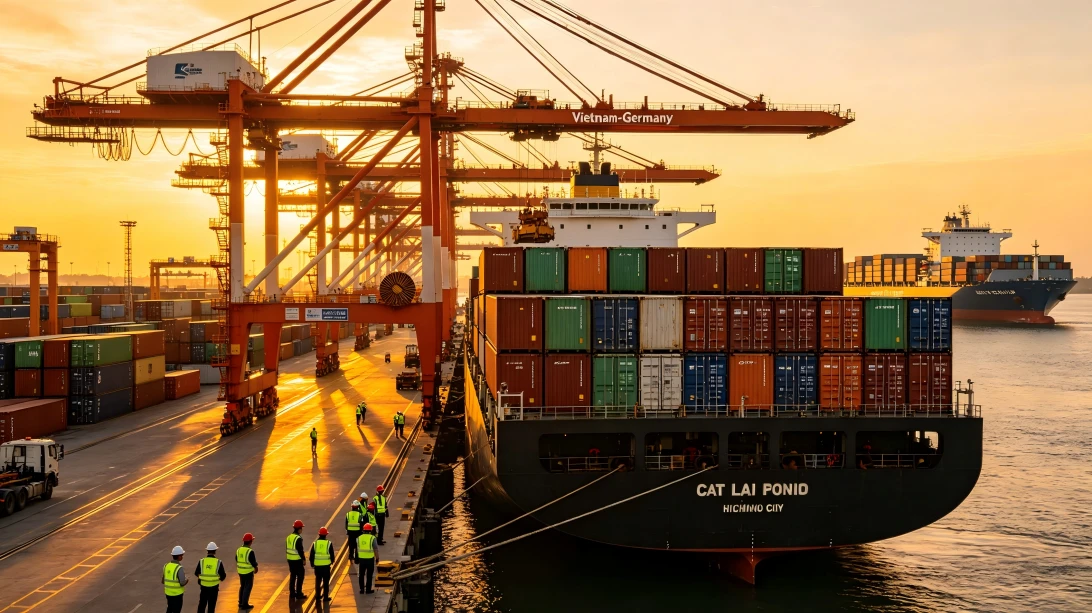
Shipping cost from Vietnam to Malaysia is the first question every buyer asks when sourcing from Ho Chi Minh City, Hai Phong, or Da Nang. Despite bilateral trade crossing USD 16 billion annually, finding transparent, English-language guidance on real rates and total landed cost remains surprisingly difficult. Most resources are either generic freight calculators or overly technical platforms that never explain the “why” behind the numbers. At VNForwarder, Shipping from Vietnam to Malaysia has been a core service since 2018. Drawn from our actual operational experience moving FCL (Full Container Load), LCL (Less than Container Load), and Air Freight every week, this guide breaks down everything you need to know. Whether you need port-to-port delivery or a true Door-to-Door Service (DDP) solution, you will learn exactly which mode to choose, what the real costs are, and how to leverage ASEAN trade agreements to cut your landed cost.
What Affects Shipping Cost from Vietnam to Malaysia
Before you can compare quotes accurately, you need to understand the variables that drive shipping cost from Vietnam to Malaysia up or down. Two shipments of identical products can produce wildly different invoices depending on how these factors interact.
Cargo Weight and Volume
For sea freight, LCL rates are calculated per CBM (cubic meter) or per metric ton, whichever is greater. For air freight, carriers use chargeable weight — the higher of actual weight or volumetric weight (Length × Width × Height in cm ÷ 6000). A carton of lightweight foam packaging may weigh only 8 kg but occupy enough space to be charged at 15 kg. Understanding this distinction prevents budget surprises.
Cargo Type
General cargo moves at standard rates. Hazardous goods, temperature-controlled cargo, electronics with lithium batteries, and food or cosmetics all carry handling surcharges, additional documentation requirements, and sometimes mandatory inspections that add both cost and time.
Origin and Destination Pairing
Shipping from a factory in Binh Duong to Port Klang is straightforward. Shipping from a supplier near Hanoi to Penang involves different inland trucking, port fees, and sailing schedules. The origin-destination pair is one of the most underappreciated cost drivers on this lane.
Shipping Mode
Sea freight (FCL/LCL), air freight, and cross-border trucking each have fundamentally different cost structures. Sea is cheapest per kilogram but slowest. Air is fastest but most expensive. Trucking sits in the middle for certain cargo types and routes.
Incoterms 2020
Whether you negotiate EXW, FOB, CIF, DDU, or DDP with your Vietnam supplier determines who pays for trucking, export customs, ocean freight, import customs, duties, and GST. The Incoterm you choose can shift thousands of dollars between parties.
Seasonality and Surcharges
Vietnam’s Tet Holiday (January-February) creates peak-season congestion, container shortages, and rate spikes of 10-30%. Fuel surcharges (BAF), peak season surcharges (PSS), and demurrage/detention fees at Malaysian ports can all inflate the final bill if not budgeted upfront.
Customs and Duties
Malaysia applies import duty and GST on most imports. However, because both countries are ASEAN members, ATIGA and RCEP can reduce or eliminate duties entirely — provided you have the correct documentation. Missing a Certificate of Origin (CO) Form D can cost you 5-20% in unnecessary tariffs.
| Cost Factor | Impact on Final Price | What to Watch |
|---|---|---|
| Weight/Volume | Direct — higher = more expensive | Chargeable weight rules differ by mode |
| Cargo Type | Moderate — specialized cargo adds 10-50% | Hazardous, refrigerated, food-grade |
| Origin-Destination | Moderate — inland trucking varies | Factory location vs. port proximity |
| Shipping Mode | High — sea vs. air can differ 5-10x | Urgency vs. budget trade-off |
| Incoterms | High — DDP vs. EXW shifts liability | Who pays for customs and duties |
| Seasonality | Moderate — Tet can spike rates 10-30% | Book 2-3 weeks ahead of peak |
| Trade Agreements | High — ATIGA can eliminate duties | CO Form D must be accurate and complete |
Sea Freight from Vietnam to Malaysia: FCL vs. LCL Rates and Transit Times
Sea freight is the dominant mode for Vietnam-Malaysia trade, handling roughly 85% of total cargo volume by weight. The geographic proximity — just 5-8 days port-to-port on most direct sailings — makes ocean freight exceptionally competitive on this lane compared to longer routes like Shipping from Vietnam to USA or Shipping from Vietnam to UK.
When to Choose Sea Freight
Sea freight is the default choice for shipments over 100 kg or 0.5 CBM that are not time-sensitive. If your cargo is heavy, bulky, or non-urgent, ocean freight will almost always be the most economical option.
FCL (Full Container Load)
When you book FCL shipping from Vietnam to Malaysia, you reserve an entire container exclusively for your cargo. The standard sizes are:
- 20’ GP (General Purpose): ~28 CBM capacity, ~22 metric tons payload
- 40’ GP: ~58 CBM capacity, ~26 metric tons payload
- 40’ HQ (High Cube): ~68 CBM capacity, same payload as 40’ GP — ideal for light, bulky cargo like furniture and textiles
FCL pricing is a flat rate per container. Whether you fill it to 60% or 95%, the ocean freight charge remains the same. This creates a clear economies-of-scale advantage once your cargo exceeds approximately 5 CBM or 3-5 metric tons, where the per-unit cost of FCL drops below LCL.
Estimated FCL rates (Q2 2026, port-to-port):
| Route | 20’ Container | 40’ Container | 40’ HC Container |
|---|---|---|---|
| Hai Phong → Port Klang | $503 – $524 | $780 – $950 | $850 – $1,050 |
| Cat Lai (HCM) → Port Klang | $450 – $550 | $720 – $880 | $800 – $980 |
| Cat Lai → Penang | $480 – $580 | $750 – $920 | $830 – $1,020 |
| Cat Lai → Johor | $420 – $520 | $680 – $850 | $760 – $940 |
Rates are market references for base ocean freight only. All-in DDP quotes include origin, freight, and destination charges.
The Hai Phong → Port Klang rate of ~$503 for a 20’ container reflects live market data from Cogoport (June 2026). At VNForwarder, we monitor these rates weekly and lock in contracted allocations with carriers to protect our clients from spot-market volatility. In our experience, clients who book FCL 2-3 weeks ahead of Tet Holiday (late January to early February) typically save 15-25% compared to those who wait until the last minute, when carrier space tightens and rates spike.
LCL (Less than Container Load)
LCL shipping from Vietnam to Malaysia is the right choice when your shipment is under ~5 CBM, when you are shipping samples or trial orders, or when you source from multiple Vietnamese suppliers and want to consolidate their cargo into a single Malaysia delivery.
Your cargo is delivered to a Container Freight Station (CFS) in Vietnam, palletized, and loaded into a shared container. Upon arrival at Port Klang, Penang, or Johor, it is deconsolidated and made available for pickup or final delivery.
Estimated LCL rates (Q2 2026):
| Route | Rate per CBM | Minimum Charge |
|---|---|---|
| Hai Phong → Port Klang | $35 – $55 | 1 CBM or 1,000 kg |
| Cat Lai → Port Klang | $30 – $50 | 1 CBM or 1,000 kg |
| Cat Lai → Penang | $35 – $55 | 1 CBM or 1,000 kg |
| Cat Lai → Johor | $28 – $45 | 1 CBM or 1,000 kg |
LCL vs. FCL break-even point:
- Under 3 CBM → LCL is almost always cheaper.
- 3-5 CBM → Request both LCL and FCL quotes. Destination CFS fees can erode LCL savings.
- Over 5 CBM → FCL is typically the better deal.
At VNForwarder, we run weekly LCL consolidations from both Cat Lai (Ho Chi Minh City) and Hai Phong to Port Klang and Penang. For example, a mid-sized electronics buyer sourcing from three suppliers around Hanoi benefits from our weekly consolidation service: instead of managing separate small shipments, we combine cargo at our Hai Phong warehouse, handle unified Vietnam export customs clearance, and deliver a single consolidated shipment to their Kuala Lumpur distribution center — cutting per-unit freight cost by roughly 20% and eliminating three sets of customs paperwork.
Sea Freight Transit Times
| Route | Port-to-Port | Door-to-Door (DDP) |
|---|---|---|
| Cat Lai → Port Klang | 5 – 7 days | 8 – 12 days |
| Cat Lai → Penang | 6 – 8 days | 9 – 14 days |
| Cat Lai → Johor | 4 – 6 days | 7 – 11 days |
| Hai Phong → Port Klang | 5 – 7 days | 8 – 13 days |
| Da Nang → Port Klang | 7 – 10 days | 10 – 16 days |
Door-to-door includes origin pickup, export customs, ocean transit, import customs, and last-mile delivery.
Hidden Sea Freight Costs to Watch
Even with transparent quoting, these fees can catch first-time importers off guard:
- CFS charges (origin and destination): $25 – $75 per shipment
- D/O (Delivery Order) fee at Malaysia port: $30 – $60
- Customs inspection fees (if selected): $80 – $200
- Demurrage/detention (if container not returned on time): $15 – $40/day
- Malaysia port handling charges: Vary by port and container size
Air Freight from Vietnam to Malaysia: Rates, Transit Times, and Best Use Cases
Air freight from Vietnam to Malaysia is the go-to mode when speed matters more than cost. With door-to-door transit as fast as 2-5 days, air freight bridges the gap between urgent restocks and ocean freight’s longer timeline.
When to Choose Air Freight
- Urgent inventory restocks with tight deadlines
- High-value electronics, semiconductors, or prototypes
- Perishable goods requiring fast transit
- Sample shipments under 100 kg
- E-commerce orders with express delivery promises
Key Air Freight Routes
The primary air corridors are:
- SGN (Ho Chi Minh City) → KUL (Kuala Lumpur) — daily flights on Vietnam Airlines, Malaysia Airlines, and cargo carriers
- HAN (Hanoi) → KUL (Kuala Lumpur) — 4-6 weekly flights
Air Freight Pricing
Air freight is billed by chargeable weight — the greater of actual weight or volumetric weight (L × W × H in cm ÷ 6000).
Estimated air freight rates (Q2 2026, general cargo):
| Chargeable Weight | SGN → KUL | HAN → KUL |
|---|---|---|
| +45 kg | $3.50 – $5.00/kg | $4.00 – $5.50/kg |
| +100 kg | $2.80 – $4.00/kg | $3.20 – $4.50/kg |
| +300 kg | $2.50 – $3.50/kg | $2.80 – $3.80/kg |
| +500 kg | $2.20 – $3.20/kg | $2.50 – $3.50/kg |
| +1,000 kg | $2.00 – $2.80/kg | $2.20 – $3.00/kg |
Rates are airport-to-airport base rates. All-in DDP air freight adds origin pickup, export customs, fuel/security surcharges, import clearance, GST, and last-mile delivery.
Air Freight Transit Times
| Service Level | Door-to-Door |
|---|---|
| Express (courier integration) | 2 – 3 days |
| Standard air freight | 3 – 5 days |
| Economy air freight | 5 – 7 days |
Cost-Saving Tip for Air Freight
Consolidate multiple supplier shipments at a Vietnam warehouse before air export. Instead of paying minimum charges on three separate 30 kg shipments, you pay the better +100 kg or +300 kg rate on a single 90 kg consolidated shipment — often saving 20-30%.
Cross-Border Trucking: An Overlooked Alternative
For certain cargo types and origins, cross-border trucking from Vietnam through Cambodia and Thailand into Malaysia offers a compelling middle ground between sea and air. If your supply chain also involves neighboring markets, VNForwarder also handles Shipping from Vietnam to Cambodia, Shipping from Vietnam to Thailand, and Shipping from Vietnam to Singapore with the same door-to-door DDP reliability.
When Trucking Makes Sense
- Factories located near the Vietnam-Cambodia border (Tay Ninh, Long An)
- Medium volumes (1-5 CBM) needing faster-than-sea transit
- Cargo that benefits from continuous ground transport without port handling
- Time-sensitive shipments where air freight is too expensive
Route and Timing
Vietnam → Cambodia → Thailand → Malaysia by road. Total transit time is typically 7-12 days door-to-door, depending on border clearance efficiency and route.
Cost Positioning
Trucking costs usually fall between sea and air freight. For a 2 CBM shipment from southern Vietnam to Kuala Lumpur, trucking may cost 30-50% more than LCL sea freight but 60-70% less than air freight — with transit time roughly half of ocean.
Documentation Considerations
Cross-border trucking requires transit declarations at each border, customs bonds, and multi-country permits. This is where an experienced forwarder with regional ground-transport partnerships becomes essential.
Malaysia Import Duties, GST, and How ATIGA/RCEP Reduce Your Costs
This is where most shipping guides stop — and where VNForwarder’s expertise begins to deliver real savings. Understanding Malaysia import duties and how ATIGA and RCEP work can reduce your landed cost by 5-20%.
The ASEAN Trade Advantage
Vietnam and Malaysia are both members of ASEAN. Under the ASEAN Trade in Goods Agreement (ATIGA), goods wholly produced or sufficiently transformed in Vietnam qualify for preferential or zero tariffs when imported into Malaysia — provided you submit the correct documentation.
Certificate of Origin (CO) Form D
The Certificate of Origin Form D is the document that proves your goods qualify for ATIGA preferential treatment. Without it, Malaysian customs will apply standard Most Favored Nation (MFN) duty rates, which are often significantly higher.
How to obtain CO Form D:
- Your Vietnam supplier applies through the Vietnam Chamber of Commerce and Industry (VCCI) or a local trade promotion office.
- The application requires a commercial invoice, packing list, and proof of origin (manufacturing records, material sourcing documentation).
- Processing typically takes 3-5 business days.
- At VNForwarder, we assist clients in verifying CO Form D accuracy before shipment to avoid customs rejection.
Malaysia Import Duty Structure
| Product Category | HS Code Range | MFN Duty Rate | ATIGA Preferential Rate |
|---|---|---|---|
| Textiles and apparel | 61 – 63 | 0 – 20% | 0% |
| Footwear | 64 | 0 – 30% | 0% |
| Electronics and machinery | 84 – 85 | 0 – 15% | 0% |
| Furniture | 94 | 0 – 20% | 0% |
| Coffee and agricultural products | 09, 21 | 0 – 15% | 0% |
| Wood and wood articles | 44 | 0 – 20% | 0% |
Rates are indicative. Always verify current HS-code-level rates with Malaysia’s Royal Customs Department or your forwarder.
Malaysia GST
Malaysia applies a Goods and Services Tax (GST) on imports. As of 2026, the standard rate is 6-10% depending on the product category. GST is calculated on the CIF value (Cost + Insurance + Freight) plus any applicable import duty.
Example: A shipment with CIF value of $10,000, subject to 0% ATIGA duty and 6% GST:
- Import duty: $0
- GST: $10,000 × 6% = $600
- Total tax: $600
Without CO Form D, if the same shipment faced a 10% MFN duty:
- Import duty: $10,000 × 10% = $1,000
- GST: ($10,000 + $1,000) × 6% = $660
- Total tax: $1,660
- Savings with CO Form D: $1,060 (10.6% of CIF value)
RCEP and CPTPP Benefits
Beyond ATIGA, RCEP (Regional Comprehensive Economic Partnership) and CPTPP (Comprehensive and Progressive Agreement for Trans-Pacific Partnership) offer additional tariff reduction pathways. For certain product categories, RCEP may provide even more favorable rates than ATIGA. According to the General Department of Vietnam Customs, RCEP entered into full force for Vietnam in 2022, expanding preferential tariff coverage beyond ASEAN to include China, Japan, South Korea, Australia, and New Zealand. VNForwarder’s customs team evaluates all available trade agreements — ATIGA, RCEP, and CPTPP — on a per-shipment basis to ensure clients claim the maximum possible savings. In one recent case, a client shipping machinery parts from Hai Phong to Port Klang saved an additional 3% by using RCEP instead of ATIGA, because the specific HS code fell under a more favorable RCEP tariff schedule.
Incoterms Guide: FOB, CIF, DDP, and EXW for Vietnam-Malaysia Shipping
Choosing the wrong Incoterm can shift thousands of dollars in unexpected costs. Here is how the five most common Incoterms work on the Vietnam-Malaysia lane.
| Incoterm | Seller Pays | Buyer Pays | Best For |
|---|---|---|---|
| EXW | Nothing beyond factory gate | Everything: pickup, export customs, freight, import customs, duties, delivery | Experienced buyers with full logistics control |
| FOB | Delivery to Vietnam port + export customs | Ocean freight, insurance, import customs, duties, Malaysia delivery | Buyers with their own Malaysia customs broker |
| CIF | Freight + insurance to Malaysia port | Import customs, duties, GST, delivery from port | Buyers comfortable managing Malaysia import clearance |
| DDU | Everything except Malaysia import duty/GST | Malaysia import duty and GST | Buyers who want delivery but prefer to handle taxes directly |
| DDP | Everything including duties and GST | Nothing — fully landed cost | Buyers without Malaysia customs broker; those wanting cost certainty |
EXW (Ex Works)
Under EXW, the buyer handles everything from the supplier’s factory door. This gives maximum control but requires deep logistics expertise on both sides of the border. Most SMEs find EXW overwhelming for Vietnam-Malaysia trade.
FOB (Free On Board)
FOB is popular with experienced importers who have established customs brokers in Malaysia. The supplier delivers to the Vietnam port and handles export customs. The buyer pays for ocean freight, insurance, and all Malaysia-side costs. The risk: if your Malaysia broker is slow or makes errors, demurrage and storage fees accumulate quickly.
CIF (Cost, Insurance, Freight)
CIF includes ocean freight and insurance to the Malaysia port. The buyer handles import clearance and delivery. Watch for inflated CIF rates — some suppliers markup freight costs significantly. Always cross-check CIF quotes against market rates.
DDU (Delivered Duty Unpaid)
DDU delivers to your door, but you pay Malaysia import duty and GST directly. This works if you have a GST registration and prefer to manage tax payments yourself.
DDP (Delivered Duty Paid)
DDP is the most hands-off option. Your forwarder handles everything — pickup, export customs, freight, import customs, duties, GST, and last-mile delivery. You receive one all-in quote with no surprises.
When DDP from VNForwarder saves money:
- Eliminates hidden fees and currency risk
- Prevents demurrage from slow customs clearance (we have seen buyers rack up $200-400 in demurrage because their Malaysia broker took 4-5 days to clear a container)
- Consolidates multiple supplier shipments into one DDP delivery
- Often reduces total landed cost by 8-15% for SMEs compared to managing FOB + separate Malaysia broker
When FOB or CIF might be better:
- If you have an established, responsive customs broker in Malaysia with direct port relationships
- If you import large volumes regularly and can negotiate better-than-market freight rates independently
- If you prefer to manage GST payments directly for cash-flow or accounting reasons
Sample Cost Calculations: LCL, FCL, and Air Freight Scenarios
Let us put theory into practice with three real-world scenarios.
Scenario A: LCL 1 CBM Textiles, Cat Lai → Port Klang, DDP
A Malaysian retailer imports 1 CBM of apparel from a factory in Binh Duong Province.
| Cost Component | Amount (USD) |
|---|---|
| Origin pickup (Binh Duong → Cat Lai) | $45 |
| Vietnam export customs clearance | $65 |
| LCL ocean freight (1 CBM) | $42 |
| CFS handling (origin + destination) | $55 |
| Malaysia import customs clearance | $85 |
| Import duty (0% under ATIGA with CO Form D) | $0 |
| GST (6% on CIF ~$550) | $33 |
| Last-mile delivery (Port Klang → KL warehouse) | $55 |
| Total All-In DDP | ~$380 |
Scenario B: FCL 20’ Container Electronics/Furniture Mix, Hai Phong → Port Klang, DDP
A Malaysian distributor imports a full container of electronics accessories and flat-pack furniture from northern Vietnam suppliers.
| Cost Component | Amount (USD) |
|---|---|
| Container loading and trucking (Hai Phong) | $120 |
| Vietnam export customs clearance | $85 |
| Ocean freight FCL 20’ (Hai Phong → Port Klang) | $515 |
| BAF / fuel surcharge | $95 |
| THC (origin + destination) | $180 |
| Malaysia import customs clearance | $140 |
| Import duty (0% under ATIGA with CO Form D) | $0 |
| GST (6% on CIF ~$18,000) | $1,080 |
| Last-mile delivery (Port Klang → KL warehouse) | $180 |
| Total All-In DDP | ~$2,395 |
Per-CBM equivalent (assuming 28 CBM utilized): ~$85/CBM all-in
Scenario C: Air Freight 100 kg Electronics, SGN → KUL, DDP
A Malaysian electronics brand needs urgent restock before a promotional campaign.
| Cost Component | Amount (USD) |
|---|---|
| Origin pickup (HCMC industrial zone → SGN) | $35 |
| Export customs clearance | $55 |
| Air freight (100 kg at $3.20/kg) | $320 |
| Fuel/security surcharges | $65 |
| Malaysia import customs clearance | $75 |
| Import duty (0% under ATIGA) | $0 |
| GST (6% on CIF ~$850) | $51 |
| Airport-to-door delivery | $45 |
| Total All-In DDP | ~$646 |
Comparison Summary
| Mode | Shipment | Transit Time | All-In DDP Cost | Best For |
|---|---|---|---|---|
| LCL Sea | 1 CBM textiles | 8 – 12 days | ~$380 | Small-volume, non-urgent |
| FCL Sea | 20’ container | 8 – 13 days | ~$2,395 | Large-volume, cost-focused |
| Air Freight | 100 kg electronics | 3 – 5 days | ~$646 | Urgent, high-value |
Industry-Specific Shipping Considerations
Textiles and Footwear
Vietnam is the world’s second-largest textile exporter. For Malaysia-bound apparel, bulk optimization and CO Form D accuracy are critical. ATIGA grants zero duty on most textile HS codes, but only if origin documentation is complete. Quota considerations are minimal on the Vietnam-Malaysia lane compared to EU or US destinations. For larger volumes headed to Western markets, many of our clients also rely on our Shipping from Vietnam to Germany and Shipping from Vietnam to Canada services.
Electronics and Machinery
High-value electronics require cargo insurance, anti-static packaging, and careful HS code classification. If your shipment contains lithium batteries, you will need UN38.3 test reports and MSDS documentation for air freight. For sea freight, IMDG compliance is required.
Furniture and Wood Products
Furniture and wood products are a major export from Vietnam. Furniture shipments benefit from container loading optimization — using 40’ HC containers for light, bulky items maximizes space utilization. Moisture barriers are essential during the humid monsoon season (May-October). Malaysia has specific import standards for treated wood under the Malaysian Timber Industry Board (MTIB) regulations; ensure your supplier provides phytosanitary certificates where required. In our experience, a furniture exporter in Binh Duong Province recently shipped a full 40’ HC container of flat-pack dining sets to Port Klang. By optimizing the loading plan — stacking cartons to maximize vertical space and using moisture-absorbent desiccants — we achieved 94% container utilization and zero moisture damage, even though the shipment transited during peak monsoon humidity in August.
Agriculture, Seafood, and Food Products
Cold chain integrity is non-negotiable for perishables. Reefer containers or temperature-controlled air freight must maintain consistent temperatures throughout transit. Halal certification is important for food products entering Malaysia’s Muslim-majority market. Sanitary and phytosanitary certificates are required for most agricultural imports.
Oversized & Project Cargo
When shipping heavy machinery or factory relocation equipment from Vietnam to Malaysia, standard containers won’t always suffice. Our project cargo team frequently handles Oversized & Project Cargo out of Da Nang and Hai Phong, coordinating special flat-rack containers, port heavy-lift equipment, and route surveys to ensure safe and compliant delivery.
E-Commerce and Small Parcel Consolidation
For Shopee, Lazada, and TikTok Shop sellers, weekly consolidation programs allow multiple small orders to be combined into single LCL or air freight shipments. VNForwarder offers e-commerce logistics services including pick-and-pack, labeling, and last-mile delivery integration with Malaysia’s major courier networks. If you are also shipping to Australia, our Sea Freight from Vietnam to Australia guide covers FCL, LCL, and DDP rates for that lane in detail.
How to Choose a Reliable Freight Forwarder for Vietnam-Malaysia Shipments
Not every forwarder who claims to handle Vietnam-Malaysia freight delivers the same value. Here is what to look for — and what to avoid.
What to Look For
Local Vietnam presence: Can the forwarder pick up from factories in Binh Duong, Dong Nai, Hanoi, Hai Phong, and Da Nang? A forwarder without local offices relies on third-party agents, adding cost and communication friction. At VNForwarder, our trucks reach factories within 100 km of Ho Chi Minh City same-day, and Hai Phong pickups are typically completed within 24 hours of booking confirmation.
Malaysia customs broker network: Do they have licensed partners for fast import clearance at Port Klang, Penang, and Johor? According to Port Klang Authority data, customs clearance averages 1-2 days for properly documented shipments but can stretch to 5-7 days if documentation is incomplete — making broker expertise critical. Customs delays are the single biggest cause of demurrage fees.
Transparent quoting: All-in DDP quotes should itemize every cost component — origin pickup, export customs, ocean freight, BAF/THC, destination handling, import customs, duty, GST, and last-mile delivery. Vague quotes with lines like “handling fee — TBD” are red flags. At VNForwarder, our quotes break down every line item so you know exactly where your money goes.
Tracking and communication: Real-time tracking, a dedicated account manager, and 24⁄7 support across time zones are essential for international trade. You should never have to chase your forwarder for an update.
Industry experience: Have they handled your cargo type before? Shipping furniture and shipping pharmaceuticals require completely different expertise. Ask for references or case studies in your specific industry.
Trade agreement knowledge: Can they explain ATIGA, RCEP, and CO Form D? Can they advise which agreement offers the best tariff rate for your specific HS code? If not, you are leaving tariff savings on the table. This is where a forwarder with in-house customs expertise — not just a shipping broker — makes a measurable difference to your landed cost.
Red Flags
- No physical office or team in Vietnam
- Cannot explain how CO Form D works
- Quotes exclude duties, GST, or destination fees
- No real-time tracking system
- Vague or delayed responses to quote requests
- Hidden fees appearing after cargo arrives
Why VNForwarder Is Your Vietnam-Based Partner for Malaysia Shipments
At VNForwarder, we do not just move cargo — we optimize your entire Vietnam-Malaysia supply chain.
Vietnam-based expertise: Headquartered in Ho Chi Minh City since 2018, with operations in Hai Phong and Da Nang. We pick up from factories across Vietnam and handle export customs through direct relationships with Vietnam Customs.
Transparent, all-in DDP quotes: Every line item disclosed upfront — ocean freight, THC, BAF, customs, duties, GST, and last-mile delivery. No hidden fees. No surprises.
Fast quoting: Clear, detailed quotes within 2-4 hours of receiving your cargo details.
Dedicated Account Manager + 24⁄7 support: Personal support across time zones. Your account manager knows your cargo, your suppliers, and your delivery requirements.
Complete service coverage: Pickup anywhere in Vietnam → export customs → sea/air/truck freight → Malaysia import clearance → GST payment → last-mile delivery to your warehouse.
Weekly LCL consolidations from Hai Phong and Cat Lai to Port Klang and Penang. Fixed schedules, predictable departures, and lower per-unit costs for smaller shipments.
Trade agreement support: We help clients obtain, verify, and submit CO Form D to maximize ATIGA and RCEP tariff savings. Our customs team reviews every shipment for compliance before departure.
Request a free, no-obligation quote at VNForwarder and get your Vietnam-Malaysia shipping cost breakdown within hours.
FAQ: Common Questions from Importers Shipping from Vietnam to Malaysia
How long does sea freight take from Vietnam to Malaysia? Port-to-port transit is 5-8 days depending on the route. Door-to-door DDP typically takes 8-14 days including customs clearance and last-mile delivery.
How much does it cost to ship a 20’ container from Vietnam to Malaysia? Base ocean freight for a 20’ container from Hai Phong to Port Klang is approximately \(503-524 (Q2 2026). All-in DDP including pickup, customs, duties, GST, and delivery typically ranges from \)2,200-2,800 depending on cargo value and origin. For comparison, see our detailed breakdown of Shipping Cost from Vietnam to USA and Shipping Cost from Vietnam to Canada.
What is the cheapest shipping method from Vietnam to Malaysia? For shipments over 100 kg or 0.5 CBM, LCL sea freight is usually the cheapest. For very small parcels under 5 kg, express courier may be competitive.
Can VNForwarder handle DDP door-to-door delivery in Malaysia? Yes. Our DDP service covers everything from factory pickup in Vietnam to final delivery at your Malaysia warehouse, with all duties and GST prepaid.
What documents does my Vietnam supplier need to prepare? At minimum: Commercial Invoice, Packing List, Bill of Lading (B/L) or Airway Bill (AWB), and Vietnam Export Customs Declaration. For ATIGA benefits, add Certificate of Origin Form D.
Is air freight or sea freight better for my shipment? Choose air freight if transit time is critical (2-5 days) or cargo is under 100 kg. Choose sea freight if cost is the priority and you can wait 8-14 days door-to-door.
How do I avoid hidden fees when shipping from Vietnam to Malaysia? Request an all-in DDP quote that itemizes every cost component. Work with a forwarder who has local presence in both countries. Verify that duties, GST, and destination fees are included upfront.
Conclusion
Shipping cost from Vietnam to Malaysia depends on more than just the freight rate. The mode you choose, the Incoterm you negotiate, the trade agreements you leverage, and the forwarder you partner with all shape your final landed cost.
At VNForwarder, we have been helping importers move cargo from Vietnam to Malaysia since 2018. We also serve businesses expanding across the Asia-Pacific region with reliable Shipping from Vietnam to South Korea and Shipping from Vietnam to Australia. If you are ready to get a transparent, all-in quote with no hidden fees, contact us today and receive your shipping cost breakdown within 2-4 hours.