

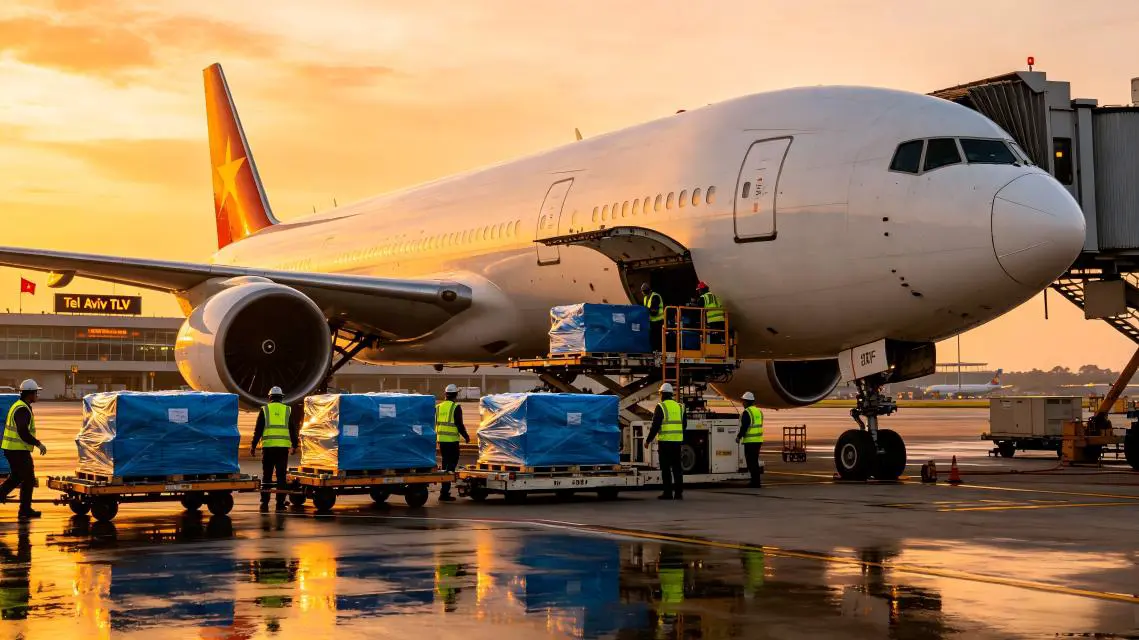
You have a shipment ready at your factory near Ho Chi Minh City. Your buyer in Tel Aviv needs it delivered yesterday. Sea freight takes over 40 days. Express courier burns your margins at small-parcel rates. There has to be a better way — and there is. Air freight from Vietnam to Israel bridges this gap: commercial-scale cargo moving in 5–8 business days at rates that make economic sense for shipments above 45 kg. Whether you are shipping electronics from Bac Ninh, textile samples from Hanoi, or coffee from the Central Highlands, this guide covers every step — from choosing the right Vietnamese airport to clearing Israel customs under the newly enacted VIFTA free trade agreement.
Why Choose Air Freight from Vietnam to Israel?
The decision between transportation modes is one of the first and most consequential choices importers face. Understanding the real trade-offs helps you avoid committing to the wrong option for your cargo profile.
Air freight vs sea freight is primarily a question of time versus money. Ocean freight from Vung Tau to Ashdod takes approximately 41 days, while air cargo consolidation from either SGN or HAN to TLV delivers door-to-door in 5–8 business days. That 33+ day difference can mean the difference between meeting a product launch deadline and missing the season entirely.
| Factor | Air Freight | Sea Freight (FCL/LCL) | Express (DHL/FedEx/UPS) |
|---|---|---|---|
| Transit Time (Door-to-Door) | 5–8 business days | 40–45 days | 3–5 business days |
| Cost Efficiency (per kg) | $2.2–$5.5 (45 kg+) | $0.3–$0.8 | $8–$25 |
| Minimum Shipment | ~45 kg | 1 CBM (LCL) / 1 Container (FCL) | 0.5 kg |
| Best For | Commercial cargo, 45–5,000 kg | Bulk, heavy, low-urgency | Documents, samples, e-commerce small parcels |
Here are the most common scenarios where air freight from Vietnam to Israel makes strategic sense:
- Electronics and high-value components: Samsung and Apple supply-chain shipments from northern Vietnam factories to Israeli tech firms. The cargo value justifies air speed, and insurance costs are manageable.
- Textile and footwear samples: Vietnamese garment exporters sending pre-production samples for buyer approval before committing the bulk order to ocean freight.
- Perishable agricultural products: Vietnamese coffee, cashew nuts, and tropical fruits moving under cold-chain air freight, where shelf life constraints rule out sea transport.
- Urgent machinery spare parts: An Israeli manufacturer whose production line is down waiting for a replacement part from a Vietnamese supplier.
Our Industry Insight: We have seen too many first-time shippers default to express courier for 80–100 kg commercial shipments simply because they were unaware air freight consolidation existed. The difference? Express courier at that weight often runs $12–$18/kg. Consolidated air freight from Vietnam typically lands at $3.5–$5.0/kg. On a 100 kg shipment, that is a saving of roughly $1,000. The transit time difference is marginal — maybe one extra day for consolidation handling at origin and destination.
While every trade lane has its own dynamics, the consolidation principles discussed here apply broadly. For example, sea freight from Vietnam to Australia — another popular Vietnam export lane — requires similar forwarder expertise but adds quarantine compliance under BMSB seasonal restrictions.
Air Freight Routes: Vietnam Airports to Israel
Air freight from Ho Chi Minh City to Tel Aviv and air freight from Hanoi to Israel are the two primary lanes, with a central Vietnam option available for specific cargo origins.
Departure Airports in Vietnam:
- Tan Son Nhat International Airport (SGN), Ho Chi Minh City: The busiest cargo airport in southern Vietnam. Ideal for shipments originating from Ho Chi Minh City, Binh Duong, Dong Nai, and the Mekong Delta manufacturing clusters. Handles the broadest range of international air cargo consolidation services.
- Noi Bai International Airport (HAN), Hanoi: The primary hub for northern Vietnam’s electronics, textiles, and machinery exports. Closer to key industrial parks in Bac Ninh, Thai Nguyen, and Hai Phong.
- Da Nang International Airport (DAD): A secondary option for central Vietnam cargo, though fewer international freighter services operate from DAD, often requiring trucking to SGN or HAN first.
Destination Airport:
All air cargo from Vietnam to Israel arrives at Ben Gurion International Airport (TLV) in Tel Aviv — Israel’s sole international cargo gateway, located approximately 20 km southeast of Tel Aviv city center.
Airlines and Route Options:
| Route | Carrier | Frequency | Aircraft Type | Flight Time |
|---|---|---|---|---|
| SGN → DEL/BOM → TLV | Air India | 2–4x/week | Airbus A320neo series | ~17h 42m (incl. transit) |
| HAN → ADD → TLV | Ethiopian Airlines Cargo | 2–4x/week | Boeing 777-200F Freighter | ~17h 10m (incl. transit) |
| SGN/HAN → BKK/SIN/DXB → TLV | Multiple (upon request) | Varies | Mixed | Varies by routing |
Currently, there are no direct flights between Vietnam and Israel — all air freight routes involve at least one transit stop, typically in Delhi, Mumbai, Addis Ababa, Bangkok, Singapore, or Dubai. The total airborne time (gate-to-gate) is approximately 12–14 hours; the remaining 3–6 hours are transit and ground-handling time at the intermediate hub.
Air Freight Transit Times & Scheduling
When importers ask how long does air freight take from Vietnam to Israel, the answer depends on whether you are looking at airborne time alone or the complete door-to-door journey.
Here is a realistic door-to-door timeline breakdown:
| Stage | Duration |
|---|---|
| Factory pickup & transport to origin airport | 1 day |
| Vietnam export customs clearance | 0.5–1 day |
| Airport cargo terminal handling & security screening | 0.5–1 day |
| Flight (SGN/HAN → TLV, including transit stop) | 17–20 hours |
| Israel import customs clearance (SHAAR system) | 1–3 days |
| Last-mile delivery to consignee (Tel Aviv, Haifa, etc.) | 1–2 days |
| Total Door-to-Door (Express Consolidation) | 5–7 business days |
| Total Door-to-Door (Standard Consolidation) | 7–9 business days |
Two scheduling factors unique to this lane deserve special attention:
Tet Holiday (Vietnamese Lunar New Year): For 2–4 weeks before Tet, air cargo capacity out of SGN and HAN tightens dramatically as factories rush to ship before the nationwide shutdown. Rates typically surge by 30–50%, and spot bookings become difficult. We recommend booking space at least 3–4 weeks in advance if your shipment window falls in January or early February.
Israeli Holiday Calendar: During Rosh Hashanah (Jewish New Year, typically September), Yom Kippur, and Pesach (Passover, March/April), Israel’s customs offices and logistics operations run on reduced schedules. Clearance that normally takes 1–2 days can stretch to 4–5 days. Factor this into your planning if your cargo arrives during these periods.
Air Freight Costs: Rates, Chargeable Weight & Hidden Fees
Understanding air freight cost from Vietnam to Israel begins with mastering one concept most first-time shippers get wrong: chargeable weight.
Chargeable Weight: The Fundamental Pricing Rule
Airlines charge based on whichever is higher — your cargo’s actual weight or its volumetric weight. The formula:
Volumetric Weight (kg) = Length (cm) × Width (cm) × Height (cm) ÷ 6,000
Example: You ship a carton measuring 60 cm × 50 cm × 40 cm, weighing 15 kg.
- Actual weight: 15 kg
- Volumetric weight: (60 × 50 × 40) ÷ 6,000 = 120,000 ÷ 6,000 = 20 kg
- Chargeable weight: 20 kg (the higher value)
You pay for 20 kg, not 15 kg. Light but bulky cargo (textiles, molded foam packaging, empty boxes) is especially prone to volumetric surprises. Always calculate volume before requesting a quote.
Rate Reference Ranges (2026 Estimates)
Air freight rates Vietnam to Israel per kg vary based on shipment volume and the level of consolidation service:
| Weight Break | Consolidation Rate (Est.) | Typical Service |
|---|---|---|
| +45 kg | $3.5–$5.5/kg | Standard consolidation |
| +100 kg | $2.8–$4.5/kg | Standard consolidation |
| +300 kg | $2.2–$3.8/kg | Express consolidation available |
| +500 kg | $1.8–$3.2/kg | Negotiable, priority loading |
| +1,000 kg | Quoted case-by-case | Dedicated ULD allocation possible |
Full Cost Breakdown
The per-kilogram rate is just the starting point. A transparent air freight quote should break down as follows:
| Cost Component | Typical Range | Notes |
|---|---|---|
| Base freight rate | Per kg, as above | Depends on weight break and season |
| Fuel Surcharge (FSC) | 15–25% of base freight | Floats monthly with jet fuel index |
| Security Surcharge | $0.10–$0.20/kg | Mandatory, IATA-compliant |
| Air Waybill Fee (AWC) | $15–$30 per AWB | Per master air waybill |
| Export Customs Clearance | $50–$120 per shipment | Vietnam-side broker fee |
| Cargo Insurance | 0.3–0.5% of declared value | Highly recommended |
| Destination Terminal Handling | $0.08–$0.15/kg | TLV cargo terminal charges |
| Israel Customs Broker Fee | $80–$150 per entry | Required for commercial clearance |
Our Industry Insight: Many online rate aggregators show only the base freight rate — which looks attractively low — but omit fuel, security, and terminal charges. When comparing quotes, insist on an all-in landed cost. At VNForwarder, our quotations always include every line item itemized, so you know exactly what you are paying before you book.
For shipments under 45 kg, air freight consolidation is rarely the cheapest air freight from Vietnam to Israel option — express courier services (DHL, FedEx, UPS) usually offer better value at that weight due to their integrated pickup and clearance networks.
While rate structures vary by destination, the chargeable weight calculation and cost breakdown framework apply universally. For a different lane reference, our shipping cost from Vietnam to USA guide walks through how trans-Pacific freight pricing follows the same logic but with destination-specific surcharges.
Vietnam Export Process: Step-by-Step Air Freight Workflow
The air freight process for Vietnam export follows a well-defined sequence. Understanding each step helps you prepare documentation correctly and avoid delays.
The 6-Step Vietnam Air Export Flow
- Booking & Space Reservation: Your freight forwarder confirms available routing (SGN or HAN departure), carrier, flight schedule, and secures ULD space. Booking should be confirmed 3–5 days before the intended flight date.
- Factory Pickup & Inland Transport: Cargo is collected from your factory or warehouse and trucked to the origin airport cargo terminal. Southern Vietnam shipments route to SGN; northern Vietnam shipments to HAN.
- Export Customs Declaration: Your forwarder submits the Vietnam Customs electronic declaration via the VNACCS/VCIS system. Required documents: Commercial Invoice, Packing List, Certificate of Origin (critical for VIFTA preferential tariff claims), and any product-specific certificates (e.g., MSDS for electronics, phytosanitary certificate for agricultural goods).
- Cargo Build-Up & ULD Loading: At the airport cargo terminal, your shipment is built onto air cargo pallets or into Unit Load Devices (ULDs) — the standardized containers that fit into aircraft cargo holds. This step includes X-ray security screening.
- Flight Departure: The loaded ULDs are transferred to the aircraft. The forwarder receives confirmation of the Master Air Waybill (MAWB) number — the contract of carriage between the airline and the forwarder.
- House Air Waybill Issuance: Your forwarder issues a House Air Waybill (HAWB) under their own name, listing you as the shipper and your buyer as the consignee. The HAWB is the document you will use for tracking and, importantly, for the consignee to clear customs in Israel.
Key Distinction — MAWB vs HAWB: The airline issues one Master AWB to the freight forwarder for the entire consolidated shipment. Your forwarder then issues individual House AWBs to each shipper whose cargo is on that consolidation. When your consignee’s broker in Israel clears the goods, they present the HAWB to Israel Customs. This is normal and expected — do not be alarmed if you see a different company name on the MAWB tracking.
Israel Customs Clearance: Duties, VAT & Compliance
Israel import customs clearance is conducted through the SHAAR electronic system operated by the Israel Tax Authority. For commercial shipments valued above $75, a licensed Israeli customs broker is required to file the entry.
VIFTA: The Game-Changer for Vietnam→Israel Trade
The Vietnam-Israel Free Trade Agreement (VIFTA), signed in 2024 and effective from 2025, is the single most important development for importers on this lane — yet not a single competitor article mentions it.
VIFTA eliminates or reduces tariffs on approximately 92% of product categories traded between the two countries. For Vietnam-origin goods accompanied by a valid Certificate of Origin (Form VIFTA or EUR.1), the preferential duty rates are significantly lower than standard Most-Favored-Nation (MFN) rates:
| Product Category | HS Code Range | Standard MFN Rate | VIFTA Preferential Rate |
|---|---|---|---|
| Electronics & electrical machinery | HS 85 | 0–10% | 0–5% |
| Apparel & textiles | HS 61–62 | 6–12% | 0–6% |
| Footwear | HS 64 | 12% | 0–8% |
| Machinery & mechanical appliances | HS 84 | 0–4% | 0% (duty-free) |
| Furniture | HS 94 | 0–8% | 0–4% |
| Processed foods | HS 16–21 | 4–50% | Varies (reduced) |
To claim VIFTA benefits, you need an origin-compliant Certificate of Origin issued by the Vietnam Chamber of Commerce and Industry (VCCI). The goods must meet the agreement’s rules of origin — generally meaning at least 40% of the ex-works price originates in Vietnam, or a specific HS code-level transformation. Your forwarder should verify origin eligibility before shipping.
VAT and Additional Compliance
Israel applies 17% VAT on the sum of (CIF value + customs duty). This is payable at the time of import and is generally recoverable by VAT-registered businesses in Israel.
Two additional compliance factors specific to the Israeli market:
- SII Standards Approval (Standards Institution of Israel): Electronics, toys, food-contact materials, and many consumer goods require SII testing and certification before they can clear customs. The process typically takes 2–4 weeks and should be initiated before the cargo ships — not after it arrives. Your importer in Israel needs to handle this with SII directly.
- Kosher Certification: Food products imported into Israel often require Kosher certification from a recognized rabbinical authority. If you are shipping Vietnamese coffee, cashew nuts, dried fruits, or processed foods, confirm Kosher requirements with your buyer before shipment. Non-Kosher food products face restricted market access within Israel’s retail channels.
Types of Cargo Suitable for Air Freight
Not every product belongs on a plane. Understanding which cargo categories benefit most from air freight helps you budget accurately and avoid unpleasant surprises.
Ideal for Air Freight (Vietnam → Israel):
- Electronics & components: Circuit boards, semiconductors, smartphone parts — high value, small volume, time-sensitive. Samsung and Apple suppliers in Bac Ninh and Thai Nguyen routinely air-freight components to Israeli tech manufacturers.
- Textile & garment samples: Vietnamese garment factories air-ship pre-production samples for Tel Aviv buyers to approve before ocean-freighting the bulk order.
- Footwear samples and small production runs: High-value branded footwear where speed-to-market justifies air cost.
- Machinery spare parts: When an Israeli factory’s production line is down, the cost of downtime dwarfs the air freight premium.
- Pharmaceuticals & medical devices: Requiring temperature-controlled air freight with active cold-chain monitoring.
- Coffee, cashew nuts, specialty foods: High-value Vietnamese agricultural products where freshness and shelf life matter.
Special Cargo Handling Notes:
- Lithium batteries (UN3480/UN3481): Require dangerous goods (DG) declaration, special packaging, and are subject to carrier-specific restrictions. Not all airlines accept lithium battery shipments.
- Perishables (PER): Require temperature-controlled ULDs and coordination with TLV’s cold-chain handling facilities.
Door-to-Door Air Freight & DDP Solutions
For importers who want a hands-off experience, Vietnam to Israel air freight door to door under DDP (Delivered Duty Paid) Incoterms is the most streamlined option.
Under DDP, a single freight forwarder handles every step:
Factory pickup in Vietnam → Export customs clearance → Air freight (SGN/HAN → TLV) → Israel import clearance → Duty & VAT payment → Last-mile delivery to consignee’s door
The key advantage: you do not need your own Israeli customs broker or importer-of-record registration. Your forwarder manages everything under one consolidated quote, and all costs — freight, duties, VAT, brokerage — are pre-calculated with no post-delivery surprises.
DDP vs other Incoterms on this lane:
| Incoterm | Seller/Shipper Responsibility | Best For |
|---|---|---|
| EXW | You arrange everything from factory gate | Experienced importers with own logistics team |
| FOB | You handle Vietnam-side only | Shippers comfortable managing forwarder but want buyer to handle import |
| CIF | You pay freight + insurance to TLV | Buyers who have their own Israel broker |
| DDP | You handle everything door-to-door | Importers wanting turnkey solution with predictable landed cost |
How to Choose a Reliable Air Freight Forwarder
Finding the right air cargo Vietnam to Israel shipping company makes the difference between a smooth shipment and a logistics headache. Here are five criteria to evaluate any freight forwarder for Vietnam to Israel:
- Local Vietnam Presence: Does the forwarder have physical operations in Ho Chi Minh City and/or Hanoi — not just a sales office — with staff who can personally supervise cargo pickup, documentation preparation, and airport terminal handover?
- Israel Destination Expertise: Do they have an established partnership with a licensed Israeli customs broker who uses the SHAAR system daily and understands SII and Kosher requirements?
- Airline Relationships: Contract rates with Air India and Ethiopian Airlines Cargo — the two main carriers on this lane — plus the flexibility to route via Bangkok, Singapore, or Dubai when needed.
- Transparent Pricing: An itemized quote covering base freight, fuel, security, AWC, customs brokerage, terminal charges, and insurance. No lump-sum “all-in” numbers that hide margin padding.
- Speed of Response: In a fast-moving air freight market, a forwarder who takes 24 hours to quote may lose the available space. The industry benchmark for Vietnam air freight is 2–4 hours from inquiry to a firm quotation.
For a complete overview of all transport modes available on this lane — including ocean FCL/LCL, rail-sea combinations, and express options alongside air — visit our dedicated shipping from Vietnam to Israel route page.
VNForwarder has been operating as a Vietnam-based international freight forwarder since 2018, with air freight consolidation services from both SGN and HAN to Tel Aviv (TLV). Our team understands the VIFTA requirements inside out, can pre-check your Certificate of Origin for compliance, and works with a trusted Israeli brokerage partner to ensure smooth SHAAR clearance. We provide itemized DDP quotations within 2–4 hours — no hidden fees, no surprises. Get your free air freight quote from Vietnam to Israel today →
Frequently Asked Questions
Q: How long does air freight take from Vietnam to Israel?
Door-to-door air freight from SGN or HAN to TLV takes 5–8 business days for express consolidation and 7–9 business days for standard consolidation. The actual flight time (including one transit stop) is approximately 17–20 hours.
Q: What are the typical air freight rates from Vietnam to Israel per kg?
For consolidated air freight, rates range from approximately $3.5–$5.5/kg at 45 kg, scaling down to $1.8–$3.2/kg at volumes above 500 kg. These are base freight only — fuel surcharge, security, and terminal fees are additional.
Q: Air freight or express courier (DHL/FedEx/UPS) — which is cheaper?
For shipments above approximately 45–50 kg, consolidated air freight is significantly more economical than express courier. Below 45 kg, express courier usually wins on both price and simplicity.
Q: Is DDP air freight available from Vietnam to Israel?
Yes. DDP door-to-door air freight covers factory pickup in Vietnam, export clearance, air transport, Israel import clearance, duty and VAT payment, and final delivery to the consignee’s address — all managed under a single forwarder and a single invoice.
Q: How much can VIFTA save on import duties?
Depending on the product category, VIFTA reduces Israeli import duties by approximately 4–12 percentage points versus standard MFN rates. For footwear (12% MFN → up to 0% under VIFTA), the savings are particularly dramatic. A valid Vietnam-issued Certificate of Origin (Form VIFTA or EUR.1) is required.
Q: What types of cargo from Vietnam are best suited for air freight to Israel?
Electronics components, textile and footwear samples, machinery spare parts, pharmaceutical products, and high-value specialty foods (coffee, cashews) are the most common air-freighted categories on this lane.
Q: What documents are needed for Israel customs clearance?
The core import package includes: Commercial Invoice, Packing List, House Air Waybill (HAWB), Certificate of Origin (for VIFTA claims), and — where applicable — SII approval certificates and Kosher certification. Your Israeli customs broker files these through the SHAAR electronic system.
Q: How does Tet (Vietnamese New Year) affect air freight availability?
During the 2–4 weeks before Tet (typically January/February), air cargo space from SGN and HAN becomes extremely tight as factories ship heavily before the holiday shutdown. Rates can spike 30–50%. Book at least 3–4 weeks in advance if shipping during this period.